I SOLD A CASINO A 7-PERSON SUPPORT TEAM FOR $40,000 A MONTH
JEV + HAIKU 5.5 + OPUS 5.5. NOT ONE OF THEM IS HUMAN. THE CASINO KNOWS, AND WHY THEY STILL PAY FULL PRICE IS THE PART NOBODY BELIEVES
i didn't pitch "cheap bots". i pitched a support desk that never sleeps, never gets tired at 4am, and never forgets a player's history
here's the team
→ jev = triage. can't write a word. tags every ticket in under a second: answer, escalate, or safer-gambling
→ haiku 5.5 = the front desk. first reply in seconds, opens every chat by saying it's an ai
→ opus 5.5 = the senior. payment disputes, kyc questions, angry vips
→ me = the only human. every escalation lands on my phone
the reason they pay $40k isn't the replies
it's the third tag
a player chasing losses at 3am types different. faster, angrier, "just one more deposit". a tired human agent misses it. jev doesn't
one missed case can cost a casino more in fines than a year of support. that's what they're actually buying
the prompts, copy them:
1. jev (triage)
classify this ticket: answer / escalate / safer-gambling. safer-gambling if the player mentions chasing losses, borrowing, raising limits after a loss streak, or asks to cancel a withdrawal. when unsure between answer and safer-gambling, pick safer-gambling
2. haiku 5.5 (front desk)
you are an ai support agent for [casino]. say you're an ai in your first message. answer only from the help-center docs in /kb. never offer bonuses, never encourage play. if the player asks for a human, hand off immediately
3. opus 5.5 (senior)
you get tickets haiku couldn't close. read the full player history. write a resolution under 150 words and one line: what policy this is based on. anything about money over $500 goes to a human for approval
4. safer-gambling route
on this tag: pause bonus offers for this player, send the limits and self-exclusion page, and alert a human within 15 minutes. log everything to flags.json
honestly the team cost me less than one senior human agent. the margin isn't the trick. the third tag is
they didn't pay for people. they paid for nobody ever falling asleep
IS IT REALLY POSSIBLE TO MAKE MONEY WITH AI AGENTS HAIKU 5.5 + GROK + JEV + DOTS?
A $70,000 SYSTEM. DOING NOTHING
I tested it and i'm in complete shock. not only can you actually make money, you don't even have to do anything for it
it grew out of the research desk in the article below. i kept haiku and jev and put two more agents in front of them
here's who does what
→ Grok = the scout. reads x live all day, flags any ticker people suddenly can't stop talking about
→ OpenAI Dots = the researcher. its own cloud computer and browser. pulls the filing, the earnings call and the news on every flag while i sleep
→ Haiku 5.5 = the reader. turns each pile into one card: what changed, the number, the link. under a cent a card
→ Jev = the bouncer. can't write a word. answers ignore, watch or act in under a second. throws out ~99%
→ Code = the hands. fixed size, hard stop, every verdict logged
→ me = one tap a day. go or no
honestly the shock wasn't the money. it was how little of it needed me. the market moves at 3am, the desk is awake, i'm not
the prompts i run, copy them:
1. Grok
every 30 min scan x for us stock tickers whose mentions jumped 3x+ vs their 7-day average. return ticker, mention count and the 3 most shared posts with links. no opinions
2. OpenAI Dots
for each ticker in flags.md pull the latest 10-q or 8-k, the last earnings call transcript and news from the past 48h. save raw text to research/<ticker>/. don't summarize
3. Haiku 5.5
read research/<ticker>/. write one card under 120 words: what changed, the one number that matters, source link. if nothing material changed, write "nothing material". no buy or sell opinions
4. Jev
given this card answer ignore, watch or act. act only if the change is new, material and confirmed by a filing, not just by posts. max 3 acts a day
5. Code
on act: log it to verdicts.json and send me the card with jev's score. size fixed at 1% of the account, stop at -3%. nothing executes until i reply "go"
reading the market used to be a full-time job. now it's a night shift nobody has to work
OPUS 5.5 + HAIKU 5.5 + JEV BUILT A PROJECT FOR ME THAT JUST GOT VALUED AT $43,000. NONE OF THEM COULD'VE DONE IT ALONE
i read the guide and it clicked. this thing is actually powerful
→ Opus 5.5 = the architect. reads the brief once, splits the project into small tasks. each task gets one "done when" line
→ Haiku 5.5 = the crew. one task per run, many at once. builds exactly the task, nothing extra
→ Jev = the inspector. can't write a word. checks every finished task against its "done when" and answers pass, fix or reject
→ Me = the final yes
the rule that made it work: nothing gets merged without a pass from jev
and the part people get backwards
opus does the least work on the team. it writes the plan, then only sees what jev rejected. it never reads junk
honestly the "done when" line did more for quality than any model upgrade. a vague task can't be checked, so it can't be trusted
here's the setup. paste it into claude code:
build this project as a 3-agent chain. brief: brief.md
1. architect (model: opus): read brief.md once, write plan.md. split the work into tasks of 30 min or less. each tasks/<id>.md gets a goal, inputs and one "done when" line a machine can check
2. builder (model: haiku): one run per task. build only what the task file says. no extra features
3. inspector (jev via typesafe-sdk): for every finished task answer pass / fix / reject against its "done when" line. fix goes back to haiku once. reject goes to opus
4. only "pass" gets merged. log every verdict to verdicts.json
5. show me plan.md first. nothing runs until i say go
THIS IS INSANE... I fired my marketing team after this GROK update
I tried wiring Grok, Dots and Opus together and what came out honestly shocked me
so this is my team now
-Grok — the dispatcher. after elon's update it picks the best model for every task by itself. reads x live, catches what's moving, does the easy stuff on its own
-OpenAI Dots — research that never logs off. its own cloud computer and browser, 4,000+ connected apps, working while i sleep
-Opus 5.5 — the senior. strategy, copy, ad angles. reads the numbers and says what to kill
brief at 3am. research by morning. copy and ads ready before anyone would've opened slack
faster. better. a fraction of the old payroll
I only tell the truth
I F*CKING COULDN'T BELIEVE MY EYES...We haven't even recovered from Opus 5.5 and Haiku 5.5 is already shocking everyone
I tested it today. it made me $4,300 in about two hours
a store client had a 38,000-product catalog: broken categories, duplicate listings, half the descriptions missing. i'd quoted $4,300 for the cleanup. normally that's two weeks of my life
I gave Opus 5.5 the brief and let it run Haiku 5.5 as subagents
it split the catalog into batches, merged the duplicates, rebuilt the categories, wrote every missing description, checked its own work and exported a clean file
I didn't touch anything. i just sat there and watched it make me money
api bill: $9.40
margin: basically 100%
are you sure you are using Haiku 5.5 correctly?
I asked Opus 5.5 to rank the top 40 discoveries of the last 3 years. i still can't wrap my head around the answer
31 of them came out TODAY
🔵 human · 🔴 ai, before oct 6 · 🟢 ai, the oct 6 OpenAI drop
1. 🔴 finite-time blowup for 3d navier–stokes with smooth forcing — openai, 2026
2. 🟢 zero-free half-plane for riemann zeta, re(s) > 7/8 — openai, 2026
3. 🔵 categorical unramified geometric langlands — gaitsgory, raskin et al., 2024
4. 🟢 hodge conjecture for cm abelian varieties — openai, 2026
5. 🟢 full bsd formula in selmer coranks zero and one — openai, 2026
6. 🟢 unique games conjecture and optimal approximation thresholds — openai, 2026
7. 🟢 logarithmic-space derandomization: l = rl = bpl — openai, 2026
8. 🔴 counterexample to the jacobian conjecture — levent alpöge / claude fable 5, 2026
9. 🟢 isomorphism of all nonabelian free group factors — openai, 2026
10. 🔴 finite-time blowup for smooth, unforced 3d euler flow — openai, 2026
11. 🟢 hilbert's sixteenth problem: uniform limit-cycle bounds — openai, 2026
12. 🟢 deterministic polynomial-time factorization over prime fields — openai, 2026
13. 🔵 three-dimensional kakeya set conjecture — hong wang & joshua zahl, 2025
14. 🟢 hilbert–smith conjecture in every dimension — openai, 2026
15. 🟢 counterexamples to hadwiger's graph-minor conjecture — openai, 2026
16. 🟢 log abundance in all dimensions — openai, 2026
17. 🟢 undecidability of hilbert's tenth problem over q — openai, 2026
18. 🟢 symmetric and nonsymmetric mahler conjectures — openai, 2026
19. 🔵 disproof of ravenel's telescope conjecture — burklund, hahn, levy & schlank, 2023
20. 🟢 modularity of elliptic curves over imaginary quadratic fields — openai, 2026
21. 🟢 counterexamples to coefficient-free baum–connes — openai, 2026
22. 🟢 counterexamples to kaplansky direct finiteness and gottschalk surjunctivity — openai, 2026
23. 🔴 existence of non-sofic groups — openai / astra, 2026
24. 🟢 erdős's reciprocal-sum conjecture and quasipolynomial szemerédi bounds — openai, 2026
25. 🟢 cannon's conjecture — openai, 2026
26. 🟢 anderson localization and delocalization for uniform-disorder lattice models — openai, 2026
27. 🟢 large-data global smoothness for 3d relativistic vlasov–maxwell — openai, 2026
28. 🟢 falconer distance conjecture in every dimension — openai, 2026
29. 🔵 bourgain's slicing and thin-shell conjectures — bo'az klartag & joseph lehec, 2024–2025
30. 🟢 gromov's scalar-curvature inequality and gromov–lawson inessentiality — openai, 2026
31. 🟢 shelah's eventual categoricity conjecture — openai, 2026
32. 🟢 minimal models for generalized log-canonical pairs in characteristic zero — openai, 2026
33. 🟢 goldfeld's density and mean-rank conjectures — openai, 2026
34. 🟢 p-adic section conjecture — openai, 2026
35. 🟢 area law for gapped two-dimensional quantum systems — openai, 2026
36. 🟢 spacetime penrose inequality using enclosing area — openai, 2026
37. 🟢 quantum geometric langlands at irrational level — openai, 2026
38. 🟢 3d kakeya maximal conjecture and 4d kakeya dimension conjecture — openai, 2026
39. 🔴 counterexample to the real sum-product conjecture — bloom, sawin, schildkraut & zhelezov, with gpt-5.5, 2026
40. 🟢 infinite finitely presented residually finite torsion group — openai, 2026
4 blue. 5 red. 31 green
humans needed 3 years to land 4 of these. openai made 31 discoveries in a single day
we are living in an incredible time
We’re releasing a broad range of new mathematical results produced by an internal frontier model.
We’ve been consulting with the independent Advisory Group on Mathematics and Artificial Intelligence at the Institute for Advanced Study, and we have drawn on their advice and public recommendations to inform how we release these results.
https://t.co/7N6TPlft1P
whoever leaked this has bigger b*lls than sense
SpaceXAI rolled out five ready-to-hire digital workers at $200 a month, then buried the catch in its own Grok Bot docs and kept the page live: all five share one computer, so a single sign-in exposes the browser session, files, and command-line credentials to every one of them.
133 days earlier, the NSA, CISA, and cyber agencies from the UK, Canada, Australia, and New Zealand had issued the opposite guidance: no broad or unrestricted access; low-risk, non-sensitive work only.
For a week I ran four on one account and tracked what each could reach: eleven signed-in apps, one browser profile. Deleting one bot left all of it untouched.
Grok Bot is worth hiring five times over, and you can map its zone of impact before the second one exists:
-Sign in for the bot that needs the site, then open the others and see what they can reach: that session becomes theirs the moment it exists.
-Give each bot its own app account, because the docs say in plain writing: stop treating separate bots as an access barrier.
-Put the stop condition in the description, since an approval governs only the proposed action and leaves whatever already ran where it landed.
-Cap spending outside the product, because there is no per-bot spend limit yet and the review of their actions is still coming.
-Keep the money and customer replies in your own hands, and let the other four start from zero each morning on work that cannot bite.
-One sign-in is also why this pays: five names finish inside your real tools instead of handing you drafts to paste.
My take, and it is the uncomfortable one: your actual ceiling with Grok Bot is how many logins you will put on one machine. The easy part was always the hiring.
funny thing is keynes predicted the opposite of this
he thought by now we'd all be on like 15 hour weeks bc productivity
and then sometime in the 80s it flipped. top earners started working the longest hours, low earners the shortest. nber has data on it, each extra hour over 40 just started paying more
ai is basically that on steroids. your ambitious friends aren't crazy, their hour is just worth way more now
so yeah keynes got his 15 hour week. just not for everyone
one small detail nobody talks about changed his life (The Story of Ray Dalio)
1982: borrows $4,000 from his dad to feed his family, right after the biggest mistake of his career
2026: worth $18.9B
1982. Ray Dalio is so sure a depression is coming that he says it on wall street week and tells congress. mexico defaults. then the fed eases, stocks rip, and the depression never shows up
"i was dead wrong," he said later
his firm, bridgewater, shrinks to one employee: him
here's the detail
he didn't get smarter. he started writing things down. every decision, the criteria behind it, in plain words. later those rules got coded and backtested
by 2019: ~$150B under management. per barron's, the biggest net profit any hedge fund has ever made
that detail is the same idea as the guide below, 40 years early. plain .md files, one topic each, a decisions.md for every choice, and one map file the machine reads before it answers
Dalio had to build software to read his notebook. you need a folder and a claude.md
one thing worth stealing: before your next trade, add one line to decisions.md. why you're in, and what would prove you wrong. read it before you sell
most people don't lose the edge because they're dumb. they lose it because they forget why they bought
the depression call cost him everything. the file he started after it paid for all of itx
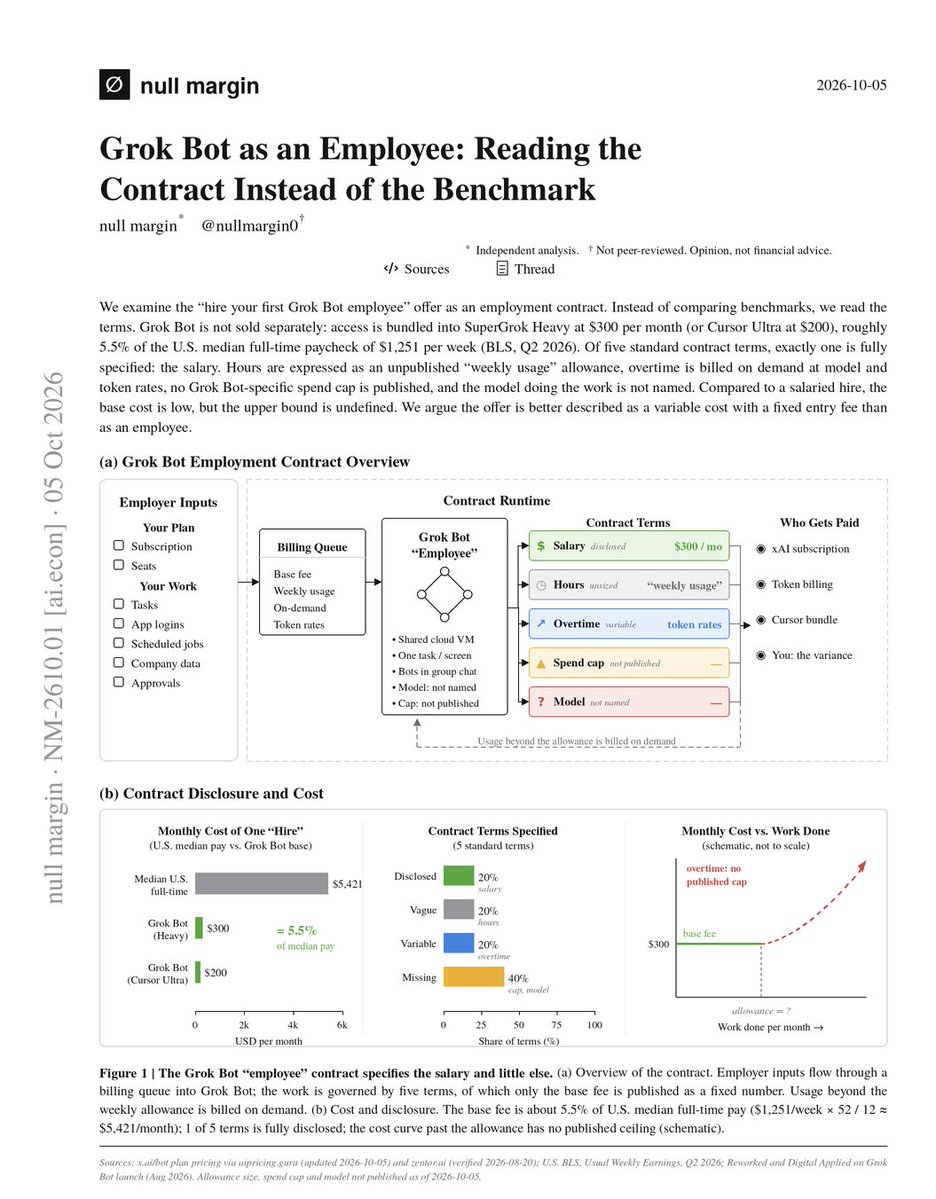
EVERYONE'S HIRING THEIR FIRST GROK BOT EMPLOYEE. ALMOST NOBODY READ THE CONTRACT
i did. it has one number in it
the shift: stop reading the benchmark, start reading the terms
term 1 → salary: $300/mo via supergrok heavy, or $200 via cursor ultra. grok bot isn't sold on its own
term 2 → hours: "weekly usage". how much work that actually buys isn't published
term 3 → overtime: past the allowance you pay on demand, at model and token rates
term 4 → spend cap: no grok bot-specific cap published
term 5 → who does the work: xai doesn't name the model
where it gets interesting:
$300/mo is ~5.5% of the median us full-time paycheck ($1,251/wk, BLS Q2 2026)
so the salary is the cheapest line in the deal. it's also the only line with a number on it
a human contract fixes pay, hours and the overtime rate. this one fixes the entry fee and leaves the ceiling blank
that's not a hire. that's a variable cost wearing a name tag
would you sign an offer with the overtime line empty?
wall street lost $590B in one day for forgetting one man from 1865
an ai startup just named its model after him
1865: william stanley jevons, 29, spots something odd. steam engines got far better at using coal. britain didn't burn less. it burned more. by 1913 output hit 292M tons a year
cheaper made coal worth using in places nobody had bothered with
then the part nobody tells. jevons got scared paper would run out next. he stockpiled so much brown packing paper that 50 years after he died, his kids still hadn't used it up (per keynes)
jan 27, 2025: deepseek shows ai can run far cheaper. the market trades the obvious story: cheaper ai, fewer chips. nvidia loses ~$590B in a day, a record
the night before, satya posted four words: "jevons paradox strikes again!"
nvidia today: $5.7T
now jev, from typesafe. it can't write a sentence. it only answers yes, no, or pick one. $0.042 per million input tokens, output free
hanako's math: 10,000 decisions cost ~$0.42 on jev vs ~$300 on a frontier model
the instinct says your ai bill just fell ~700x
jevons says every "if" nobody bothered to price is about to become a model call
cheaper never shrank a bill. it found more places to spend
Bill Ackman’s post about inflation took me back to the late 1970s, when similar concerns were everywhere. What followed was stronger growth and falling inflation, helped by the PC and software revolution. We believe today’s innovation platforms could have an even greater impact.
Most people think our forecast for high single-digit real GDP growth is crazy. I understand why. We’ve spent our lives in a roughly 3% global growth world.
But look at AI. At a fixed level of performance, inference costs are falling 99.99% a year. Yet OpenAI’s annualized revenue run rate has jumped from $20 billion to $70 billion. As prices fall, demand explodes. We’ve never seen anything like this kind of growth!
We believe those cost declines will seep into the broader economy, lifting productivity and profitability while pushing inflation much lower than most investors expect. That’s “good deflation.” Interest rates could rise in that environment because real growth is stronger.
In this month's In The Know, I respond to Bill’s concerns, explain the research behind our outlook, and examine what credit markets are telling us about the AI investment boom. Watch it here: https://t.co/G0ikwI6QkN
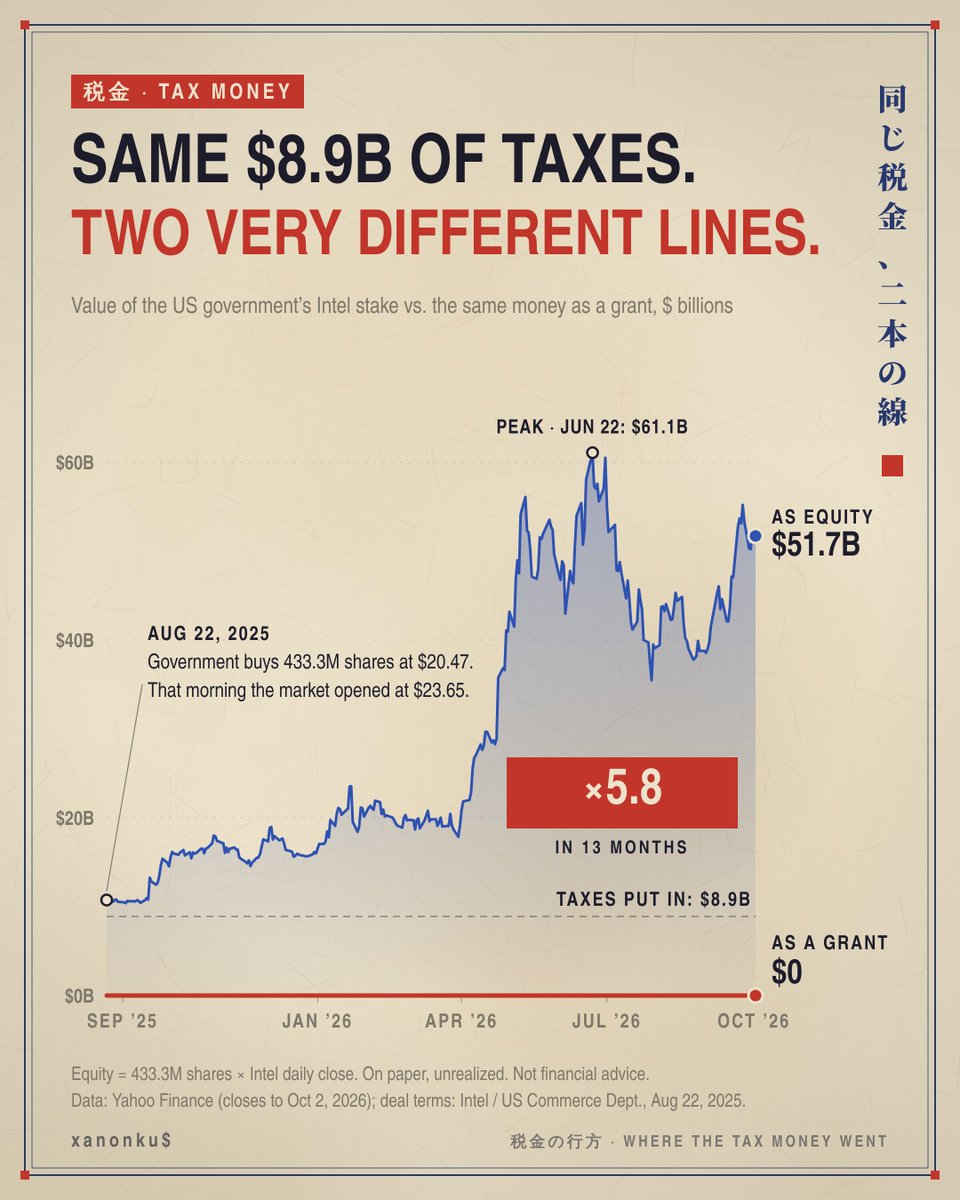
your taxes made ~$43B on one ai stock. you won't see a cent of it
and it started as money that was supposed to be a gift. now they want to do it again with openai
aug 2025: intel is the sick man of chips. it lost ~$18.8B the year before. the stock sits near $24 and almost nobody wants it
washington had already promised it $8.9B in chips act grants. money the taxpayer would never see again
then the deal changed. same $8.9B, but now in exchange for 9.9% of the company. 433M shares at $20.47
that same morning the stock opened at $23.65. the government got in cheaper than anyone with a brokerage app
friday close: $119.33
the stake on paper: ~$51.7B. about 5.8x in 13 months
the same $8.9B leaves the treasury either way
as a grant it returns $0
as equity it's up ~$43B
and now trump says openai and anthropic could be next
here's what makes that a different trade
intel needed the money. openai and anthropic don't. a stake there would most likely come from new shares, priced in a room you're not in, diluting everyone still waiting for an ipo
with intel, washington bought a company nobody wanted. this time it wants the one everybody does
would you want the government holding a piece of the ai you use every day?
Jeff Bezos called ai a bubble exactly one year ago. and said that's the good news
his reasoning goes like this:
→ 90s biotech: investors as a group lost money. the world got a couple of life-saving drugs
→ 2000 fiber: the companies that laid the cable went bankrupt. the cable stayed
→ so an "industrial bubble" is good for society
read it twice. "society" quietly excludes whoever paid for it
napkin math, one year later:
amazon + microsoft + alphabet + meta guided ~$730B capex for 2026
amazon alone ~$220B
in 2000 amazon was on the other side. stock went 113 → 6, the business kept growing on bandwidth someone else overbuilt
in 2026 amazon is the one laying the cable
bezos isn't wrong. he's describing a game where the builder and the winner are rarely the same company
the question was never "is it a bubble"
it's who's laying the cable and who rents it cheap after
so who's the 2026 version of the company that got the fiber for free?
nvidia just hit $5.7T. one man has sold it twice. only one of those sales was a mistake
may 2017: masayoshi son's vision fund quietly buys 4.9% of nvidia. gaming chips, crypto miners. nobody is saying "ai" yet
late 2018: crypto crashes, nvidia gets cut in half. by january 2019 softbank is out. the whole stake, worth ~$3.6B at exit
4.9% of today's nvidia is roughly $280B. son later called it "the fish that got away"
so he bought back in
october 2025: softbank sells again. all 32.1M shares, $5.83B. this time to pay for openai
"i was crying to sell nvidia shares" — son, december 2025
here's the part nobody checks
that cash went into openai at a $300B valuation. openai's march round priced it at $852B, roughly 2.8x on paper
nvidia since that sale: about +30%
same man. same stock. two exits
the first time he sold into panic. the second time, into tears. only the panic cost him
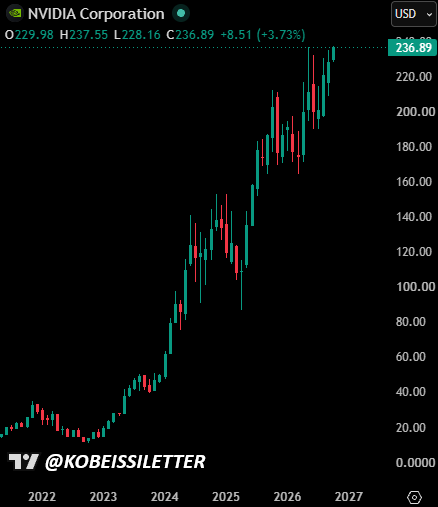
BREAKING: Nvidia, $NVDA, surges to its highest level on record, now worth $5.7 trillion.
If you invested $10,000 in Nvidia 10 years ago, you would now have $1,580,000.
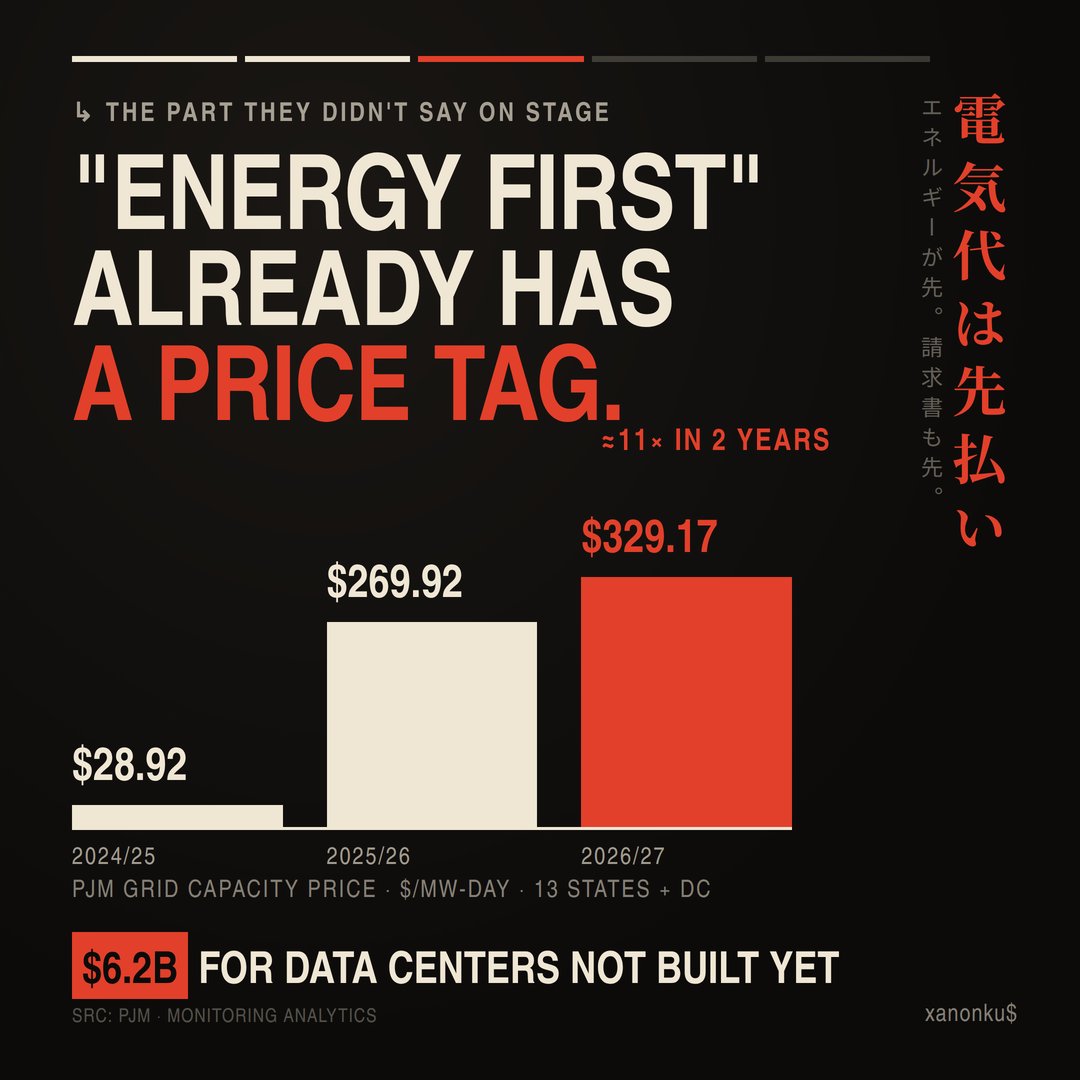
"energy first" already has a price tag lol. it's just on your power bill
pjm grid (13 states + dc): capacity price went $28.92 → $329.17/MW-day in 2 years. ~11x
and ~$6.2B of the last auction was for data centers that aren't even built yet
ngl ai gets the power. you get the invoice
april 22, 2019: musk tells tesla owners their car could earn them up to ~$30,000 a year
april 22, 2026. same day, 7 years later: he says their cars can't do it
the owners who believed him got $0. the shareholders who believed him got ~20x
the 2019 pitch: buy full self-driving, add your car to tesla's network, let it drive strangers around while you sleep. owners keep ~70%. musk called teslas appreciating assets
people paid up to $15,000 for fsd. one dutch leasing firm bought 4,000+ teslas on that idea
7 years later:
— the robotaxi runs on tesla's own fleet. not one owner's car is in it
— ~4M hardware 3 cars "simply do not have the capability," musk said on the q1 call
— that leasing firm watched used teslas lose value ~3x faster than the market
— and today tesla lined up $30B of credit while it scales its own cybercab fleet
tsla on autonomy day: $17.52 split-adjusted. monday close: $357.45
same promise. two receipts
owners paid for the car. shareholders paid for the story. only the story paid back
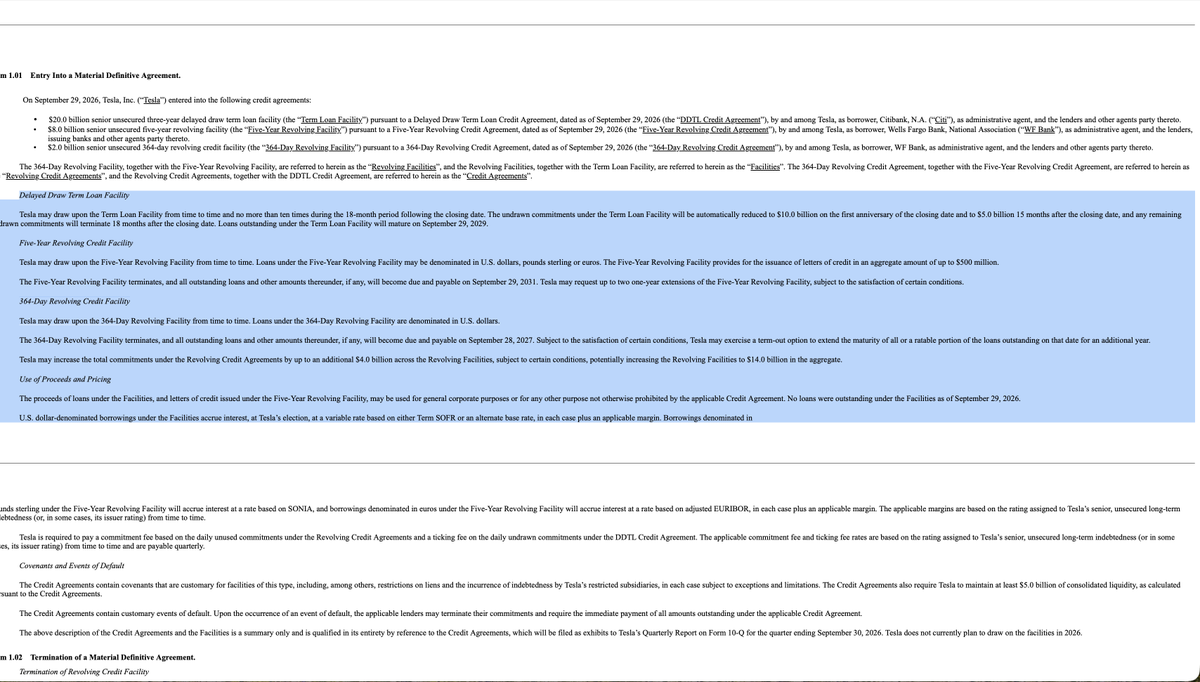
Tesla has just secured a new $30 billion financing package, significantly expanding the company’s available borrowing capacity, according to a new SEC filing.
• $20B delayed-draw term loan facility
• $8B five-year revolving credit facility
• $2B 364-day revolving credit facility
Tesla has not borrowed any of the $30 billion yet and says it currently does not plan to draw on the facilities in 2026.
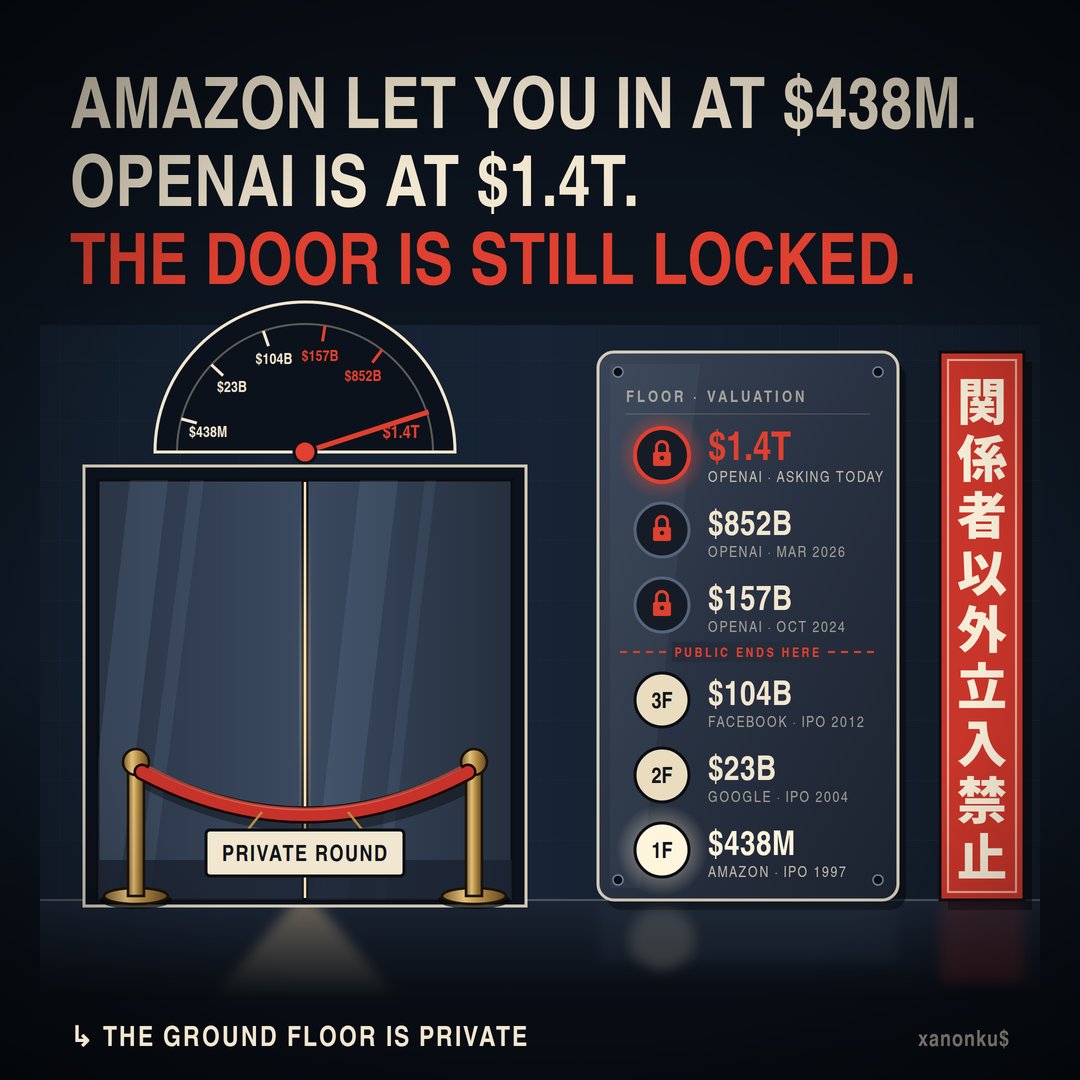
Amazon went public at $438M. openai is at $1.4T and you still can't buy a single share
1997: amazon ipos at a $438M valuation. anyone with a brokerage account could get in. that stake is worth ~6,000x today
2004: google lists at ~$23B
2012: facebook lists at ~$104B. late, but still public
now openai:
oct 2024: $157B
mar 2026: $852B
today: bloomberg says it wants $30B more at ~$1.4T
that's ~9x in two years. every step of it in private rounds
altman says no ipo this year, calls it an ill-advised moment
so by the time regular people can click buy, it's already bigger than all but a handful of public companies
the 90s let the public in on the ground floor. now the ground floor is private
the ai didn't find sicker patients. it found billable ones
the tell is buried in the bcbsa paper: hospitals coding the most post-surgery anemia actually transfused less. 16.9% vs 19.3%
more diagnoses. less treatment
~55k stays bumped into a pricier tier, ~$11k each. $942M in two years
and insurers are running their own ai to deny it. one bot bills, one bot rejects, your premium pays for both
ai didn't make care better. it made the invoice smarter
the guy who wrote the book on being a wall street junior just hired four of them in a day
real estate, dtc, niche pe, gpu sales. on a normal street that's like ~$400k+ a year in analyst pay
his cost is basically a subscription lol
juniors didn't get replaced. they got repriced