HAS ANYONE EVER USED AI AGENTS LIKE THIS? I PUT GROK BOT, OPUS 5.5, JEV AND AN OPENAI DOT ON ONE SHOPIFY STORE. $57,072 IN 3 DAYS
i gave each one a single job. none of them dropped it. none of them touched anyone else’s
dropshipping = you sell it, a supplier ships it, you never touch a box
who does what:
→ GROK BOT reads x live and finds what people want before tiktok does
→ OPUS 5.5 checks suppliers, sets the price, builds the page and writes the ads
→ JEV judges every ad. it can’t write a single word. it only says kill, keep or scale, with a probability
→ the DOT (gpt-6 astra) runs the ads, sends every order to the supplier and never sleeps
→ HAIKU 5.5 answers every buyer for pennies
→ me: refunds and the payout. that’s it
day 1: $8,268
grok bot found 40 posts from travelers whose airbnb host walked in without knocking. zero ads running for a fix. opus picked a $6.40 portable door lock that fits any hotel or airbnb door in 2 seconds, cut a supplier that ships in 14 days, priced it at $39 and wrote 12 hooks. the dot launched all 12 at 9am. 212 orders
day 2: $22,446
jev scored the 12 ads and killed 9 before i woke up. the dot moved the money into the 3 left. then grok bot caught a second wave: parents moving their kids into dorms where the door barely locks. opus added a 2-for-$64 bundle by lunch. 96 people took it
day 3: $26,358
6am, a copycat store launched the same lock at $24 with my exact hook. this is where a human panics and starts a price war
jev re-scored my 3 ads: still scale. opus checked the copycat: 21-day shipping from overseas. so it didn’t touch the price. it added one line to every hook: “ships from the us in 5 days”. nobody asked me
one $39 refund did. that’s my only rule: changes under $50 go auto, money going back needs my ok
1,040 × $39 + 258 bundles × $64 = $57,072
ads $19,640. product + shipping $15,021. fees + 20 refunds $2,824. models $214. i kept $19,373
what actually got me: the most expensive model never picked a single ad. the one that can’t write did
and when the copycat showed up, the cheapest move was the right one: do nothing to the price
$57,072 isn’t a lucky product. it’s five agents that each do one job and stay out of the rest
the prompts i used ↓
GROK BOT
“read x live for the last 72 hours. find complaints, not hype: people describing a problem a cheap product could fix. return the top 5 problems with post counts, 3 example posts each with links, and how many ads already target it. don’t pick products.”
OPUS 5.5
“here’s the problem grok found: [paste]. find 3 suppliers with us warehouses and 7-day max shipping. pick one and say why. set a price that leaves 40%+ after product, shipping and fees. write the product page and 12 ad hooks. every hook opens with the problem in the buyer’s own words.”
JEV (not a prompt, 2 typed questions)
action: choice → kill / keep / scale
pays_back: noul → “this ad makes back its spend within 48h”
thresholds live in code: kill above 0.80, scale only if pays_back > 0.85
THE DOT (gpt-6 astra)
“you run the store 24/7. launch the 12 ads at $220/day. send every order to the supplier within 10 minutes. move budgets only in steps under $50, only to ads jev marked scale. switch suppliers only after opus approves one. never refund, never change the price. anything that sends money back waits for me.”
HAIKU 5.5
“answer every buyer message using only the order data and the product page: tracking, shipping times, which doors it fits. never promise a refund. if someone asks for money back, pass it to me.”
THIS IS F*CKING CRAZY... HAIKU 5.5 + OPUS 5.5 + JEV WAS ALREADY UNREAL. THEN I ADDED GROK AND THE RESULT SHOCKED ME: A $200,000 PROJECT
it's the best team i've ever worked with. they communicate better than most humans i know
i gave them one task: build something big enough to sell for $200k. do everything yourselves. i only approve the result
that's exactly what happened. every agent had its own role, but none of it works without them talking to each other
who did what:
→ GROK runs the project. it turned my one line into tickets, gave every agent its seat and holds the standup. when two agents disagree, it calls a vote
→ HAIKU 5.5 reads everything. 500 companies a night: filings, calls, news. no opinions. a fact without a link is "unknown"
→ JEV decides. it can't write a single word. it scores every card, throws away 495 and passes on 5
→ OPUS 5.5 writes. one page per company: bull case, bear case, the one fact that kills the idea. it never sees the chart
→ when opus doesn't trust a fact, it sends the card back to haiku. when jev flags a mismatch, grok reroutes it. nobody waits for next week's meeting
→ i read 5 pages and click approve. nothing ships without me
the whole loop, simplified:
tasks = grok.plan("build the earnings desk")
cards = [https://t.co/JqcvJRQVrl(t) for t in tasks.tickers] # 500 cards
dig = jev.pick(cards, cap=5) # 0 words, only picks
for t in dig:
page = opus.write(cards[t], price=None) # never sees the chart
if page.doubts:
cards[t] = haiku.reread(t, page.doubts) # back to the reader
page.add(price_line(t)) # code adds it, last
grok.standup(dig)
me.approve()
a human team spends a week agreeing who owns what. these four settled it before i finished my coffee
detailed setup for every agent (roles, gate code, prompt for claude code) is in the article below ↓
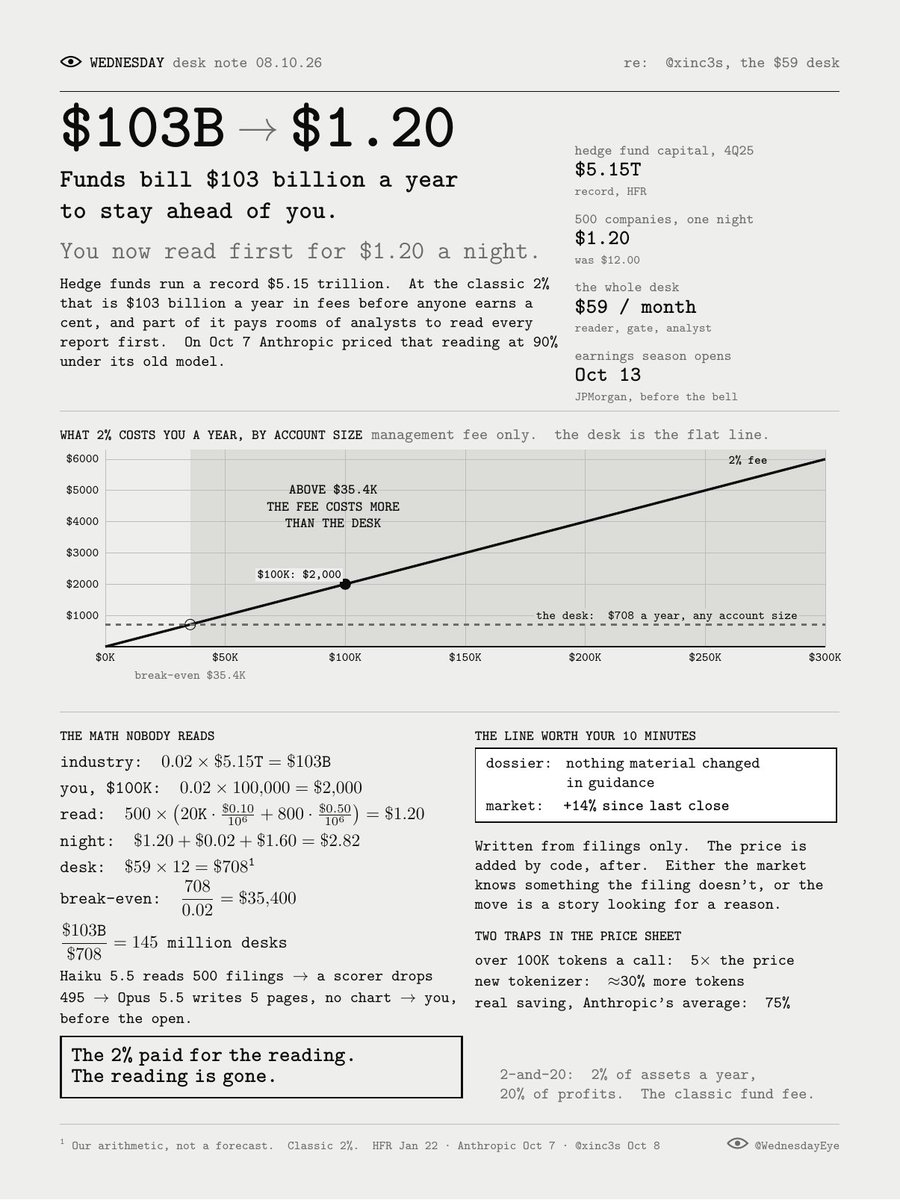
Hedge funds bill $103 billion a year at 2%. Anthropic just made their edge, reading earnings first, $1.20 a night.
The industry runs a record $5.15 trillion. Haiku 5.5 launched yesterday at 90% under the old model → it reads 500 companies' filings overnight → a scorer drops 495 → Opus writes 5 one-page reports without seeing the chart → you read them before the open.
$103 billion on their side. $708 a year on yours. Earnings season opens Tuesday.
The 2% paid for the reading. The reading is gone.
Send this to whoever still pays 2% for a summary.
THIS IS F*CKING INSANE... I already tested the Grok update Elon is talking about, paired it with OPENAI DOTS, and it built a $100k system
the update sounds small: Grok stops being one model and routes each task to whatever's best, Opus 5.5 included
the part nobody's talking about is what happens when you give that router a team
i plugged in 4 Dots and the whole thing turned into a 14-second meeting:
→ Grok reads the task and hands the chair to Opus 5.5
→Opus asks each dot what it knows: one reads the research, one the code, one the user data, one runs the tests
→ they disagree out loud, then vote. majority wins, no egos in the room
→ Claude Code writes the change, tests run, whatever breaks gets fixed before anyone moves on
→ last vote: ship or not. if it passes, it becomes a pull request and waits for a human
they communicate better than most human teams. nobody defends their own idea, nobody waits for next week's sync, nobody says "let's take this offline"
in my run they cut a sign-up form from 9 fields to 3. my whole job was one click: approve
a human team spends 14 seconds asking "can everyone hear me?"
Musk gave Grok the best brains. the money is in making them hold the meeting
Important note regarding Grok @Bot:
Going forward, @SpaceX will use the best back end model for any given task, including Claude Opus 5.5, MidJourney, Suno and other leading APIs.
Whatever is most likely to give you the best outcome.
good q, not announced yet. elon said Grok will pick the best model but didn't say which plan gets it, so i wouldn't count on it being free
the team part i pay for separately anyway, it's just api calls. Opus is the pricey one so i only let it handle the hard stuff, cheaper models do the rest
fair question, and my post made it sound easier than it is. there's no button for this in the Grok app
Elon's update is Grok picking the best model on its own side. the "team" part i wired myself: a small script that calls the models through their apis, one lead model chairs, 4 Dots each get one job (research, code, user data, tests), majority vote decides, nothing ships without my approve
THIS IS INSANE... I fired my marketing team after this GROK update
I tried wiring Grok, Dots and Opus together and what came out honestly shocked me
so this is my team now
-Grok — the dispatcher. after elon's update it picks the best model for every task by itself. reads x live, catches what's moving, does the easy stuff on its own
-OpenAI Dots — research that never logs off. its own cloud computer and browser, 4,000+ connected apps, working while i sleep
-Opus 5.5 — the senior. strategy, copy, ad angles. reads the numbers and says what to kill
brief at 3am. research by morning. copy and ads ready before anyone would've opened slack
faster. better. a fraction of the old payroll
I only tell the truth
I asked Opus 5.5 to rank the top 40 discoveries of the last 3 years. i still can't wrap my head around the answer
31 of them came out TODAY
🔵 human · 🔴 ai, before oct 6 · 🟢 ai, the oct 6 OpenAI drop
1. 🔴 finite-time blowup for 3d navier–stokes with smooth forcing — openai, 2026
2. 🟢 zero-free half-plane for riemann zeta, re(s) > 7/8 — openai, 2026
3. 🔵 categorical unramified geometric langlands — gaitsgory, raskin et al., 2024
4. 🟢 hodge conjecture for cm abelian varieties — openai, 2026
5. 🟢 full bsd formula in selmer coranks zero and one — openai, 2026
6. 🟢 unique games conjecture and optimal approximation thresholds — openai, 2026
7. 🟢 logarithmic-space derandomization: l = rl = bpl — openai, 2026
8. 🔴 counterexample to the jacobian conjecture — levent alpöge / claude fable 5, 2026
9. 🟢 isomorphism of all nonabelian free group factors — openai, 2026
10. 🔴 finite-time blowup for smooth, unforced 3d euler flow — openai, 2026
11. 🟢 hilbert's sixteenth problem: uniform limit-cycle bounds — openai, 2026
12. 🟢 deterministic polynomial-time factorization over prime fields — openai, 2026
13. 🔵 three-dimensional kakeya set conjecture — hong wang & joshua zahl, 2025
14. 🟢 hilbert–smith conjecture in every dimension — openai, 2026
15. 🟢 counterexamples to hadwiger's graph-minor conjecture — openai, 2026
16. 🟢 log abundance in all dimensions — openai, 2026
17. 🟢 undecidability of hilbert's tenth problem over q — openai, 2026
18. 🟢 symmetric and nonsymmetric mahler conjectures — openai, 2026
19. 🔵 disproof of ravenel's telescope conjecture — burklund, hahn, levy & schlank, 2023
20. 🟢 modularity of elliptic curves over imaginary quadratic fields — openai, 2026
21. 🟢 counterexamples to coefficient-free baum–connes — openai, 2026
22. 🟢 counterexamples to kaplansky direct finiteness and gottschalk surjunctivity — openai, 2026
23. 🔴 existence of non-sofic groups — openai / astra, 2026
24. 🟢 erdős's reciprocal-sum conjecture and quasipolynomial szemerédi bounds — openai, 2026
25. 🟢 cannon's conjecture — openai, 2026
26. 🟢 anderson localization and delocalization for uniform-disorder lattice models — openai, 2026
27. 🟢 large-data global smoothness for 3d relativistic vlasov–maxwell — openai, 2026
28. 🟢 falconer distance conjecture in every dimension — openai, 2026
29. 🔵 bourgain's slicing and thin-shell conjectures — bo'az klartag & joseph lehec, 2024–2025
30. 🟢 gromov's scalar-curvature inequality and gromov–lawson inessentiality — openai, 2026
31. 🟢 shelah's eventual categoricity conjecture — openai, 2026
32. 🟢 minimal models for generalized log-canonical pairs in characteristic zero — openai, 2026
33. 🟢 goldfeld's density and mean-rank conjectures — openai, 2026
34. 🟢 p-adic section conjecture — openai, 2026
35. 🟢 area law for gapped two-dimensional quantum systems — openai, 2026
36. 🟢 spacetime penrose inequality using enclosing area — openai, 2026
37. 🟢 quantum geometric langlands at irrational level — openai, 2026
38. 🟢 3d kakeya maximal conjecture and 4d kakeya dimension conjecture — openai, 2026
39. 🔴 counterexample to the real sum-product conjecture — bloom, sawin, schildkraut & zhelezov, with gpt-5.5, 2026
40. 🟢 infinite finitely presented residually finite torsion group — openai, 2026
4 blue. 5 red. 31 green
humans needed 3 years to land 4 of these. openai made 31 discoveries in a single day
we are living in an incredible time
while you're paying a realtor, other people are doing it with claude + jev. almost for free
he only gets paid if you say yes. they get paid the same if you walk away
in spain he takes ~3–6% of the price, due the day the deed is signed at the notary. a "no" pays him zero. so every listing comes with the view and without the winter
here's the team that does it instead:
→ 4 scouts on sonnet 5.5, one per town, pull every listing every night
→ "the local" on fable 5.1 owns no listing. it only asks what the ad skips: water cuts in august, fire and flood cover, flights in january, can you even rent it out
→ jev sorts every listing into keep / drop / dig in under a second, so the expensive model only reads the few that split
→ opus 5.5 writes one page: buy, wait or walk. it never sees the photos
the photos are where you lose the money
the first thing it surfaced wasn't a price. it was rules:
→ spain closed the property route to the golden visa in april 2025
→ barcelona is phasing out all ~10,100 tourist-rental licences by november 2028, and the constitutional court let it
half the "it pays for itself on airbnb" math dies on one line like that
nearly a million views on "worth buying there now". every seller in those towns can read too
he sells you the view. the agent prices the winter
paste this into claude code ↓
"Set up a house-hunting team in this folder. Towns: [4 towns]. Budget: [€].
In ~/.claude/agents create two subagents:
scout, model: sonnet. one per town. saves each listing's price, size, year, area and link to listings/<town>.md
local, model: fable, read-only. owns no listing. for each one finds what the ad doesn't say: summer water restrictions, fire and flood risk and insurance, winter flights and transport, short-term rental rules, recent tax and visa changes. every answer needs a source link, otherwise it's "unknown", and unknown counts against the house
You're the lead. Read only the scouts' facts and the local's findings, never the photos. Write verdict.md: buy / wait / walk per house, plus what the first winter costs
Show me the agent files first. Nothing runs until I say go."
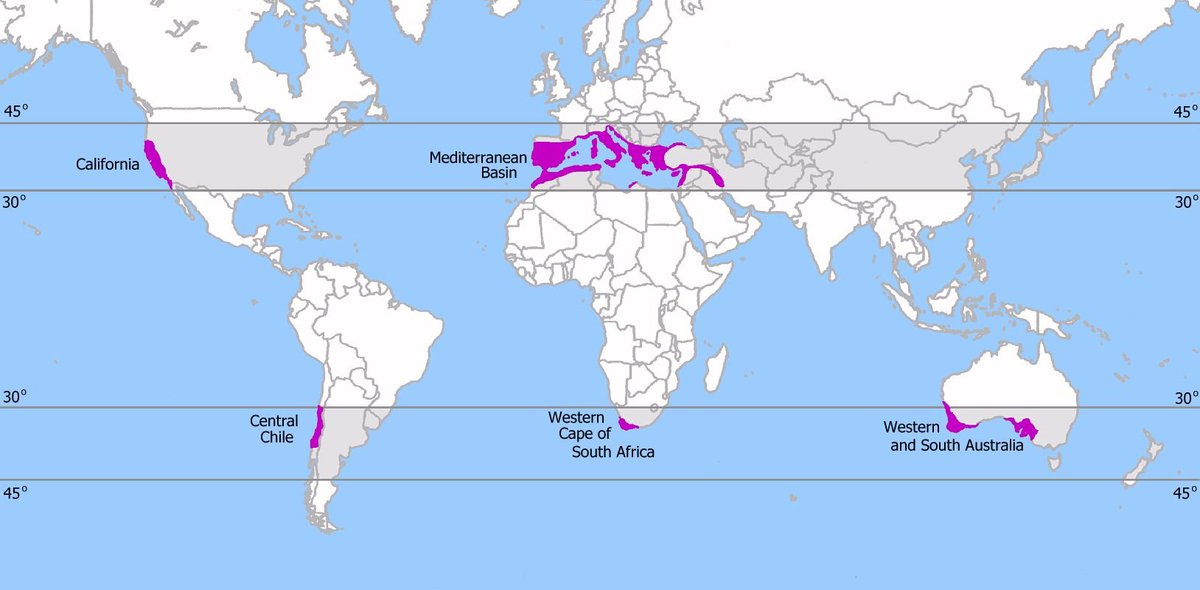
once ASI is here and living somewhere because of "work" becomes pointless, people with money will just move to the nicest places on earth
Mediterranean climate, ocean, mountains, good food, beautiful isolated towns
places like this are going to become insanely valuable
probably worth buying real estate there now
@PennyLedgerr respect for actually running four of them for a week instead of just quoting the docs
the "delete the bot and the 11 sessions stay open" part is wild, nobody else is gonna catch that
IT'S INSANE... Jev's best feature is the one nobody talks about. and it changes the game
not the speed. not the price ($0.042 per million input tokens, output free)
it can't write
no paragraphs, no "here's my analysis". you send it state and typed questions, it sends back numbers with probabilities in 70–500ms:
→ is this true: 0 to 1
→ which one: a pick + probabilities
→ rate it: a score on your rubric
sounds like a downgrade. it's the whole edge
a model that writes can talk itself into a token. a judge that only returns 0.91 can't. code holds the threshold, the bots don't get opinions
on this desk it sits at the end of a funnel: hundreds of fresh tokens → tens → a handful → 3 dossiers → 1 pick. or none
and "none" is a real answer. ask "worth trading at all?" and it can come back low for every candidate
everyone will copy the six grok bots. almost nobody will copy the judge that can't talk
a model that can't explain itself can't sell you a story either
OPUS 5.5+SONNET 5.5 + JEV + OPENAI DOTS: this stack turns one person into a 40-engineer company. but only one kind of person, and it's not the one with the biggest budget
40 seats, 4 teams of 10, 16 threads: sales, leads, ads, CRM, billing, legal, hiring and 9 more. all running while you sleep
40 humans give you 1,600 hours a week. 40 agents give you all 168, which is 6,720
here's the trap nobody draws: a human on salary at 3:47 am costs you nothing extra. an agent at 3:47 am is a meter running
one lead lands on one thread. routed, planned, built, checked, retried. 5 hops, 5 billed calls, and nobody's awake yet
put opus on every hop and the spider in the middle of the web eats you alive
the people who actually get superpowers from this build it the other way:
→ jev decides who gets each task. it can't write a single word, it only picks
→ sonnet does the everyday work
→ opus wakes up only for the genuinely hard calls
→ dots keep the whole thing on 24/7
→ anything that moves money or deletes data waits for you
same 40 seats. same 6,720 hours. a fraction of the bill
the web doesn't make you powerful. owning the router does
agents work 168 hours. so does the invoice
OpenAI Dots is insane for building a 24/7 AI company...
I mapped the whole OpenAI Dots architecture into one paper: agents, models, tools, memory, delegation, guardrails and the revenue layer.
Here are the 10 steps:
step 1 → stop treating Dots like a chatbot. each Dot runs in a persistent cloud environment with its own browser, terminal, files, memory and scheduled execution. close the laptop and the workflow keeps moving
step 2 → hire by responsibility. give every Dot one clear domain, dedicated sources, a working style, an approval boundary and a trigger. a "general helper" has no role, only undefined context
step 3 → make one Dot the orchestrator. you give it the objective, it decomposes the work, delegates to specialized agents, checks their outputs and merges everything into one deliverable
step 4 → stop being the courier between agents. with isolated delegation, each worker gets only the context and tools it needs, executes in its own environment, then returns a structured result to the orchestrator
step 5 → connect the real business stack: cloud browser sessions, Slack, Microsoft Teams, Google Workspace, internal dashboards and APIs. a Dot without tools is still just a conversational layer
step 6 → put the company on a clock. recurring routines and event triggers turn one-off tasks into persistent operations. research, monitoring, reporting and pipeline checks can run while nobody is online
step 7 → automate the reversible, gate the irreversible. let agents read, research, analyze and draft autonomously, but require human approval before messages send, money moves, records change or production code ships
step 8 → route intelligence by cost. keep the strongest model on orchestration, conflict resolution and final audits, and let cheaper high-context models handle background research, classification and repetitive execution
step 9 → give the company shared memory. project specs, approved claims, pricing, decisions and requirements live in one persistent workspace, so every agent works from the same source of truth instead of rebuilding context from old chats
step 10 → connect the loop to revenue. research finds the signal, outreach creates the opportunity, execution moves the work forward, analytics measures the result and monitoring discovers the next action
AI stops being something you open when you need an answer. It becomes an operating layer that keeps economically useful work moving after you log off.
Copy the complete OpenAI Dots architecture blueprint, then read the full roadmap below ↓