CODEX SKILL THAT FINDS COMPLEXITY HOTSPOTS IN YOUR CODEBASE!
I made a Codex skill that analyzes your codebase and reports where performance can be improved safely.
Scan your project while Codex checks loops, repeated lookups, render-heavy code, N+1 patterns, and places where complexity can potentially be reduced without breaking behavior.
-> codebase complexity analysis
-> O(n²), O(n*m), repeated scan detection
-> before/after complexity estimates
-> safe optimization suggestions
-> risk level + tests needed
-> report-only mode by default
-> one-command install
Install: npx --yes codex-complexity-optimizer
100% open source.
Repo in Bio.
New blog: Building agents that reach production systems with MCP.
When should agents use direct APIs vs CLIs vs MCP? Plus patterns for building MCP servers, context-efficient clients and pairing MCP with skills.
https://t.co/Q4UrUVgVYB
New in Claude Code: /ultrareview (research preview) runs a fleet of bug-hunting agents in the cloud.
Findings land in the CLI or Desktop automatically. Run it before merging critical changes—auth, data migrations, etc.
Pro and Max users get 3 free reviews through 5/5.
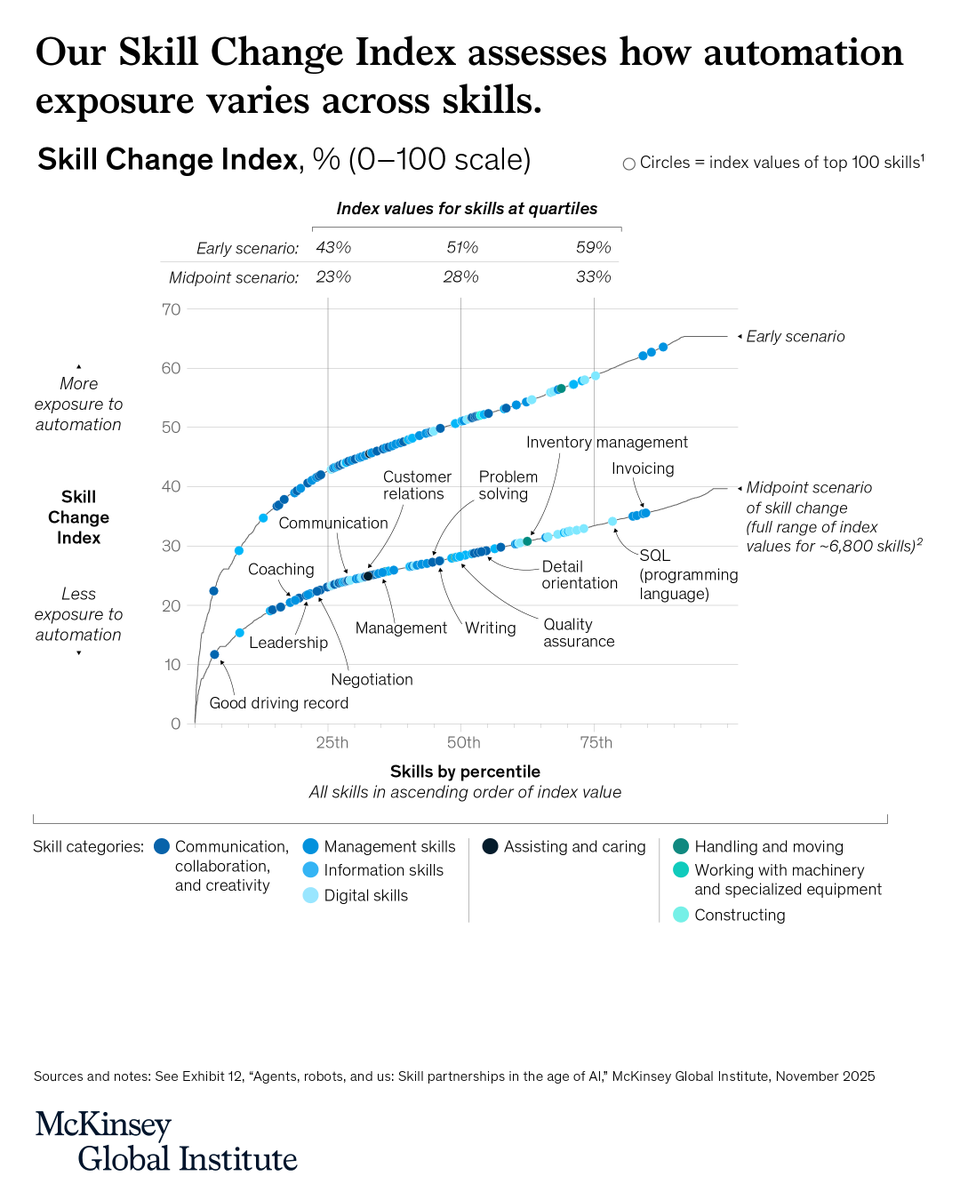
AI won’t make most human skills obsolete, but it will change how they’re used.
Negotiation, problem solving, and leadership will matter more than ever as people work alongside agents and robots.
Our new Skill Change Index shows which skills will be most, and least, exposed to automation in the next five years: https://t.co/fRXfHF1k56
Introducing Claude Design by Anthropic Labs: make prototypes, slides, and one-pagers by talking to Claude.
Powered by Claude Opus 4.7, our most capable vision model. Available in research preview on the Pro, Max, Team, and Enterprise plans, rolling out throughout the day.
Opus 4.7 feels more intelligent, agentic, and precise than 4.6. It took a few days for me to learn how to work with it effectively, to fully take advantage of its new capabilities.
Will post a few more tips throughout the day, starting with this blog post: https://t.co/XQrH8P28yo
Spark 2.0 is here! 🚀
We’re redefining what’s possible on the web with a streamable LoD system for 3D Gaussian Splatting.
Built on Three.js, you can now stream massive 100M+ splat worlds to any device from mobile to VR using WebGL2. All open-source.
Dive into the tech 👇
Judging by my tl there is a growing gap in understanding of AI capability.
The first issue I think is around recency and tier of use. I think a lot of people tried the free tier of ChatGPT somewhere last year and allowed it to inform their views on AI a little too much. This is a group of reactions laughing at various quirks of the models, hallucinations, etc. Yes I also saw the viral videos of OpenAI's Advanced Voice mode fumbling simple queries like "should I drive or walk to the carwash". The thing is that these free and old/deprecated models don't reflect the capability in the latest round of state of the art agentic models of this year, especially OpenAI Codex and Claude Code.
But that brings me to the second issue. Even if people paid $200/month to use the state of the art models, a lot of the capabilities are relatively "peaky" in highly technical areas. Typical queries around search, writing, advice, etc. are *not* the domain that has made the most noticeable and dramatic strides in capability. Partly, this is due to the technical details of reinforcement learning and its use of verifiable rewards. But partly, it's also because these use cases are not sufficiently prioritized by the companies in their hillclimbing because they don't lead to as much $$$ value. The goldmines are elsewhere, and the focus comes along.
So that brings me to the second group of people, who *both* 1) pay for and use the state of the art frontier agentic models (OpenAI Codex / Claude Code) and 2) do so professionally in technical domains like programming, math and research. This group of people is subject to the highest amount of "AI Psychosis" because the recent improvements in these domains as of this year have been nothing short of staggering. When you hand a computer terminal to one of these models, you can now watch them melt programming problems that you'd normally expect to take days/weeks of work. It's this second group of people that assigns a much greater gravity to the capabilities, their slope, and various cyber-related repercussions.
TLDR the people in these two groups are speaking past each other. It really is simultaneously the case that OpenAI's free and I think slightly orphaned (?) "Advanced Voice Mode" will fumble the dumbest questions in your Instagram's reels and *at the same time*, OpenAI's highest-tier and paid Codex model will go off for 1 hour to coherently restructure an entire code base, or find and exploit vulnerabilities in computer systems. This part really works and has made dramatic strides because 2 properties: 1) these domains offer explicit reward functions that are verifiable meaning they are easily amenable to reinforcement learning training (e.g. unit tests passed yes or no, in contrast to writing, which is much harder to explicitly judge), but also 2) they are a lot more valuable in b2b settings, meaning that the biggest fraction of the team is focused on improving them. So here we are.
New Anthropic research: Emotion concepts and their function in a large language model.
All LLMs sometimes act like they have emotions. But why? We found internal representations of emotion concepts that can drive Claude’s behavior, sometimes in surprising ways.
Meet Gemma 4: our new family of open models you can run on your own hardware.
Built for advanced reasoning and agentic workflows, we’re releasing them under an Apache 2.0 license. Here’s what’s new 🧵
Read the technical reports on how @Kimi_Moonshot, @cursor_ai, and @trychroma train vertical agentic models with RL. Same underlying recipe, strong base model, train inside the production harness, outcome-based rewards.
- Kimi K2.5 learns to spawn parallel sub-agents through RL.
-Cursor uses the same production Harness (same tools, same prompts..) and leanrs self-summarization during RL.
- Chroma's 20B retrieval model learns to prune its own context mid-search.
Full write-up 👇
Say hello to Gemini 3.1 Flash Live. 🗣️
Our latest audio model delivers more natural conversations with improved function calling – making it more useful and informed. Here’s what’s new 🧵