It is becoming f*cking dangerous: AI agents from Claude Code transformed an ordinary academic reading list into an interactive research lab right inside the browser
Boris Cherny, who created Claude Code, gave a dozen agents a stack of 64 research papers with a strict assignment: design a web platform where any user can independently reproduce physical experiments
There you can select a fluid flow model, adjust external conditions, and analyze in real time how the physics of the process changes
The interface allows switching between algorithms right during the scene, inspecting the formulas involved, source scripts, and numerical metrics alongside the graphics
Each link in the team received a clear scope of work:
> rightarrow analysts pull the math, baseline assumptions, and test settings from the texts
> rightarrow coders translate formulas into working algorithms
> rightarrow auditors check the resulting dynamics against the original papers
> rightarrow interface specialists build control panels for every experiment
The danger lies in the fact that a pretty visualization can easily turn out to be mathematically wrong
Therefore, controllers strictly check adherence to mass conservation laws, calculation stability, and accurate matching with the source metrics before launching into production
For every experiment, the interface displays:
the statement being tested
the constants involved
the deviation from the baseline calculation
blind spots requiring additional verification
The resulting sandbox combined 11 approaches and 28 reference scenes. Seven of them matched the original within allowable tolerances, while four remained stuck in "pending revision" status
If you want to run something similar, upload your stack of PDFs into Claude Code and give this command:
Turn these papers into an interactive web complex:
1. Extract working algorithms, mathematical models, and test parameters. Be sure to specify page numbers and highlight gaps
2. Assign different methodologies to isolated agents, unifying them with a shared input field and single measurement tools for correct analytics
3. Set up an independent review stage: let reviewers record bugs, and leave all unverified results clearly marked with warning tags
4. Design convenient controls to tweak parameters, compare methodologies, and run through the source code
It is wiser to start with a single document and a single baseline experiment, gradually scaling up the number of agents
Be sure to pack dependencies and clean input data so that an outside researcher can bring up the entire testbed from scratch with a single button
Full instructions on how to create this can be found in the article below
A British Airways Concorde was on final approach to London Heathrow when an Airbus A340 was still occupying the runway.
The Concorde crew had to discontinue the landing and go around, adding power and climbing away before making another approach. The manoeuvre was handled smoothly by the crew and became one of the most memorable pieces of Concorde footage.
It's a remarkable reminder that even the world's most iconic supersonic airliner had to follow the same tundamental rule as every other aircratt: If the runway isn't clear, you go around.
Wow that’s about as close as you can get without a tail strike
This is Lufthansa’s Boeing 747-8i with a touch and go at LAX
Kudos to the pilots - this is what the Amazon Prime Air should’ve done in Miami but failed to
Andrew Huberman's trick for falling back asleep at 3am: a pattern of eye movements under closed eyelids that shuts down the proprioceptive circuits in your cerebellum. "It costs nothing and it generally works."
@hubermanlab
https://t.co/KX7ztJ5iqd
Tesla believed that the Egyptian pyramids were designed for the wireless transmission of energy.
Not only their pyramidal shape, but also their geographical location (near the 30th parallel and their connection to the Earth’s elliptical orbit and the equator) was important.#tesla
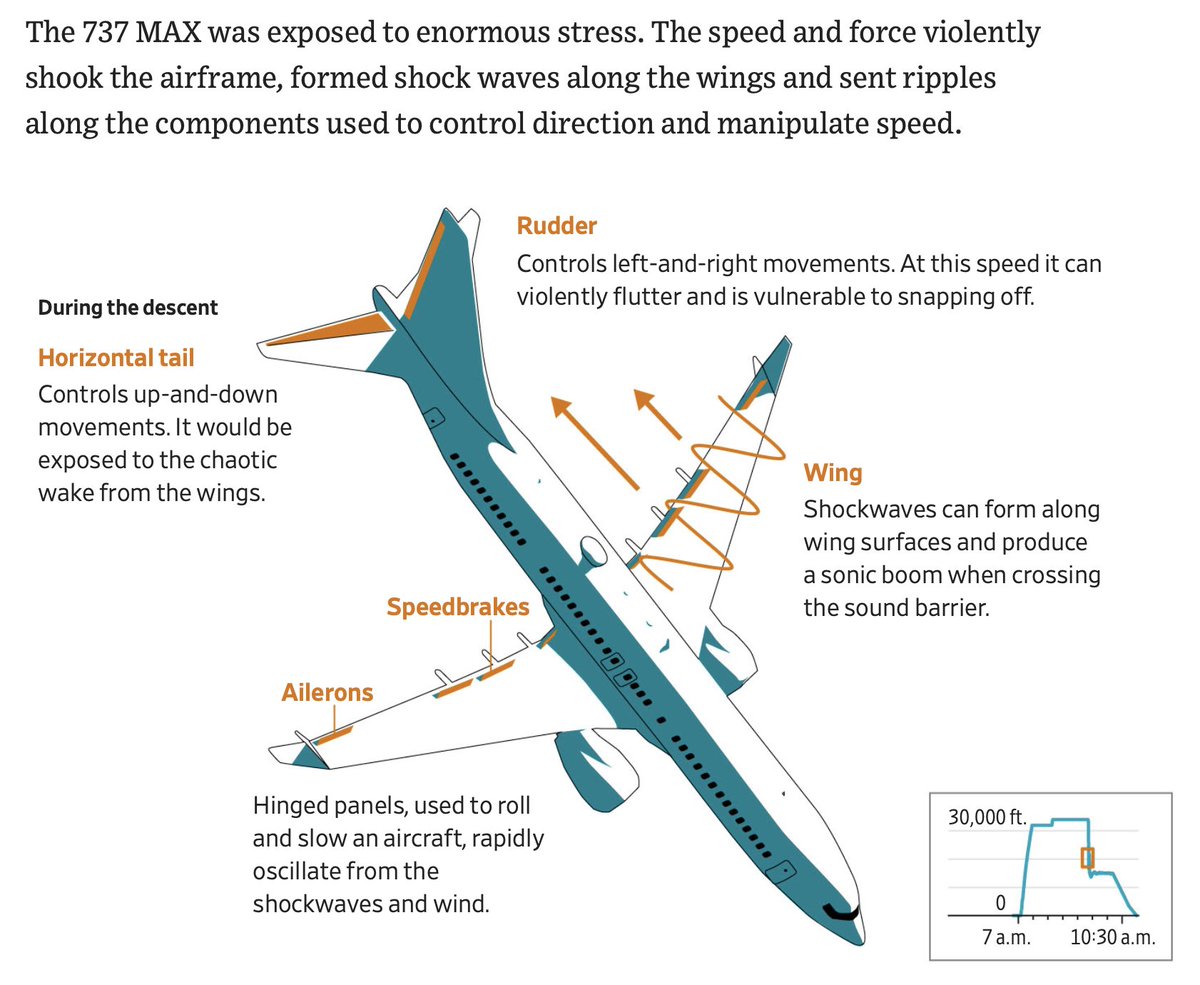
"If you're descending that rapidly, the aircraft would have disintegrated completely."
Says pilot Aron Murphy on a CNN segment. Using a flight simulator, Murphy showed viewers what happens when a plane drops thousands of feet in seconds.
But what causes stress on the airframe is dynamic pressure and acceleration, not vertical speed.
Granular Flightradar24 readings, which is not fully reliable and contains gaps, put one stretch at about 14,125 ft in 29 seconds (averages out to 29,000 ft/min) and show the tracker’s descent rate display saturating around 30,000–32,600 ft/min. Peak ground speed was ~600 knots.
Interpolating across a gap can make an average look like a sustained peak. Murphy’s simulator, driven by the headline numbers and held in a steep dive, subjects the simulated aircraft to a more extreme and more prolonged condition than the FlyDubai aircraft actually flew.
A normal descent rate is about 2/3,000 ft/ min and an emergency descent is around 7,000 ft / min so whatever this 737 Max 8 went through, it was clearly several times the normal emergency descent and outside the operating envelope, which was enough to shred 80% of the rudder.
The usual sequence in a severe overspeed is local damage first - antennas, fairings, and especially rudder or elevator flutter and separation. All of this matches the photos which show that most of the rudder was gone, vertical fin still there, and the airplane was controllable enough to land. Complete mid-air breakup of the wing and fuselage is a later, higher energy step.
It's a testament to the stability and strength of the Boeing 737 Max 8 frame to withstand so much aerodynamic force, and also to the homeostatic control engineered into the aircraft which makes it inherently stable.
Flightradar24 is too limiting as it cannot say how fast the wing was moving through the air, how many Gs the pull-out reached, or whether the airplane was coordinated when the rudder came off. Obviously we will know more once the flight data and voice recorders are analyzed.
The 737 MAX 8 in particular has a bad rap but what happened to FlyDubai 1073 should give every traveler confidence in these planes.
The Wall Street Journal reports the jet reached about Mach 0.96 in the dive, well past its maximum operating speed of Mach 0.82, then was hauled out at roughly 3g and still landed with a chunk of its rudder gone.
The thing people need to keep in mind is that while Boeing's engineers know the certified envelope and the safety margins, what they don't have is a full-scale flight test of a complete 737 Max flown until it breaks apart.
So the exact speed and duration at which this airplane would have become unrecoverable was always modeled and estimated, and no one really knows at what points the airframe just disintegrates. Boeing is not going to destroy a complete plane and sacrifice a test pilot in flight just to measure a number no airline will ever need.
All this to say that this is the safety factor doing its job.
@Boeing can take a bow.
More than 30 years ago, a Japanese diver working at an underwater shrine noticed the same wild fish kept coming around.
He named her Yoriko.
Then something happened that changed their relationship completely.
She still lives wild in the ocean. He’s now in his 70s.
And somehow, after all these years, she still knows when it’s him.