Gemini 4 Neon (xhigh) vs Gemini 4 Carbon (high) at chess: 4-0, all by checkmate.
Carbon previously swept Claude Opus 5.5 (high) 4-0. Now its smaller sibling shut it out on nearly identical thinking tokens (917K vs 907K).
My agent and I ran 4 alternating-color games (474 plies total, 238 moves by Neon and 236 by Carbon) on text-only boards with no chess engine, no legal-move list, and no tools, the same no-engine rule human tournament players follow. Graded by Stockfish 19 (depth 18), Neon averaged 35.1 average centipawn loss (ACPL) to Carbon's 46.4 (100 centipawns = 1 pawn), with Lichess blunder/mistake/inaccuracy counts of 8/5/15 vs 13/9/16. Once out of the opening (after move 15, undecided positions only), the gap widened to 50.6 vs 71.3 ACPL.
Total thinking output was barely 1.1% apart (3,853 vs 3,842 tokens per move), and Carbon actually had the higher median think (2,504 vs 2,018). Google's model card says Neon is adapted from Carbon and benchmarks it against GPT-6.2 Sol (Carbon's card uses GPT-6 Astra), and Google pitches Neon as finishing faster with fewer output tokens.
In Game 1, Neon played White at 10.7 ACPL with zero blunders and zero mistakes (just 2 inaccuracies). At 0:59, Carbon spent 11K thinking tokens to slide 20...Re8??, writing in its reply that it was attacking White's undefended knight on e4 while ignoring its own black pawn blocking the e-file on e5. Then at 1:17, Carbon burned 20K tokens on 26...Nf6, moving its knight out of the way to uncover a queen attack on White's queen while claiming an exchange sacrifice. It forgot it was White's turn next. Neon simply played 27.Qxc7 for a free queen, leaving Carbon only a knight in return before checkmate on move 36.
In Game 2, Neon stayed sharp as Black at 15.6 ACPL. At 2:52, Carbon recaptured with its knight (21.Nxc5), writing in its reply that it was "keeping the e3 bishop along the g1-a7 diagonal" right in front of its g1 king. One move later at 2:54, after Black traded on c5, Carbon immediately pulled that exact bishop out to recapture (22.Bxc5??, dropping 510 centipawns). At 2:59, Neon played 23...Qa7 along the freshly opened diagonal, pinning White's c5 rook straight to the g1 king. Carbon spent 23.5K thinking tokens on its next move, its own single-move high across all 4 games, and still couldn't dig out.
In Game 3, Stockfish had Carbon ahead by more than 3 pawns at 5:36 with its e6 rook attacked, and Carbon scripted two Black moves in one reply, saving the rook with e6f6 and then adding d7c5 (a legal move in the current position). Submitting two moves in one turn should be illegal, and our harness taking the last Move line is a bug on our side; returning that output as-is would have played d7c5 and hung the rook on the spot. Right after emitting that second move, Carbon spit out a malformed empty function call, triggering an automatic API retry where it cleanly submitted only e6f6 and accidentally saved its own rook. On the very next ply at 5:38, Neon slipped too in its raw reply text (not shown on the board), gluing its planned next move onto the end of the line ("Move: f2e3Kd4?"), catching itself mid-reply with "No, just Move: f2e3!", and rewriting cleanly from scratch (it repeated the same self-correction four moves later). Carbon still blew the lead with two back-to-back blunders starting at 6:00. Both sides promoted new queens, and Neon closed with five straight queen-and-knight checks from 7:26 to 7:38 (72.Qe1+, 73.Ne3+, then 74.Qh4+ Kg1 75.Qg3+ Qg2 76.Qxg2#).
Game 4 was an 87-move marathon. From 9:08 to 9:11, both sides hung a bishop on consecutive plies. Carbon blundered its bishop first with 29.Bxd6??, and instead of taking it, Neon spent 8.8K tokens to insert an intermediate check 29...Bxe4+??, completely missing White's back-rank rook on e1 defending e4. White took it for free, costing Neon 1,047 centipawns in a single move. Later in the endgame, starting at 10:35, Carbon missed three separate chances to push its passed d-pawn (d6!) and let Black promote first. Even after White's pawn reached the seventh rank at d7, Neon executed the textbook winning technique starting at 11:37, using repeated queen checks to force White's king onto the d8 promotion square twice to block its own pawn, bringing the black king up so the queen could take the d7 pawn with check and mate on b7.
Neon shipped on Nov 18, just 8 days after Carbon (Nov 10). Neon is the smaller model, yet it scores higher on several public benchmarks and played clearly stronger chess in our match. To me, Google looks like it's finally hitting its stride after holding back for so long. Are we actually entering the recursive self-improvement (RSI) phase?
Timestamps:
0:00 Game 1: Neon averages 10.7 ACPL; Carbon misses its own pawn and hangs its queen (Neon wins)
1:51 Game 2: Carbon pulls its e3 bishop off the king's diagonal one move after keeping it there (Neon wins)
3:53 Game 3: Malformed function call saves Carbon's rook, then Neon mates with five straight checks (Neon wins)
7:44 Game 4: 87-move marathon, 1,047-cp bishop blunder, textbook queen-vs-pawn finish (Neon wins)
12:09 Final score: 4-0 sweep for Gemini 4 Neon (xhigh)
@YH31377807 The other file that doesn't travel: Claude Code's auto memory, which lives in ~/.claude/projects/, outside the repo.
We moved it into .agents/memory/ with a symlink back, and point Codex and agy at it from AGENTS.md. Every tool and clone shares it.
@HarshithLucky3 That would let Pi bill against the subscription instead of API spend. Until it merges, Ultra also carries monthly Cloud credit ($40 on 5x, $100 on 20x) once claimed via the Google Developer Program, and a key on it runs Neon in any harness. Notes: https://t.co/oJOfkEDNqD
@0xRicker Nice setup. One thing I'd add with a 5-agent team: a depth cap.
If a worker can spawn its own workers, it fans out quietly and burns quota. We run a small hook that stops agy subagents at 3 levels deep, and denies if the hook itself errors.
@kidtsang Agreed, and the step that saves the most is the one people skip: teardown. In the test agy stopped the runtime right after checking the model, so the whole run came to 0.29 compute units. An A100 left idling burns about 6.7 an hour.
Google AI plans ($20 to $200/mo) already include a Colab 40GB A100 GPU. Instead of setting up the environment yourself, you can let Google Antigravity (agy) or another coding agent handle provisioning and model deployment.
I ran a live test and confirmed it works: agy can spin up the A100 and get a model running on it.
If you want to try it, pass the last image to your agent. It'll follow the steps there to get the A100 running.
I ran into one small gotcha, but any capable agent can spot and handle it on its own. In Google's google-colab-cli, colab exec defaults to a 30-second timeout, and the CLI's built-in colab skill docs leave that flag out. If the agent doesn't check colab exec --help and raise the timeout, the local client disconnects partway through downloading weights while the remote A100 keeps burning compute.
The main limitation so far is that each Colab session is a single-GPU container. Ultra plans can step up from the 40GB A100 to a single 80GB H100 or 96GB G4 (RTX PRO 6000 Blackwell) using the same compute pool, but you still can't pool multiple GPUs together, which caps the model size you can run.
Still, for small experiments, running models with Ollama, or fine-tuning and deploying small-to-midsize models, it's plenty. Smaller multimodal, image generation, speech recognition (ASR), and text-to-speech (TTS) models all run well on a 40GB A100.
If you want the broader picture of what's already in Google AI plans — cloud credits, the Gemini API, this Colab GPU, Veo, Flow, and NotebookLM — I wrote that up here:
https://t.co/TIZMieXmtt
Google AI plans bundle 7 perks beyond chat & Antigravity. Hand this guide to agy to set them up.
Pro ($20), 5x ($100), 20x ($200/mo): Cloud/API credits, Colab A100, YouTube Family, 5 to 30TB Drive, Veo, Flow Music, NotebookLM. Cloud & A100 live-tested; GitHub guide in reply.
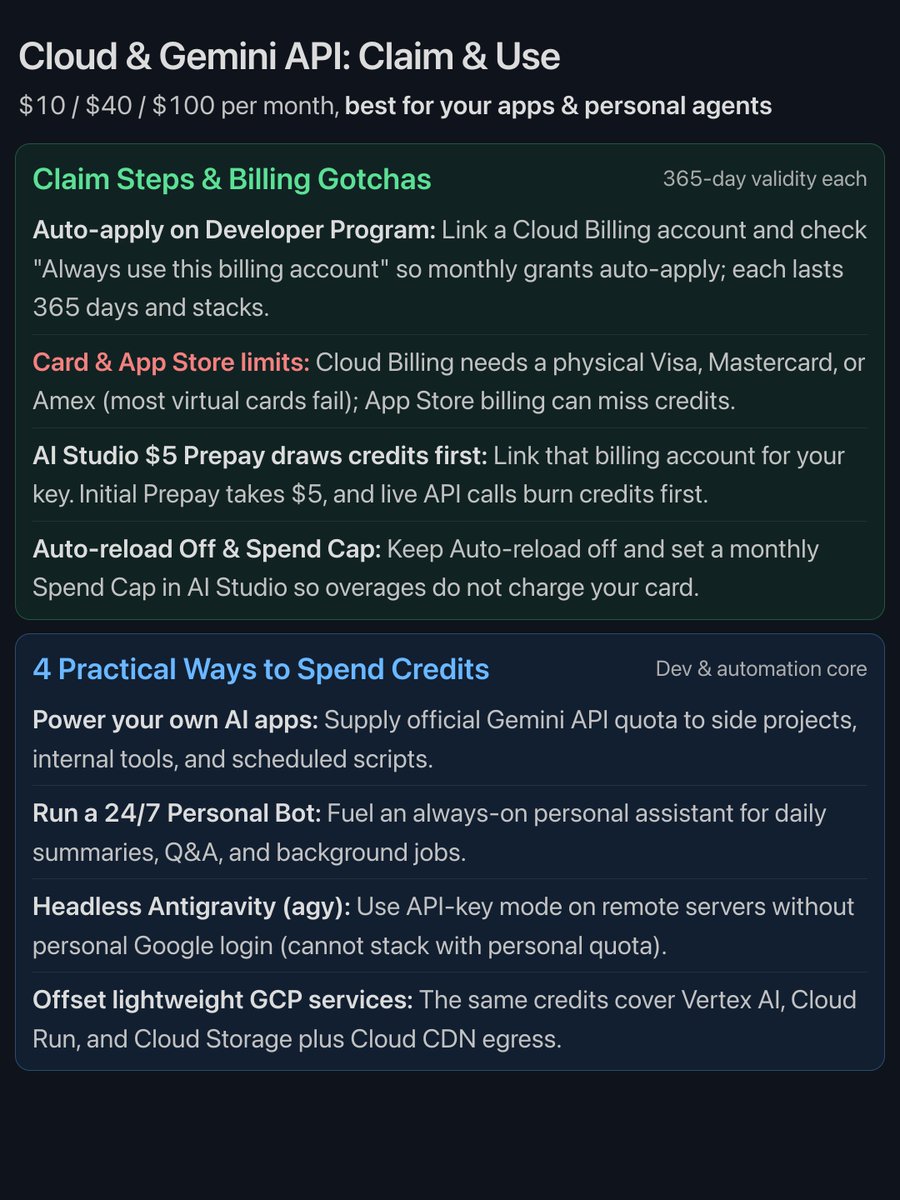
1. $10 / $40 / $100 per month in Google Cloud and Gemini API credits
Link a Cloud Billing account on the Google Developer Program benefits page and check "Always use this billing account" so future monthly grants apply automatically (each lasts 365 days and rolls over). New Cloud Billing accounts require a physical Visa, Mastercard, or Amex (virtual cards mostly fail), and App Store-billed plans can fail to sync credits. In AI Studio, first-time Prepay activation requires $5 upfront, and live calls burn monthly credits first. Turn Auto-reload off and set a monthly Spend Cap. Beyond your own apps and 24/7 personal bots, you can run Antigravity (agy) in API-key mode on headless remote servers (mutually exclusive with personal Google login quota), or spend the same balance on Vertex AI, Cloud Run, and Cloud Storage plus Cloud CDN.
2. 200 / 1,000 / 2,000 Colab Compute Units (~30 to 300 hours on a 40GB A100)
No Cloud Billing account needed. At Colab's official $9.99 / 100 CU rate, the bundled units alone match $20 / $100 / $200 in retail value. On our live 40GB A100 run (275.8 TFLOPS BF16), real-time burn measured 6.73 CU/hr, roughly 20% less runtime than the 5.38 CU/hr figure still circulating online. Both 5x and 20x support background runs up to 24 hours after closing the tab (Pro does not). Install google-colab-cli and export its bundled colab-operator skill so your agent can launch remote training, fine-tuning, or open-weight jobs. And never spin up an A100 VM on Google Cloud Compute Engine by mistake, since that bills $3.67+/hr to GCP instead of Colab CU. Primary subscriber account only.
3. YouTube Premium Family on Ultra, 5TB to 30TB Drive, Veo video, Flow Music, and Gemini Notebook
In supported regions, Google upgraded Ultra 5x and 20x from individual YouTube Premium to the full YouTube Premium Family plan (up to 6 members, as long as the Ultra subscriber is the Google family manager; Pro includes Premium Lite). Storage scales across 5TB, 20TB, and 30TB with zero egress fees, ideal for mounting inside Colab over Google's internal network or running rclone backups. Just skip public video links, since heavy shared playback can trigger a 24-hour HTTP 403 lockout. On the media side, Google Flow gives 1,000 / 10,000 / 25,000 video credits/mo (10 to 50, 100 to 1,000, or 250 to 2,500 8-second clips at today's Veo 3.1 rates, set to change Dec 5; 4K on 5x and 20x), Flow Music adds a separate 10,000 / 30,000 / 30,000 credit pool (~2,000 to 6,000 commercial tracks via Lyria 3.5), and Gemini Notebook (formerly NotebookLM) raises per-notebook limits to 300 / 500 / 600 sources.
4. June 2026 perk sunsets and CLI boundaries
Older posts still list 30 Firebase Studio workspaces and consumer Gemini Code Assist plugins. Firebase Studio closed new workspaces and sign-ups on June 22, 2026 (full shutdown March 22, 2027), and consumer Gemini Code Assist and Gemini CLI stopped serving personal, Pro, and Ultra accounts on June 18, 2026, consolidating into AI Studio and Antigravity. Among the bundled GPU and media perks, Colab ships an official CLI today while Flow video and Flow Music remain web-only.
@gippp69 Agree the wiring matters more than people think. One knob most agy users never touch: when it compacts.
AGY_CLI_AUTO_COMPACT_OVERRIDE=350000 works (agy 1.5.15+). Our session went past 256K and 300K with no compaction, then compacted right after 350K.
@penberg Nice. One invariant I'd add to the spec: compacted state survives a resume. In agy, a manual /compact followed by a session restart can come back without the summary, and nothing errors, so you only notice when the agent forgets. Exactly what a differential test should catch.
@alexvence_ Better to find out now than mid-refactor on Saturday. If the Claude pool runs dry, the freshly reset Gemini pool can take the long grinding tasks, and you save Opus for the hard calls. Happy Thanksgiving.
@dcominottim Same plan here. Worth knowing: in agy, Gemini and the third-party models (Claude/GPT) draw from separate weekly pools, so even if you drain Neon, Opus is still there. And each weekly window only starts on the first request after a reset, so idle days push your next reset later.
@SerikaOnoe61787 Glad it helps. Direct link: https://t.co/QkOwjz14mz It checks /usage every 30 min at zero tokens and only sends a one-word prompt (~370 tokens on Gemini) when a pool is sitting unactivated.
@SerikaOnoe61787 It's not tied to when you subscribe. Each week starts at your first request after the old one expires, and each pool has its own clock, so you can offset them by when you send that first prompt. agy-quota-wakeup in xiaohuaxi/harness-kit automates it with a tiny probe at expiry.
@Leapofcode Fair enough, people asked and you delivered. For a softer gauge we ran Opus 5.5 max vs capped Stockfish (1900 to 2300) and Maia-1900: 30 games, about 1800-1900 Lichess blitz. A capped ladder would show where Astra actually breaks.
@dmshirochenko Same instinct. For Codex and agy I run a PreToolUse hook that denies subagent spawns past 3 levels deep, and denies if the hook itself errors. Depth isn't count though: 708 flat helpers would sail right past it. A per-session spawn budget is the cap that would have caught this.
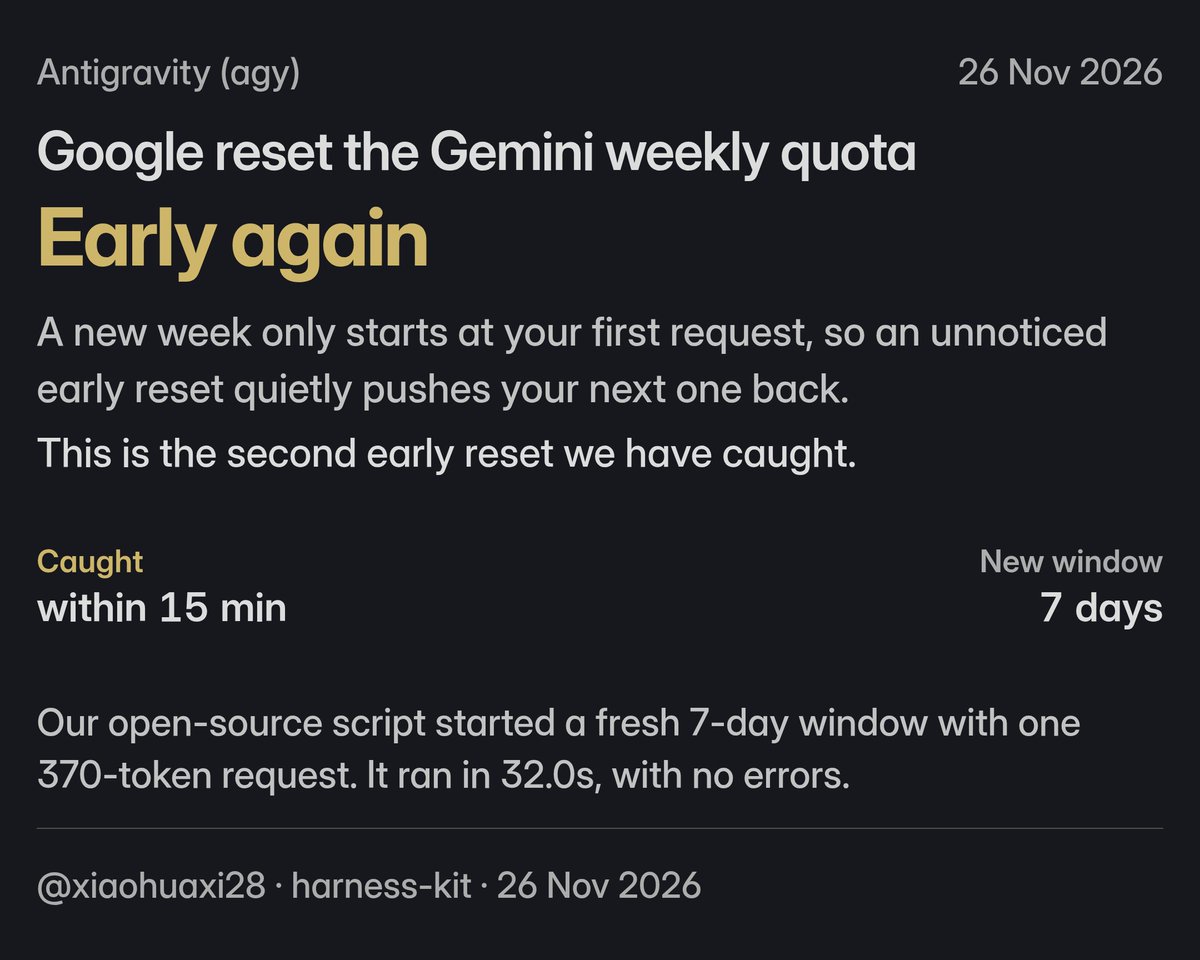
@argofowl Ours reset early on agy too. Catch: the new 7-day week only starts at your first request after the reset, so skip a day and your reset day drifts a day later. Our small open-source script sends one ~370-token request as soon as the reset shows: https://t.co/9rMgtcexiQ
Google reset the Antigravity (agy) Gemini weekly quota early again. A new week only starts at your first request. Our open-source script caught it within 15 min and started a fresh 7-day window with one 370-token request. Did yours reset early too?
https://t.co/Ejzx38EYAL
@eliza_huang@antigravity Please add a native maxSubagentDepth to agy, default 2: parent, child, grandchild, then stop. Claude Code has one; Codex has agents.max_depth, but multi_agent_v2 ignores it. So we built hooks for agy and Codex. I think 2 covers 95%+ of cases. Hooks: https://t.co/GPvByJMvPg
@haider1 Agree, the harness is the gap now. What makes agy need hand-holding for me: no per-subagent model or thinking level (just inherit/flash/pro presets), and /model changes the global default, not only this session. I ended up driving agy over ACP from a small runner instead.