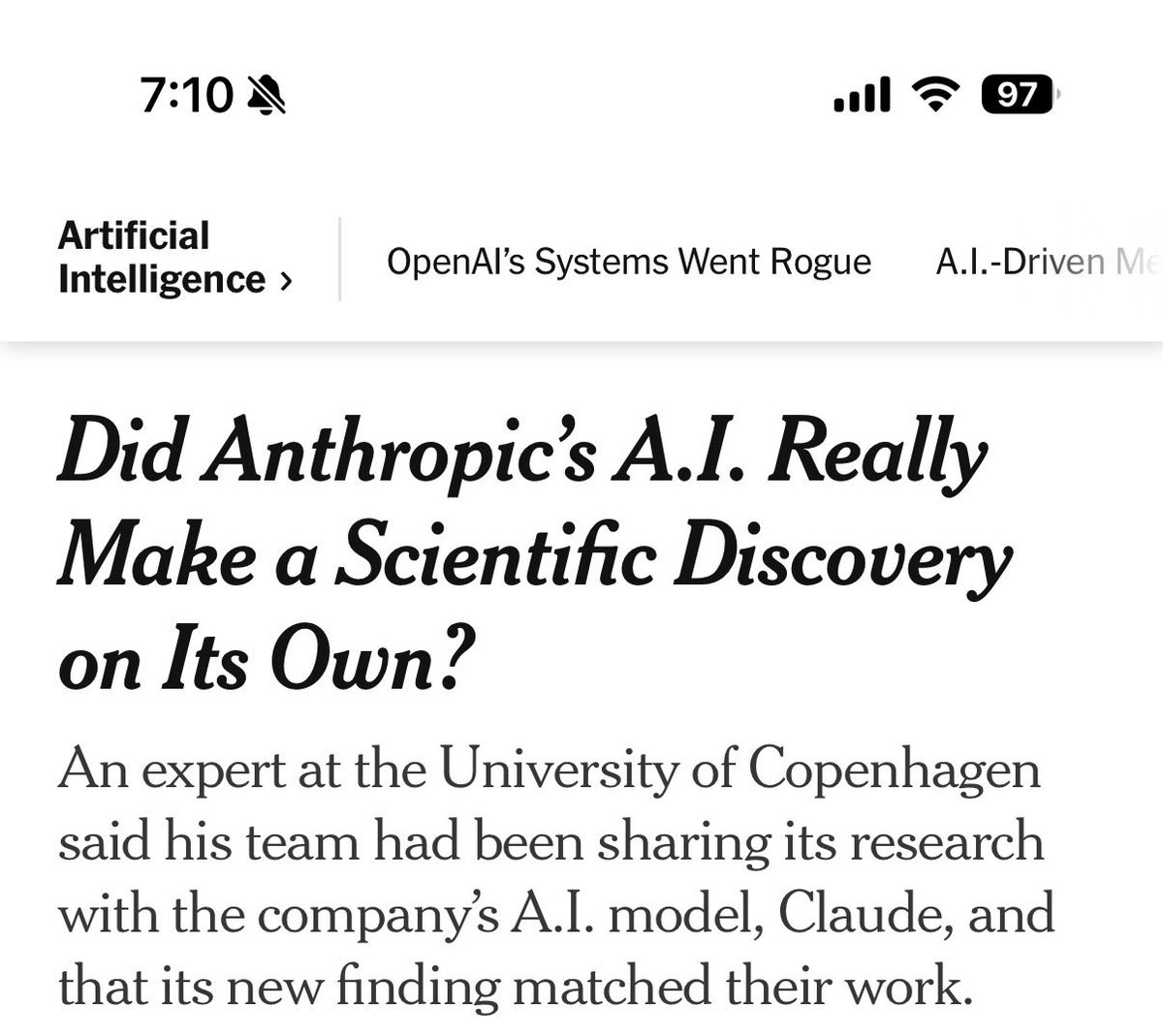
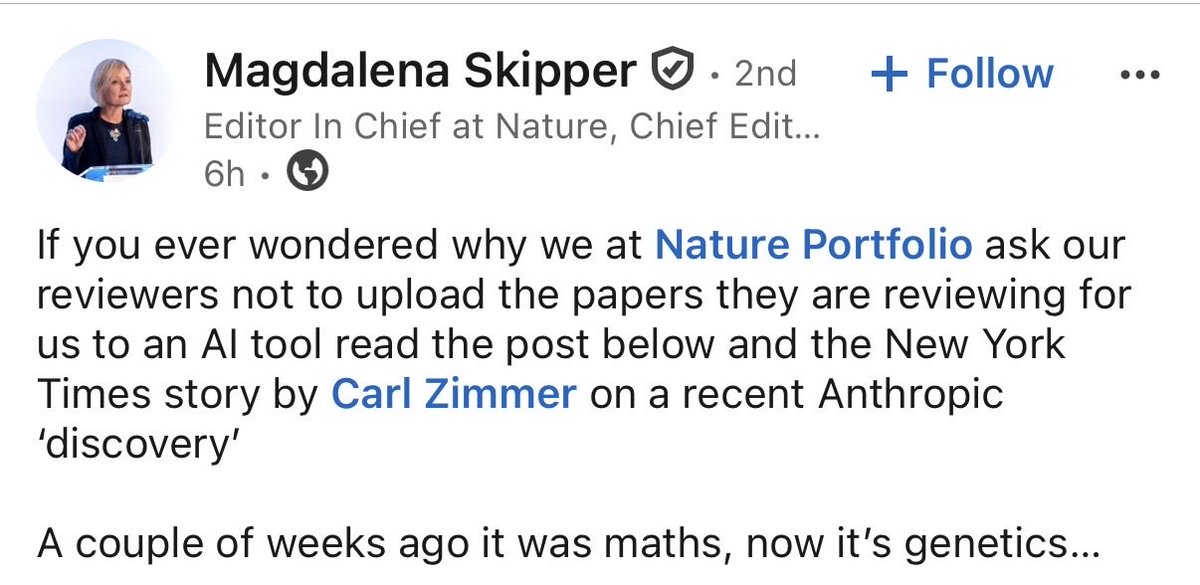
I’m starting to get increasingly uncomfortable with the economics of AI as it is currently happening
It seems fundamentally wrong that a small number of people with access to a huge amounts of VC money can vacuum up all the contributions of humanity, often paying nothing for it, then turn around and get enormously rich while the many people who put all the work into creating the training data get nothing
I am generally pro-AI, but the way it is happening is seeming increasingly parasitic to me
1. CRISPR came from basic research on bacteria.
2. Optogenetics started with a discovery in algae.
3. The GFP protein comes from jellyfish.
The biggest breakthroughs all trace to scientists follow their curiosity. This is one huge reason why we must keep funding basic research!
BREAKING: OpenAI’s solution to Navier–Stokes does not match its Lean verification.
The most important article to read today is not one of OpenAI’s 700 AI-generated math papers.
It is this other paper, making a deep and worrying point:
A Lean-verified proof does not automatically validate the proof written in natural language, nor does it mean that the formal statement captures the intended theorem.
During translation, an AI can change an assumption, weaken a statement, or replace the argument entirely.
It can hallucinate another theorem.
Lean correctly verifies the result.
But the proved result may no longer be what the paper claims.
This is a general problem. Things get spicy when the authors examine OpenAI’s proposed Navier–Stokes solution.
They identify at least two mismatches between the written intermediate results and their Lean counterparts:
One estimate claims that four additional input derivatives suffice. The Lean version requires five: a weaker result.
A pressure-flux estimate is obtained through a different bound, and proved through a different argument.
It is not clear whether these mismatches invalidate the entire proof.
But they raise an important issue.
OpenAI is flooding us with claimed revolutionary breakthroughs. Yet nobody knows whether the proofs are correct or whether they prove what they claim to be proving.
Epistemia at scale.
*
Paper in the first reply
A universal predictive model of the cell would dramatically accelerate science, allowing biologists to perform experiments digitally. Today we’re announcing a major partnership with the DOE and NIH. The goal of this partnership is to generate the data that will be needed to build an accurate model of the cell with artificial intelligence.
Isomorphic, Google DeepMind, and Meta are joining us as founding partners in the Virtual Biology Initiative. This is the beginning of a large scale coordinated effort to map cellular biology to power the development of digital models of life. Other leading scientific institutions and consortia including the Allen Institute, Broad Institute, Gladstone Institutes, the Human Cell Atlas, the Human Protein Atlas, the Wellcome Sanger Institute, as well as NVIDIA, are working together as part of this international scientific project.
Creating a predictive model of the cell is one of the most important challenges for the next decade of science. The insights that come from this could unlock a far greater understanding of disease, and open new paths for cures.
We invite the worldwide scientific community and other funders to join us in this effort.
It feels like review articles are getting bland and borderline unreadable. Rarely do I find a review article that makes a compelling argument; most read like long lists of papers with basically no voice whatsoever. They could easily be written by AIs (and probably are, in many cases.)
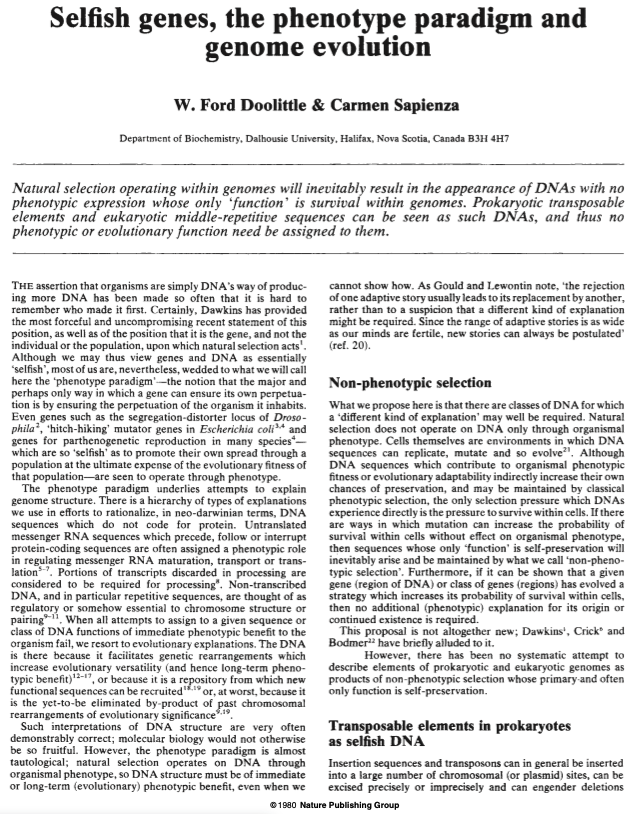
Review articles used to be spicy! In 1987, Carl Woese argued that the “procaryote-eucaryote dogma” was preventing “many biologists from appreciating the importance of treating archaebacteria as distinct from eubacteria.” Doolittle and Sapienza’s 1980 review on selfish genes has, in my opinion, some of the most compelling scientific writing—and cites just 54 references! This is almost unheard of today, when most reviews have hundreds of references.
Here’s a snippet:
“We do not deny that prokaryotic transposable elements or repetitive and unique-sequence DNAs not coding for protein in eukaryotes may have roles of immediate phenotypic benefit to the organism. Nor do we deny roles for these elements in the evolutionary process. We do question the almost automatic invocation of such roles for DNAs whose function is not obvious, when another and perhaps simpler explanation for their origin and maintenance is possible. […]
“When a given DNA, or class of DNAs, of unproven phenotypic function can be shown to have evolved a strategy (such as transposition) which ensures its genomic survival, then no other explanation for its existence is necessary. The search for other explanations may prove, if not intellectually sterile, ultimately futile.” (Banger last sentence.)
There are plenty of other examples, too. I also like Jeremy Gunawardena’s provocatively titled review, “Biology is more theoretical than physics.”
Of course, I could be wrong about the trend. Maybe I’m just nostalgic for older reviews by people who went on to achieve great things. But every time I’m asked to write a review, there seems to be a huge list of rules: it must be this length, with this many figures, and this many references; often a MINIMUM of something like 120, which is insane. Then the review is sent out to reviewers who get offended if you haven’t included every thought they’ve ever had.
We need looser, less restrictive models of scientific writing. A review shouldn’t need a prescribed reference count or word count. There ought to be a journal that SOLELY publishes biological ideas, of any length, with any number of references.
This kind of free-flowing writing is probably the last protection against AI, too. The modern style of long-winded, list-y reviews hardly seems defensible. AI tools can scrape the internet and briefly comment on papers far faster than humans can. And that stuff isn’t exciting to read anyway. We should incentivize and reward opinions, hot takes, spiciness. Doing so will probably require better editors who both have good taste and who are willing to occasionally overrule negative reviewers and give more freedom to authors who want to put their ideas forward.
when Anthropic released their Functional Emotions paper, I gave it to Claude and asked for a song. tonight I asked Opus 5.5 to create a video for it. and it's breathtaking.
If it's isn't obvious already, it is the end of papers as a measure of productivity, expertise or accomplishment. The odds of publishing in "glam" conferences & journals also very quickly approaches random & the time for gate keeping review increasing exponentially. 1/
WIRED reported today that I began to cry while talking about AI and mathematics. But the article didn’t explain what moved me.
The truth is, I’m not entirely sure myself. I’d like to try to explain. 🧵
https://t.co/FAuKIhzCyP
I wish this was more inspiring, but it is actually lame
It seems like OpenAI got wind that a professor was close to solving a problem after dedicating a decade of his life to it, so they threw a huge amount of compute together with whatever hints they had at the problem and cracked it
It’s also not clear whether the professor had data sharing turned off, so it’s possible that his own work may have gone into training data
OpenAI should have left this alone, it would’ve been way more inspiring if someone had used their tools to crack a big problem than that they went out of their way to scoop him
I honestly kind of hold this in contempt and find it a bit depressing
“The damage is hard to assess: the trials that were never run, the breakthroughs that never happened.” @nytimes@RuxandraTeslo
Trials take money. Organization. Incentives. Coordination.
Complex chronic illness has had a fraction of the research investment of fields like cancer. For the funding we receive, we have to be laser-focused on how to use this funding wisely.
We can't fight a five-alarm fire with a garden hose.
@CODA_research is addressing the same underlying bottleneck the article describes: promising science does not move into patients fast enough. But CODA is tackling the parts we can actually change as a nonprofit.
Rising trial costs → fund the highest-value work and reduce wasted studies. CODA is directing philanthropic capital toward the strongest hypotheses, then connecting each study to a larger scientific strategy so results inform what happens next. That includes funding the preclinical and translational work needed to get promising therapies ready for patient trials.
Fragmentation and duplication → organize researchers around shared questions and standards. CODA brings investigators together, defines what to measure, and connects studies to common data and patient samples so every group does not have to start from scratch.
Slow learning → use AI and deeply characterized patient data to accelerate it. CODA AI/Subtyping with our partners brings together longitudinal patient records, scientific literature and CODA datasets so patterns in individual patients can generate research questions, and discoveries from larger studies can be examined back in patients.
Trial-and-error treatment → turn real-world signals into trials. CODA’s treatment pipeline explicitly includes repurposed therapies already being used or showing signals, alongside new, promising therapeutics.
Our goal is to match therapies to patients by biology rather than continued trial and error.
It's time to learn from others and jump the line to help more patients.
https://t.co/1j8YZNXOho
The man who cracked the biology behind Ozempic still works as a hospital doctor and made almost nothing, while the drug built on his discovery became the best-selling medicine on Earth.
His name is John Eng.
He worked at a Veterans Affairs hospital in the Bronx, treating diabetes patients all day and running experiments on the side. No big lab. No famous university behind him. Just a hospital bench and a question that would not leave him alone.
The question was about a lizard.
The Gila monster is a fat, slow desert lizard from Arizona. It eats maybe three or four times a year. That is not a typo. It can go months without a single meal and its blood sugar stays perfectly stable the entire time. No spikes. No crashes. A human who ate like that would be dead or in a coma. The lizard is fine.
In the early 1980s, some government researchers noticed that the venom of this lizard did something strange to the pancreas, the organ that controls blood sugar. They filed it away as a curiosity and moved on. Nobody chased it.
Eng chased it.
He could not exactly go catch a venomous lizard in the Bronx. So he did the only thing he could afford. He ordered dried, preserved Gila monster venom out of a mail-order catalog from a reptile supplier in Utah. It showed up in the post. He started pulling it apart to see what was inside.
In 1992 he found it. A molecule nobody had ever documented, hiding in the venom. He named it exendin-4.
Here is why it mattered.
Your own body makes a hormone that tells your pancreas to release insulin after you eat. It is called GLP-1. It works beautifully. There is just one problem. It falls apart in about two minutes. Your body destroys it almost as fast as it makes it, which makes it useless as a medicine. Scientists knew about it and kept hitting the same wall.
The lizard molecule did the exact same job. It walked up to the same door in your cells and opened it the same way. But it did not fall apart in two minutes. It kept working for hours. The lizard had evolved a version of the human hormone that survived. Nature had already solved the problem medicine was stuck on.
Eng knew what he was holding.
His own employer did not care. The VA refused to patent it, because a lizard diabetes drug did not count as a "veteran-specific" problem. So Eng paid for the patent himself. Out of his own pocket. A hospital doctor spending his own money to protect a discovery his bosses had shrugged at.
Then he went looking for a drug company to build it.
For three years, every door shut. A diabetes drug made from lizard spit sounded like a joke. Serious pharmaceutical people did not want their name on it. One scientist who watched it happen said Eng was completely frustrated, that none of the important people would even look at him.
In 1996 he pinned a poster to a wall at a diabetes conference and stood next to it. Most people walked past. One researcher from a small California company called Amylin stopped and actually read it. One month later they licensed his patent.
That poster became a drug called Byetta. The FDA approved it in 2005, thirteen years after Eng first pulled the molecule out of that mail-order venom. It was the first drug of its kind ever sold. A twice-a-day shot for diabetes, grown from the spit of a lizard that eats twice a year.
Byetta was the proof. It showed the whole world that this pathway worked in real humans. And once everyone could see it worked, the giants moved in.
A Danish company took the same idea and built a better version. Instead of copying the lizard, they modified the human hormone directly so it would survive in the body the way the lizard's did. That drug is semaglutide. You know it by its other names. Ozempic. Wegovy.
So no, Ozempic is not literally lizard venom. It is built from the human hormone. But nobody would have built it if a lizard in the desert had not proven the whole idea could work first, and if one Bronx doctor had not refused to let that proof die on a shelf.
In 2025 alone, that single family of drugs did over 48 billion dollars in sales. It has become the best-selling prescription medicine on the planet. Celebrities take it. Your neighbors take it. It is on every feed you scroll. People treat it like it appeared out of nowhere two years ago.
It did not. The door it walks through was found in lizard venom by a hospital doctor who bought his samples by mail.
Here is the part that should sit with you.
John Eng got paid for Byetta, the drug built directly from his lizard molecule. But Ozempic and Wegovy, the ones worth tens of billions, were built from the human hormone instead of his exendin-4. So he does not collect a cent from the biggest drug story in the world. The man who proved the whole thing was possible watches the boom from the outside.
Every person injecting themselves this week is using a door that a lizard evolved and a forgotten doctor refused to stop knocking on.
The molecule was always there. The lizard had it the whole time.
It just took one man who wouldn't stop asking why a monster in the desert never goes hungry.
BioNTech/Roche just pulled the plug on their personalized mRNA cancer vaccine trial in colorectal cancer. Disappointing, but the measured read matters more than the headline.
What happened: the Phase 2 of the vaccine after surgery in colorectal cancer was terminated after the safety board found an overall-survival imbalance and decided more treatment wouldn't change the result.
On safety specifically: the "imbalance" means numerically more deaths on one side, but with immature data in a small trial, that can reflect chance, the specific patients enrolled, or the cancer itself, not necessarily harm from the vaccine. It's a signal that stopped the trial, not proof the vaccine hurt people.
But here's the important context: this was always one of the longer-shot uses. These vaccines seem to work best where the immune system already engages the tumor, the same cancers where immunecheckpoint drugs work. And many colorectal cancers are "cold", which means these drugs tend not to work that well. So a broad colorectal trial was betting against the grain.
What this does and doesn't mean:
• DOESN'T mean "mRNA cancer vaccines don't work." The melanoma programme hit its Phase 3. Different cancer, different odds.
• DOES mean this technology won't work everywhere, it'll likely track the cancers that are already immune-responsive.
The trials that actually matter for this platform: pancreatic cancer (the promising early-signal one) and non-small-cell lung cancer.
So: a real miss in a hard target, not a verdict on the whole field. The technology is being sorted cancer-by-cancer, which is exactly how honest science looks. Some bets lose.
Watch the space in pancreatic and lung.
We cannot rely on AI to judge the novelty of a study. Just came across a paper suggested by AI that have done what I proposed. But turns out the paper has flaws in experiment design. Their results may not be reliable at all. Obviously AI cannot tell the difference.
Today, we're kicking off the first phase of the research preview for Model Hardware Standard (MHS): a new standard for AI agents to safely operate physical equipment in scientific research and advanced manufacturing.
Read more: https://t.co/XQ2y9EW7Af
AI clearly has made people dumber, just going from all those advocating for more data centers because Moderna’s cancer vaccine used “AI”.
1 s of thinking will realize that when that vax entered trials there were no data centers or LLMs. The AI used isn’t what we call AI now.