Honored to see our work published in @NatureMedicine.
This project would not have been possible without the support, guidance, and collaboration of so many wonderful people. I would like to sincerely thank all my co-authors, collaborators, and mentors!
Longitudinal proteomic analysis of plasma from unaffected carriers of #ALS-associated pathogenic variants revealed early protein changes before ALS symptoms and enabled mapping of their trajectories as well as prediction of the timing of phenoconversion.
https://t.co/sxWCIFcjuL
What if you could predict and start treating ALS a decade before symptoms start? In Harnessing Omics to Accelerate Discovery, researchers shared how a simple blood test that measures 17 proteins can help tell ALS apart from non-ALS cases. Remarkably, those protein changes can start rising up to 10 years before symptoms even appear. That means researchers may one day be able to spot ALS earlier and start treatment before symptoms even start.
#ALSNexus
Excited to see our @NatureMedicine ALS proteomics study featured as a Research Highlight in @NatureNeuro! 🧠
Grateful to @SteveQinEmory and all our collaborators for making this work possible.
https://t.co/Th9bEyy5sU
#ALS#Neuroscience
Analysis of longitudinal blood samples shows that #CD19#CARTs can be detected at least 10 years post-treatment in patients with #lymphoma, with deeper profiling from a single patient showing that these CARTs have a dominant double negative activated effector memory-like phenotype.
@MarcoRuella@ruellalab@pennmedicine@paruzzol
https://t.co/AKP1zWUrDH
Longitudinal proteomic analysis of plasma from unaffected carriers of #ALS-associated pathogenic variants revealed early protein changes before ALS symptoms and enabled mapping of their trajectories as well as prediction of the timing of phenoconversion.
https://t.co/sxWCIFcjuL
🧵5 Top Free Alternatives to BioRender for Scientific Illustrations!
These five websites offer free scientific illustrations for biologists. Great for presentations, research papers and other research communication needs.
Save and share the post!
PhD students: Remember to apply for the Google PhD fellowship. It will make your PhD super smooth.
Application opens on 10th April 2025
Deadline: 15th May 2025
PhD programs are pausing admissions to graduate school due to NIH indirect cost cuts. See the growing number of programs here: https://t.co/3j759AlhGL
How is science supposed to advance with fewer trainees, less $ for research? This is devastating.
How cool is this? Michal Lipinski from @broadinstitute presenting stacked #Illumina spatial slides of the mouse brain with subcellular transcriptome resolution #AGBTGM
It's clear that many do not understand what @NIH-funded research does to improve health. It's time to revive a study published 10 years ago that provides incredible information about this. link in the comment
Every single new drug approved by the FDA from 2010–2016 was built on NIH-funded research—that’s all 210 drugs. But what the public sees is just the tip of the iceberg.
Pharma takes credit for the final product, but beneath each drug developed, there are ~20 years of basic research, and 90% of the cost is from basic research funded by the NIH, which discovers drug targets, understands disease mechanisms, and creates life-saving treatments.
Figuring out how cancer evades the immune system, how addiction rewires the brain, and how heart disease develops is the role of the NIH, creating the foundation for the breakthrough drugs that come 20 years later, and the NIH does all that with only 0.8% of the US budget.
Without NIH, there would be no cancer immunotherapy, no anti-overdose medication, no anti-heart attack or stroke medication, no cutting-edge treatments.
If NIH funding is cut, the iceberg will melt. That means fewer cures, more suffering, and more lives lost.
The science beneath the surface keeps us afloat.
Invest in NIH. Invest in life
How do we detect spatially variable genes (SVGs) in spatial transcriptomics?
In our Nature Communications review, we categorize 34 computational methods into three categories:
✅ Overall SVGs
✅ Cell-type-specific SVGs
✅ Spatial-domain-marker SVGs
https://t.co/heTI8pCWAi
1/1
Check out our updated #bioRxiv preprint on #bionformatics#Rstats method CRAWDAD (Cell-type Relationship Analysis Workflow Done Across Distances) for quantifying cell-type spatial relationships in #spatialomics data
📰: https://t.co/UMF2d3hetL
💻: https://t.co/132Ug6VQ2Z
I'm glad to share that our ClusterDE paper has been accepted by RECOMB2025. Here is the updated bioRxiv: https://t.co/wlefSIVgIG ClusterDE solves the "double-dipping" issue in both sc and spatial transcriptomics. Thanks to my PhD advisor Jessica @jsb_ucla and other collaborators!
An snRNA-seq atlas of #MultipleSclerosis brains is presented in @NeuroCellPress today by KI professor @GoCasteloBranco and colleagues. Patient-specific glial gene expression patterns stratify MS patients, supporting precision medicine approaches for #MS. https://t.co/ZE8iGnzL6f
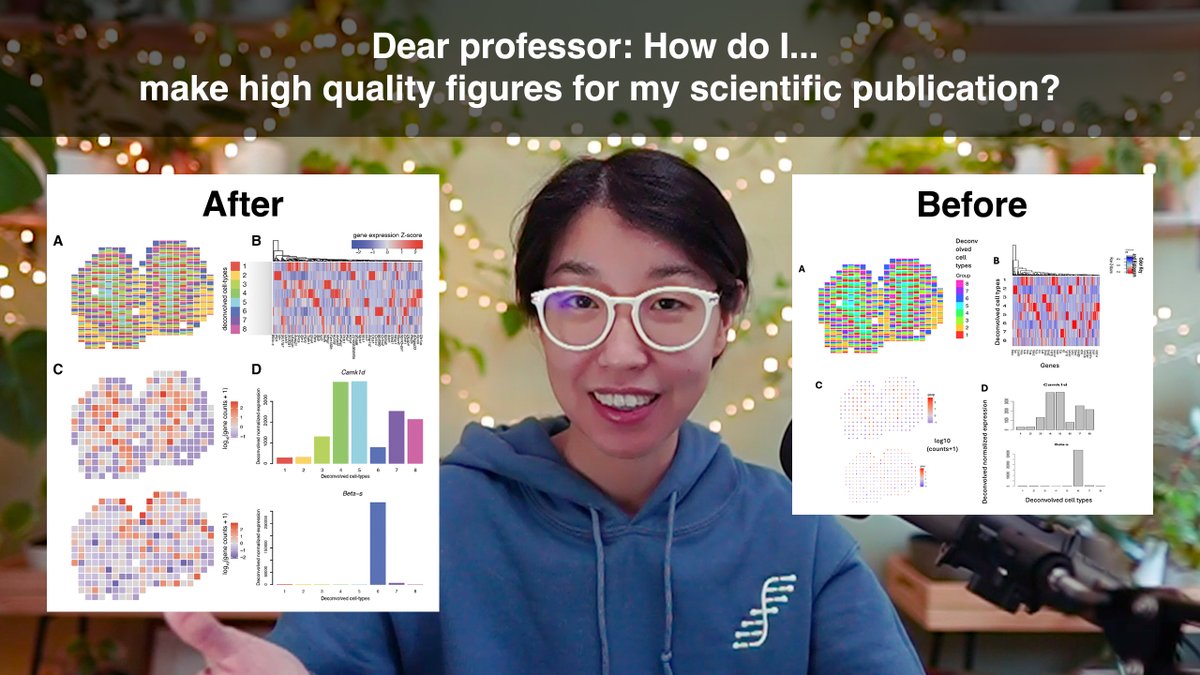
In this student-requested video, I demo the process of making a high quality publication-ready figure (from making a mockup to enhancing visual similarity in Illustrator) and narrate my general process.
Follow along 📽️: https://t.co/4uLZFkzDBA
#phdlife#AcademicTwitter#dataviz