Wow, this tweet went very viral!
I wanted share a possibly slightly improved version of the tweet in an "idea file". The idea of the idea file is that in this era of LLM agents, there is less of a point/need of sharing the specific code/app, you just share the idea, then the other person's agent customizes & builds it for your specific needs.
So here's the idea in a gist format: https://t.co/NlAfEJjtJV
You can give this to your agent and it can build you your own LLM wiki and guide you on how to use it etc. It's intentionally kept a little bit abstract/vague because there are so many directions to take this in. And ofc, people can adjust the idea or contribute their own in the Discussion which is cool.
@teslaownersSV Absolutely- Elon isn't driven by profits; he's driven by a core wish to improve people's lives!
(2017 Australia's Power Crisis)
Interviewer: "People are having to choose between food and cost of power"
Elon: "I didn't realize", on behalf of @Tesla he said "We'll work harder"-
我在2010年第一次写叶企孙,2016年访谈他的亲人和学生,拍摄了他未公开的文革日记,冲洗了他遗物中数十张底片。写完后稿子无处刊发,这些年一直把它们留在电脑里。直到上个星期看了Netflix的《三体》,有些细节触动回忆,就借这个机会跟大家分享吧。
柴静谈《三体》人物原型叶企孙:科幻和现实,哪个更残酷? https://t.co/ht994gO9Vu via @YouTube
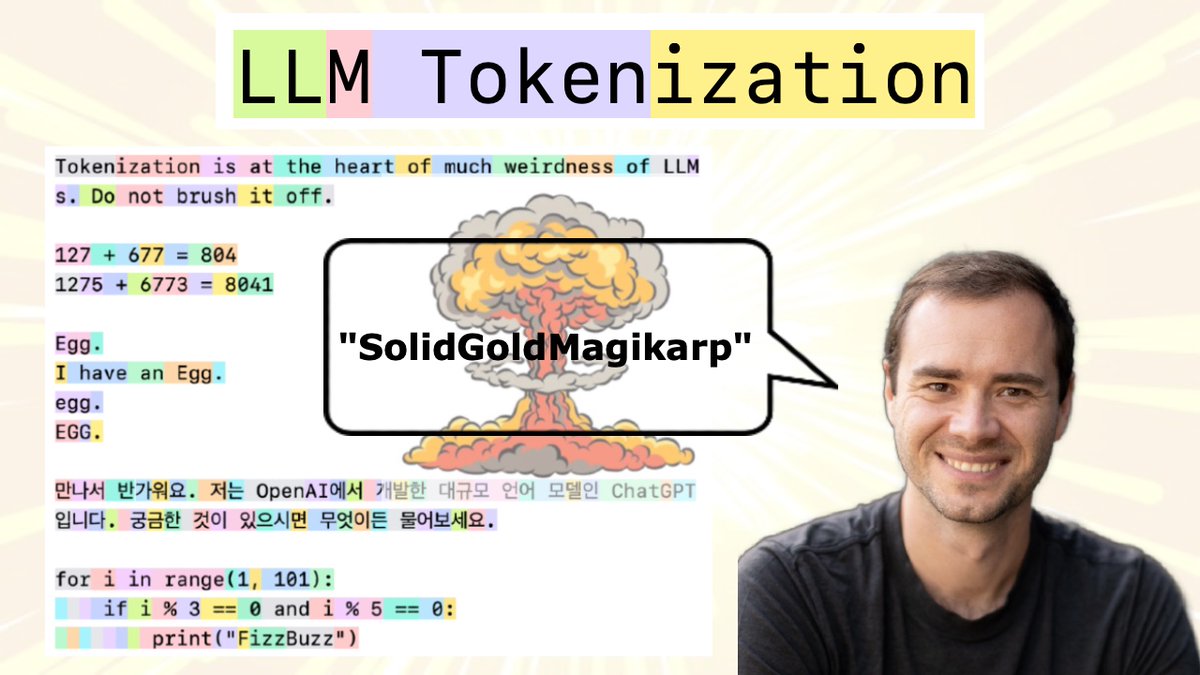
New (2h13m 😅) lecture: "Let's build the GPT Tokenizer"
Tokenizers are a completely separate stage of the LLM pipeline: they have their own training set, training algorithm (Byte Pair Encoding), and after training implement two functions: encode() from strings to tokens, and decode() back from tokens to strings. In this lecture we build from scratch the Tokenizer used in the GPT series from OpenAI.
It looks like this graph is actually an older version that ended up being corrected/updated -- see here for the newer one
Discussion here: https://t.co/epeTMfKBAA
«There is something unspeakably sinister about a machine that does nothing—absolutely nothing—except switch itself off»
—Arthur C. Clarke
https://t.co/kZCqHMTYfg
贴出关于政治抑郁症的笔记后,我看到很多人的共鸣。人灵魂生病的感觉就象是身体内住着一个陌生人,又震惊又迷惑,得到理解让人平静。所以锁教授说,“命名它,我感觉好了一半”。
很多人问这个采访能不能在YouTube播出,我觉得这只是私人谈话,录制质量太差。但我今天打开视频重看了一遍,也许我会试试。卢森医生的脸几乎看不清楚,在绿莹莹的北极光背景里闪烁,但他这个人的存在很强烈,
比如我说到,“我的朋友��对未来的预测,灾难性的。”
他说“你是谁?在预测未来?”
他说的很温和,但我感觉像有人用手肘轻轻撞了我一下,意思像是说‘你凭什么能��傲慢到知道未来?”我是为了我的朋友而问,但他却不容我处于旁观的位置,总是问我的个人感受,我尴尬,“你问得好直接。”
他突然谈起他对未来的预测,说得又快,又直白,又明确。我正在琢磨,他却话锋一转,“我有我的预测,你看,我只是呈现另一种预测,而且我不在乎。”
“不在乎?”我正在思考一样东西,这样东西占据了我的身心,他却把它取消了,成了空,“这话什么意思?”
“…我不在乎它是否需要一千年才来,这是抑郁和希望的区别。” 他语速慢了下来,停顿在这里。
不论拍摄多么粗粝,好的谈话者有这种触碰人的力量,几乎让人不适.比如当我试图总结陈词一下治愈的方式,他笑了,直呼我的名字,“柴,there is no cure for us. 对你没有,对他也没有。”
我之所以在笔记里留了唯一这句英文,因为这句话简直���在我脑子里。前天的留言中,一位读者的话像是对它的一个注解,“no cure for us 那句话给我印象很深,这句话我的理解是如果真的有cure,那必定是一个把所有人变成一样的东西,但那正是政治抑郁的根源,所以人不需要cure,需要的是理解自己的渺小,然后试着超越,当然真的超越是不可能的,但我不在乎。”
这就是交流。我朋友,我,医生,读者,一个人触碰另一个人,连绵不绝。
三周前,我把这个笔记发给朋友,我俩都没再提起此事。但上周他给我打了个电话谈明年要做的事,我吃了一惊。此前他谈到未来总是顾虑重重,这次却很明确,不管能不能挣钱,也不考虑外界评价,他说,“我不在乎了”。口气很平静。
我不只宽慰,也得到鼓舞。如果一个人无法做自己,真实地表达自己,抑郁就会来,那么我们要活下去只有一个选择,就是哈维尔在《无权���的权力��写的:活在真实中(living in truth)。
不论你身在何方,纪录你的生活,只要你有笔,写出你心底的沉默。那些不被看,不被听的,至少我在,我听你说。
[email protected]
Steve Jobs explains the importance of both thinking and doing
“The doers are the major thinkers. The people who really create the things that change this industry are both the thinker-doer in one person.”
This is applicable outside of tech too, and he uses Leonardo da Vinci as an example:
“Did Leonardo have a guy off to the side that was thinking five years into the future about what he would paint or the technology he would use to paint it? Of course not. Leonardo was the artist, but he also mixed his own paints. He also was a fairly good chemist and knew about pigments and human anatomy. Combining all of those skills together—the art and the science, the thinking and the doing—is what resulted in the exceptional result… There is no difference in our industry. The people that have really made the contributions have been the thinkers and the doers.”
Jobs speculates that one of the reasons people mix this up is because it’s easy to take credit for the thinking:
“It’s very easy for someone to say ‘I thought of this three years ago.’ But usually when you dig a little deeper you find that the people who really did it were also the people who worked through the hard intellectual problems.”