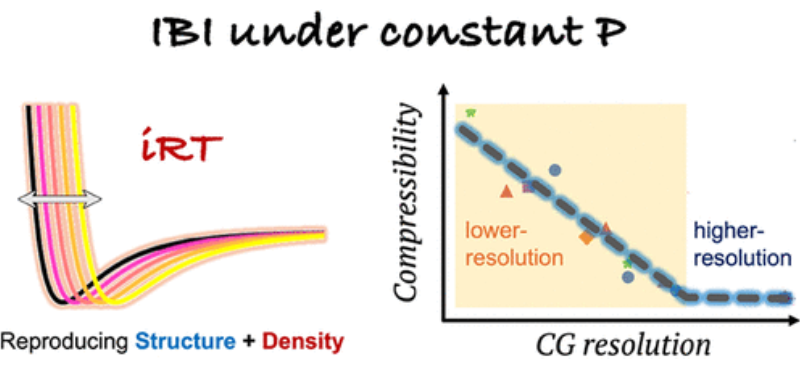
(3/3) interestingly, we also identify a rough CG resolution power-law scaling, in which the capacity for models to accurapte capture compressibility degrades beyond a certain resolution, (roughly) irrespective of chemistry. More to be learned there but some practical insights
(1/3) Sharing our new paper in @JCIM_JCTC from CSI Postdoc Zheng Yu introducing new iterative coarse-graining approaches that yield density/pressure consistency while preserving structural distribution functions: https://t.co/k5eiwCqfI7
(2/3) Most CG models are developed using data from the NVT ensemble, producing unphysical pressures and unsuitable for NPT simulations. We propose two simple adaptations to iterative Boltzmann inversion that resolve this issue and provide good compressibilities
(2/2) We evaluate the efficacy of simple metrics to take ML beyond binary classification of phase separation or not. A newly introduced metric--expenditure density--is high-performing and data-efficient. Analyzing failure modes of these metrics is also informative.
(1/2) Excited to share our latest paper in @JPhysChem (led by graduate student Wes Oliver in his first first-author publication!) on predicting the "propensity" for phase separation in coarse-grained IDP models.
🔗 https://t.co/GueM8LSNzN
(3/3) We find that NQEs may have broader relevance than previously appreciated by taking a data-driven approach to their analysis. It's important to be mindful that classical MD frequently neglects NQEs or has such effects "baked in" through the force-field parameterization
(1/3) Happy to share new work (https://t.co/7VxhxZT6e1) by student Eser Ugur in @NatureComms. We characterize room-temperature nuclear quantum effects (NQEs) across 93 organic liquids, understanding the importance of such effects and how their manifestation depends on chemistry
(2/3) NQEs arise based on the quantum nature of nuclei (not electrons). The effects are mostly considered at low temperatures or for light nuclei, like hydrogen. Equilibrium isotope effects are an importance consequence of NQEs that would not emerge in purely classical treatments
(3/3) What we effectively show here is how coupling a simple (and essentially free) theoretical estimate with an ML algorithm dramatically improves extrapolation capabilities, allowing for data for small MW to be leveraged for larger MW or homopolymers to copolymers, etc.
(1/3) Pleased to share this work from postdoc Bruce Jiang appearing today in @MacroJrnls_ACS on the synergistic application of polymer physics scaling theory and machine learning to predict properties of compositionally and architecturally complex polymers
https://t.co/oWzsLVfq8F
(2/3) This generally extends our efforts to grow the complexity of polymeric materials amenable to ML but with consideration that our data-generation capabilities can't scale with envisioned complexity.
Inspired by recent events and being in problem-writing mode for finals, I have crafted the following problem for students at the advanced 1st or 2nd-grade level. The question targets proficiency with the subtraction operator but blends this with real-world concepts:
@Andrew_S_Rosen I can save some investigation for a department whilst it's being dismantled: neither I nor anyone I have observed around Princeton have participated in anything remotely antisemitic. If we can un-suspend the grants for scientific research now, that would be great
@Andrew_S_Rosen "an administration official said that the funds would be paused while the Department of Education continues to investigate Princeton for allegations of antisemitism" -- the same Department of Education that is the target of a recent executive order? A+.