@IndexAndForget You need to read about decay, rebalancing, fee and difference this can make over the years... However the start matters so let's say you start when it's already 30-50% down that's when you'd really have an edge for longterm hold
WHAT I DO EVERY WEEKEND THAT HELPED ME MAKE MY FIRST $1,000,000 TRADING.
I’m doing it again right now trying to set up another $25,000 week.
Before Monday, I scan the money flows:
$SMH - Semiconductors
$DRAM - Memory
$EUV - Photonics
$IGV - Software
$CIBR - Cybersecurity
$WGMI - HPC
$DTCR - Data Centers
$BOTZ - Robotics
$ARKX - Space
$NLR - Nuclear
$QTUM - Quantum
$XLF - Financials
$XLV - Healthcare
$XLE - Energy
$IWM - Small Caps
Then I ask:
What is making new highs?
What is holding the 8/21 trend?
What is outperforming $SPY and $QQQ?
Where is money quietly rotating?
Then I find the strongest stocks inside the strongest ETFs.
I don’t wake up Monday searching for random trades.
I already know exactly where I’m looking.
Do this before Monday.
Charlie Mungers famous quote...
"BUY QUALITY STOCKS ON THE 200 WEEK MOVING AVERAGE"
Here's 8 stocks that STAND OUT using this rule:
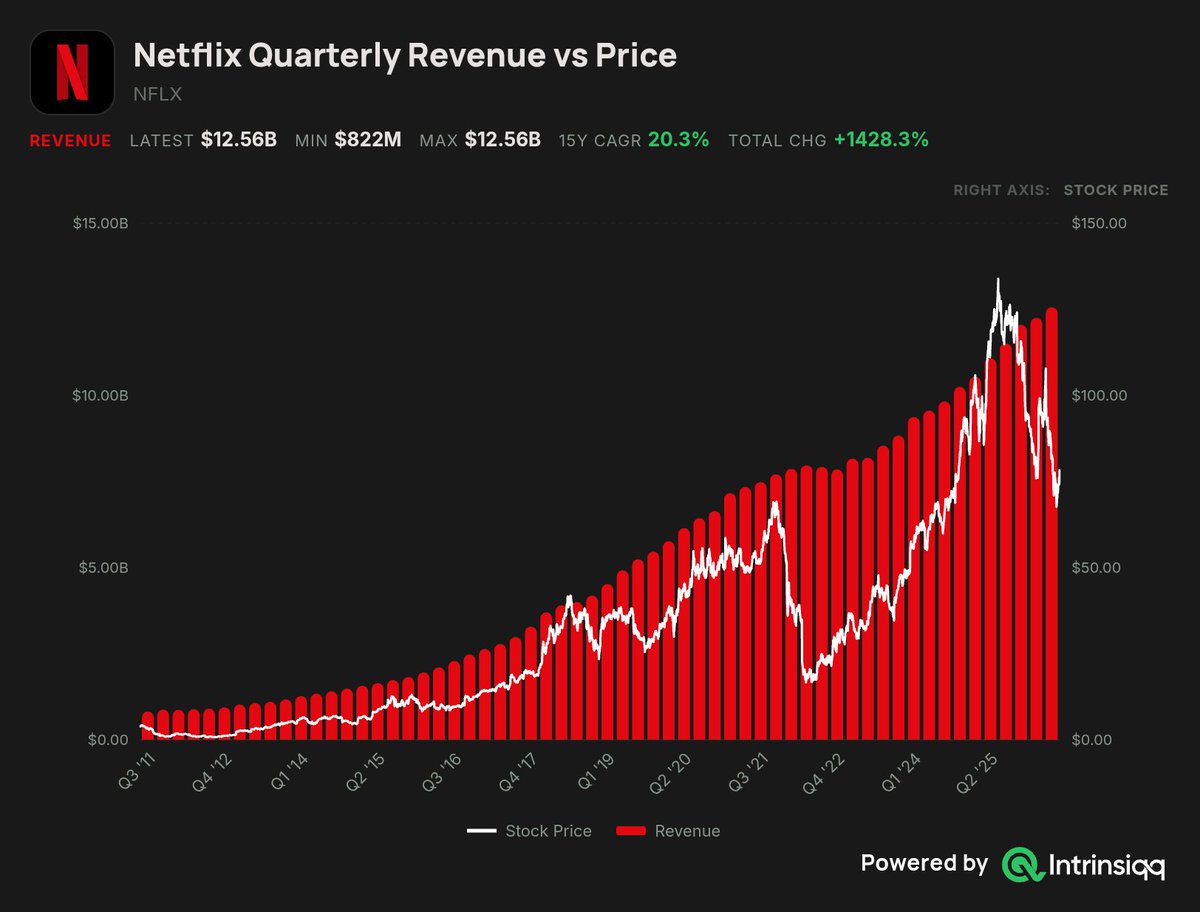
1/8 Netflix $NFLX
9.5% Above 200W SMA
🚨 I've been dividend investing for 10 years! 👨
My portfolio is now worth ~$2M
It generates roughly $10,500/month in dividends
Here's 9 High Income ETFs with NO PRICE DECAY! Worth looking into! 💸💵💰
*Save this for later!* 🔖👇
If you like High Growth...Buy
1) $DISK
2) $LAZR
3) $KMEM
4) $DRAM
5) $XLK
If you like Growth...Buy
1) $VOO
2) $QQQM
3) $SPMO
4) $SCHG
5) $AOTG
If you like Monthly Dividends...Buy
1) $XQQI
2) $XSPI
3) $OVL
4) $KQQQ
5) $TDAQ
If you like Weekly Dividends...Buy
1) $TDAX
2) $TSYX
3) $ISSB
4) $ISBG
5) $KYLD
If you like Safety...Buy
1) $CSHI
2) $BNDI
3) $OVT
4) $WEEK
5) $BOXX
If you like Dividend Growth...Buy
1) $DGRO
2) $SCHD
3) $CGDG
4) $VIG
5) $FDVV
If you like Stocks...Buy
1) Micron $MU
2) Sandisk $SNDK
3) AMD $AMD
4) Google $GOOG
5) SK Hynix $SKHY
If you want Everything...Buy
1) $VT
2) $ALLW
3) $NTSD
4) $AOA
5) $RSSX
@AddYourName_123@CoachDanGo Consistency first, but progress is what keeps it going. The two feed each other. You don't need huge wins, just enough proof that it's working, this makes showing up feel easy again. Try to track small things, not for motivation but so you can stay tuned! Check @AtomicHabitBook
@AddYourName_123@CoachDanGo Stick to whatever plan you commit to. That’s the foundation... Fixing your sleep, working out, eating cleaner and less, improving your gut, leaving toxic relationships, cutting useless consumption... none of it truly sticks until you first build consistency with yourself.
ETFs made my wife and I millionaires in 7 years.
But there's over ~10,000 to choose from.
Here are 10 ETFs that can make you a millionaire in 2026:
Total US Stock Market: $VTI
This is my bread and butter.
It tracks the ENTIRE US stock market...
So you get a piece of every pie 😉
Best Year: +30.9% (2013)
Worst Year: -38.4% (2008)
10 Year Average: ~14%
Total International: $VXUS
This tracks everything that $VTI doesn't.
If you want global diversification without picking countries...
This is your best bet.
Best Year: +32.4% (2025)
Worst Year: -16.1% (2022)
10 Year Average: ~10%
Nasdaq 100: $QQQM
This tracks the top 100 (non financial) US companies.
It's heavily weighted toward tech, AI, and innovation...
So it's high risk, high reward.
Best Year: +56.4% (2023)
Worst Year: -32.6% (2022)
10 Year Average: ~20%
S&P 500: $VOO
This is Wall Street's "gold standard."
It tracks the 500 largest US companies...
And 92% of fund managers can't beat it 🤷♂️
Best Year: +32.4% (2013)
Worst Year: -18.2% (2022)
10 Year Average: ~15%
Small Cap Value: $VBR
These are smaller US companies trading at discount valuations.
They're more volatile than large caps...
But they have a great track record.
Best Year: +36.6% (2013)
Worst Year: -32.2% (2008)
10 Year Average: ~10%
Growth Stocks: $VUG
These are the fastest growing (large cap) companies in the US...
And they're perfect for aggressive investors.
Best Year: +46.8% (2023)
Worst Year: -33.2% (2022)
10 Year Average: ~17%
Real Estate: $VNQ
This is a dividend heavy fund that tracks REITs.
(Real Estate Investment Trusts)
It's like being a landlord without the tenants 🤣
Best Year: +40.5% (2021)
Worst Year: -37% (2008)
10 Year Average: ~6%
Tech Stocks: $VGT
This tracks software, hardware, & any tech you can think of.
It's the highest returning ETF on this list...
But if a -40% year would make you sell, skip it.
Best Year: +61.9% (2009)
Worst Year: -42.8% (2008)
10 Year Average: ~22%
High Yield Dividend: $VYM
This is the "passive income" ETF.
It targets stocks with the highest dividends...
So you get paid while your portfolio grows 😏
Best Year: +30.1% (2013)
Worst Year: -31.9% (2008)
10 Year Average: ~12%
Total World Market: $VT
This lets you buy the entire world.
It's split 60/40 US / International...
With 9,000+ total stocks 🤯
Best Year: +32.7% (2009)
Worst Year: -33.1% (2008)
10 Year Average: ~13%
If you want help getting started...
Hit the link in my bio 🎯
Everyone talks about S&P 500 and done.
I hold that too. But I also hold positions most people haven't considered.
Here's where I think the next decade plays out:
→ VanEck Uranium: The world needs nuclear. Full stop. → VanEck Semiconductors: Every AI model needs chips. Demand is insatiable.
→ VanEck Defense: Global military spending just hit all time highs.
→ VanEck Quantum Computing: Early. Speculative. Potentially transformational.
→ VanEck Space: The longest bet I own. 10-20 year conviction.
These aren't replacing my index funds. They're sitting alongside them.
6% each. Enough to move the needle if they work. Small enough not to sink the ship if they don't.
That's how you size a bet.
Which sector do you think outperforms the next decade?
Link to my pie is in my pinned tweet if you want to check it out.
10 numbers every investor should know by heart:
6.9%
Real annualised return of stocks over 200 years. After inflation.
72
Divide by your return rate = years to double your money.
At 8%: 9 years. At 12%: 6 years.
40%
Of your total long-term stock return comes from reinvested dividends.
Spend them instead and you burn 40% of your compounding engine.
2%
Average annual inflation.
Over 30 years it cuts your cash’s purchasing power in half.
Over 50 years it destroys 73% of it.
10
The number of best trading days per year.
Miss them over 20 years and you lose half your returns.
Most fell during bear markets.
0.98
Correlation between S&P 500 and earnings growth over 30 years.
In the short term, sentiment rules.
In the long term, fundamentals always win.
4%
Safe withdrawal rate in retirement.
Historically lasts 30+ years without running out.
−14%
Average intra-year drawdown of the S&P 500.
Every year. Normal. Expected. Ignore it.
+36.4%
Average S&P 500 return in the 12 months after a midterm election year bottom.
The most reliable seasonal pattern in markets.
100%
Percentage of 20-year rolling periods that delivered positive real returns.
Every single one. In 150 years of data.
Save these.
They are worth more than most financial advice you will ever pay for.
A bad diet is the #1 reason why people don't lose fat.
After reading 500+ people, those who get the most results do the same thing, they repeat 3-4 simple meals every day.
Here's the list:
1. Basic chicken with rice
Gold: mentioned 30 times in the Vedas, 200 in the Torah, 400 in the Bible, and 12 in the Quran.
Value stocks and indexes? Not once.
#Gold#SPY#Investing
@Nishant_Bliss Every single crypto guru is just a modern snake oil salesman. They know nothing more than anyone else, just play with timing and hype. You’re no different from Dr. Profit, destined to fade but milking memberships till then. No shortcuts, only scams disguised as “communities”
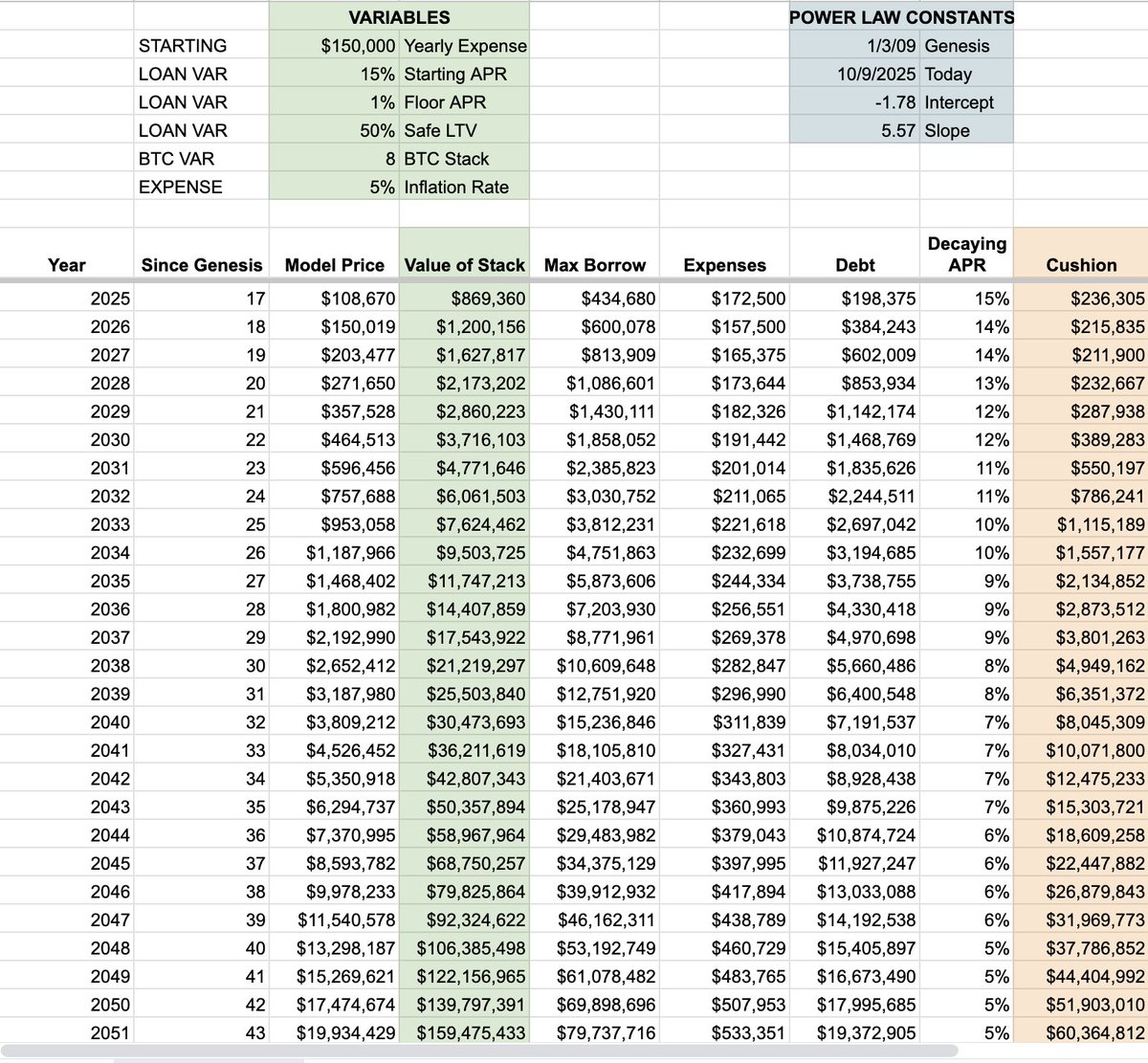
How much BTC do you need to retire? 🔥
I made a power-law calc (inflation-proof, decaying APR loans) and it says 8 BTC = endless fiat escape from 2025.
Borrow, don't sell. HODL forever.
What's your guess?
thread inbound, post 1/6
Gold: mentioned 30 times in the Vedas, 200 in the Torah, 400 in the Bible, and 12 in the Quran.
Value stocks and indexes? Not once.
#Gold#SPY#Investing
“BITCOIN IS GOING TO ZERO”
For 15 years, the “top” economists, bankers, and investors told you that.
They were all wrong: Nobel laureates, Wall Street CEOs, Ivy League professors.
I hope you didn’t listen.
List:
- Paul Krugman – Nobel Prize–winning Economist; NYT Columnist
- Joseph Stiglitz – Nobel Prize–winning Economist; Columbia University
- Nouriel Roubini – Economist; NYU Stern
- Jamie Dimon – CEO, JPMorgan Chase
- Robert Shiller – Nobel Prize–winning Economist; Yale University
- Warren Buffett – CEO, Berkshire Hathaway
- Jack Bogle – Founder, Vanguard Group
- Kenneth Rogoff – Harvard Economist; ex-IMF Chief Economist
- Atulya Sarin – Finance Professor, Santa Clara University
- Capital Economics – Macroeconomic Research Firm
- James Faucette – Executive Director, Morgan Stanley
- Prince Al-Waleed bin Talal – Chairman, Kingdom Holding Company
- Jim Rogers – Investor; Co-founder, Quantum Fund
- Alan Greenspan – Former Chairman, U.S. Federal Reserve
- Agustín Carstens – GM, BIS; ex-Governor, Bank of Mexico
- Ardo Hansson – Former Governor, Bank of Estonia; ex-ECB Council
- Stephen Poloz – Former Governor, Bank of Canada
- Charlie Munger – Vice Chairman, Berkshire Hathaway
- Peter Schiff – CEO, Euro Pacific Capital
- Sir Jon Cunliffe – Deputy Governor, Bank of England