Here is Tim Cook’s official farewell address on Apple Park to employees on his last day as Apple CEO. 😢
You can clearly see how touched, sad, and nervous he is. Thank you, Tim. ❤️🥺
Xcode 27 beta 5 can run its MCP server without opening Xcode 🤯
I used Claude Code to create a SwiftUI project, build it, render previews, and verify a flow in the simulator.
Setup, permissions, Apple’s agent skills, and caveats:
https://t.co/wZX02EoYOj
#Xcode27#SwiftUI#MCP
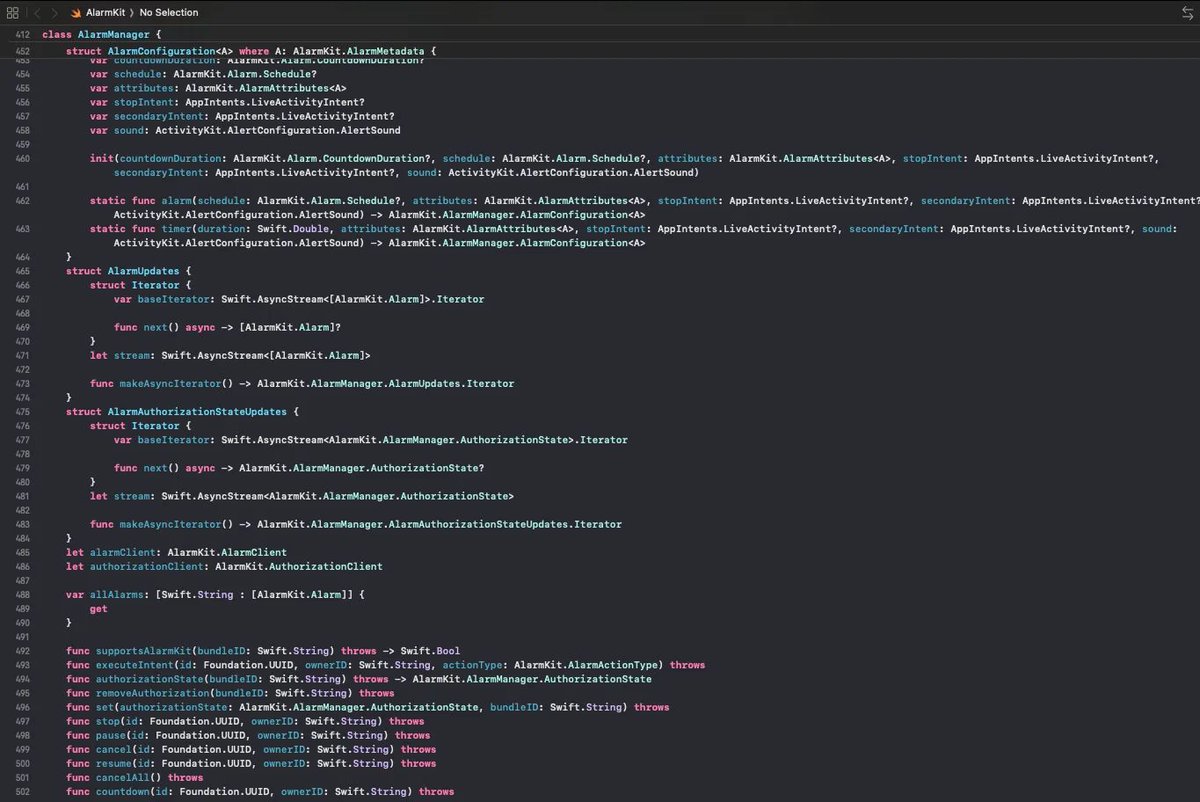
Apple's internal private frameworks are basically open-source thanks to MachOSwiftSection, which lets you reverse-engineer and inspect private binaries 🛠
The open-source MachOSwiftSection tool by MxIris is the key to reverse-engineering the interfaces from these binaries - all of which live inside the Simulator on your Mac filesystem.
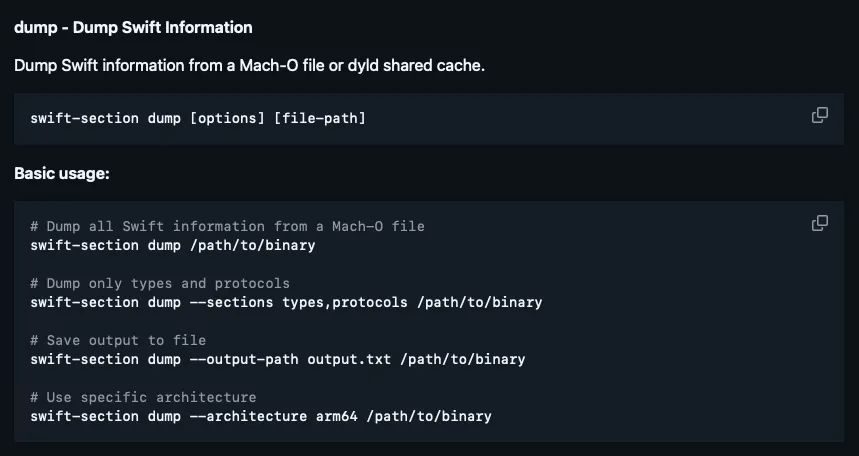
I downloaded the tool from the swift-interface branch, and ran the build script. The documentation is super clear (screenshot #1).
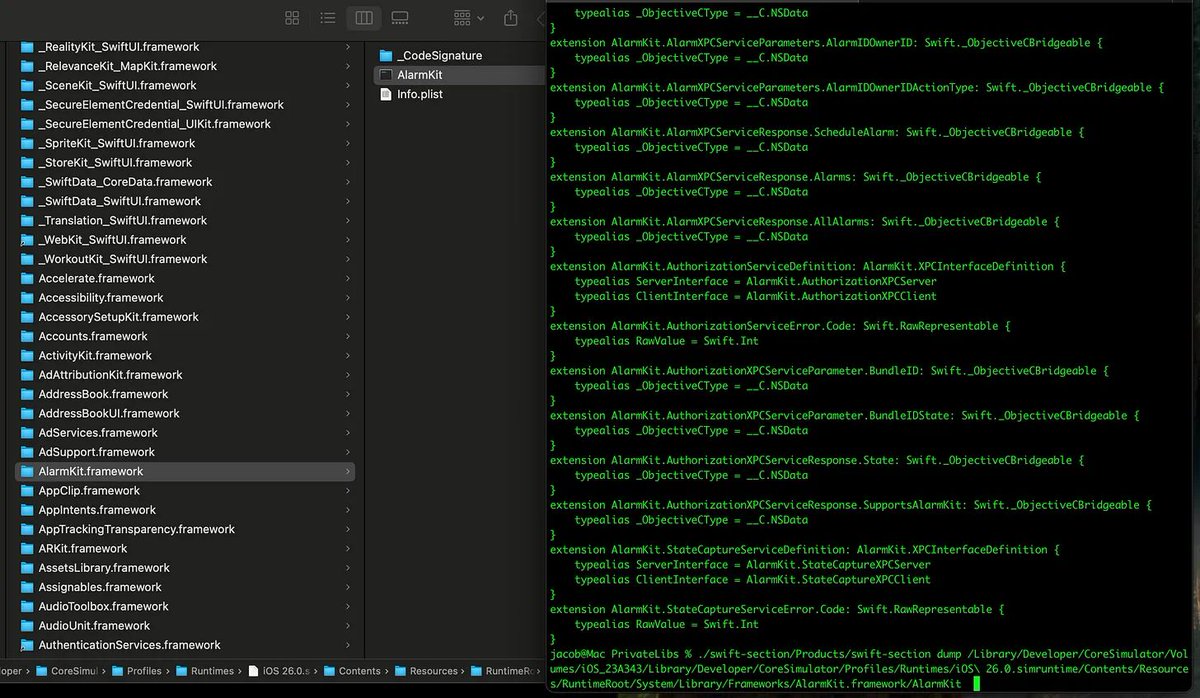
Let’s give this a try, and dump AlarmKit (screenshot #2).
Wow, it straight up just dumped the entire interface of AlarmKit. First try. That’s unbelievable.
We can get the slightly neater, Tweetable version by outputting the interface to a .swift file:
./swift-section/Products/swift-section interface --output-path AlarmKit.swift /Library/Developer/CoreSimulator/Volumes/iOS_23A343/Library/Developer/CoreSimulator/Profiles/Runtimes/iOS\ 26.0.simruntime/Contents/Resources/RuntimeRoot/System/Library/Frameworks/AlarmKit.framework/AlarmKit
This outputs a proper Swift interface containing all the internal Swift types (screenshot #3).
How does this tool work?
It walks the __swift5_* metadata sections in the Mach-O binary and reads ABI-defined descriptors in the binary to resolve types, protocols, and conformances. It runs a custom demangler to decode the resulting symbol names to reconstruct a regular Swift-y interface.
This works because the Swift ABI exactly specifies the structure and memory layout of these object code descriptors, for example, a ProtocolDescriptor always follows the exact same format when compiled into binary.
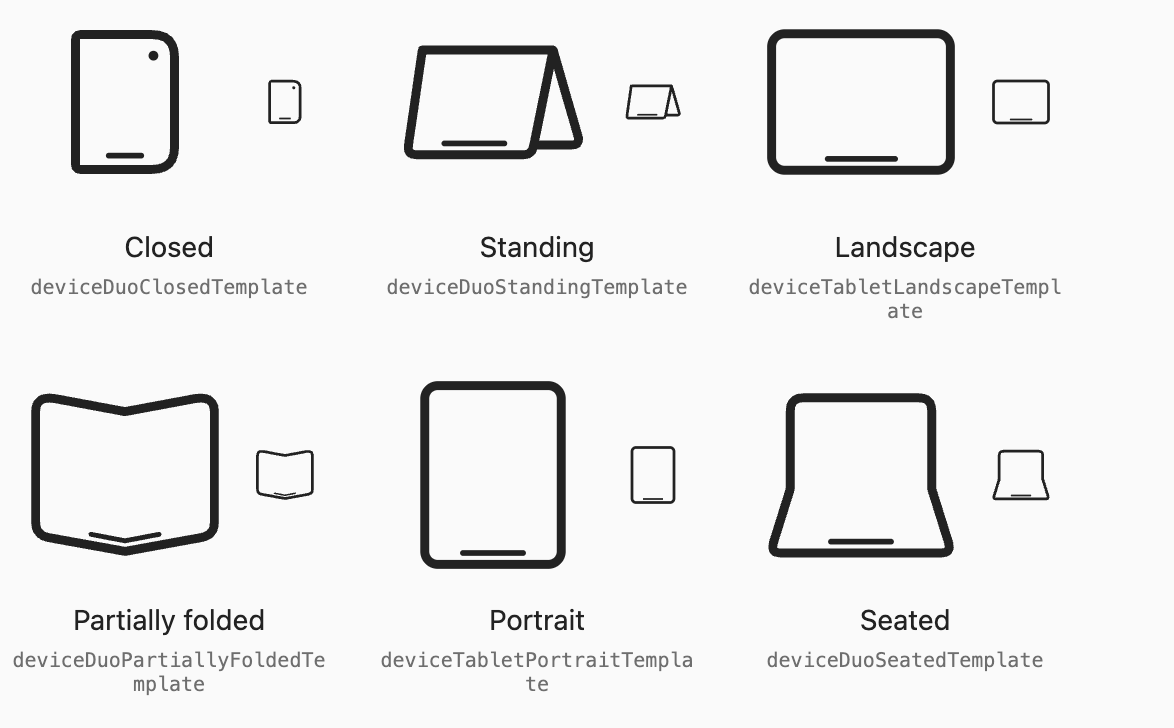
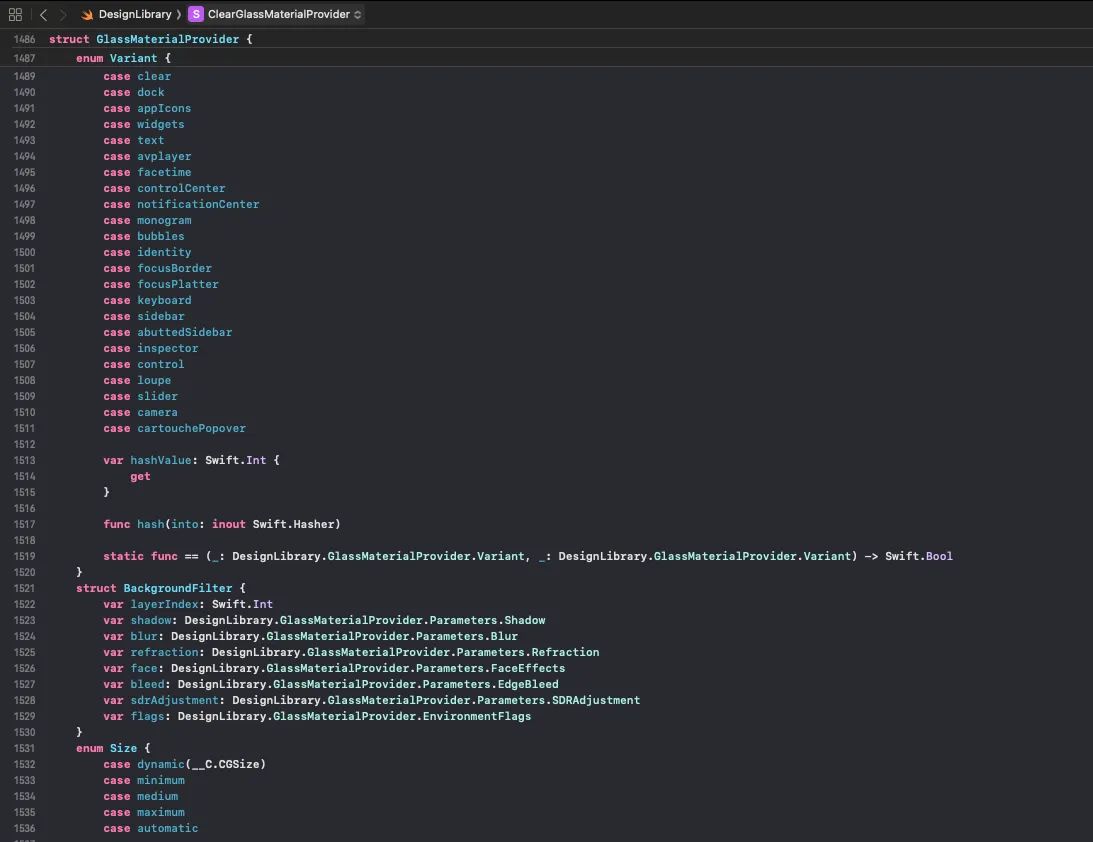
By running the tool on the DesignLibrary private framework, we can spot the original Liquid Glass configuration that inspired this article (screenshot #4).
I thought going through this exercise would make it seem less magic, but frankly I’m more convinced than ever that he’s a god.
Let me be clear: this does not reverse-engineer the actual source code from the binary, it just reconstructs the interface using type metadata. But this alone still gives us a ton of fascinating info.
./swift-section/Products/swift-section interface dump /Library/Developer/CoreSimulator/Volumes/iOS_23A343/Library/Developer/CoreSimulator/Profiles/Runtimes/iOS\ 26.0.simruntime/Contents/Resources/RuntimeRoot/System/Library/Frameworks/AlarmKit.framework/AlarmKit
If you liked this, please join my newsletter to master iOS for 10 mins every week! 🚀 https://t.co/5XrYBsTLjA
Apple just made Docker Desktop optional on Mac.
And it is completely free.
This is apple/container. 26.5k stars no Github.
You can now run Linux containers natively on your Mac without installing Docker Desktop, without a background daemon hogging your RAM, and without paying $21 a month per developer for a commercial license.
Here is what it does:
→ Runs Linux containers as lightweight VMs directly on Apple Silicon using macOS 26 virtualization
→ Fully OCI compatible. Pull any image from Docker Hub, GitHub Container Registry or anywhere else
→ Written in Swift and optimised specifically for Apple Silicon. Faster and lighter than anything Docker Desktop does on Mac
→ Standard container CLI syntax. If you know Docker commands you already know how to use this
→ Push images you build to any standard container registry and run them anywhere
Docker Desktop charges $21 per developer per month for commercial use. Apple's version costs nothing and ships as open source under Apache-2.0.
Microsoft made Docker Desktop optional on Windows with WSL Containers last month.
Apple just did the same on Mac.
Docker is not going anywhere. But the era of paying for a GUI wrapper around containers on your own machine is quietly ending.
Repo here: https://t.co/uFJ867sul6
The next generation of Apple Intelligence powers an entirely new Siri: making the apps and experiences you rely on across iPhone, iPad, Mac, and Apple Vision Pro more personal and helpful than ever.
THIS IS HILARIOUS 😂🍿
🇮🇷 Iran’s FM Araghchi turned Trump into a global clown with his 6D chess
🇺🇸 Trump at 8 AM — “Tonight we will finish the Iranian civilization”
🇮🇷 Iran — “We will retaliate” 🔥
🇺🇸 Trump at 10 AM — “We will not negotiate any further”
🇮🇷 Iran — “We don’t care” 🔥
🇺🇸 Trump at 1 PM — “We are still ready to talk” 🤣
🇮🇷 Iran — “No further talks” 🔥
🇺🇸 Trump at 3 PM — *Orders the Pakistani PM to request deadline extension of 2 weeks on X” 🤣
🇮🇷 Iran — *Refuses to talk* 🤣
🇺🇸 Trump at 6 PM — “Please somebody stop me, I beg you” 😭😭
Iran’s FM Araghchi has exposed Trump as HISTORIC LOSER with his strategic masterclass. This man is a genius 🫡
Xcode 26.4 is now available! 🚀
• Swift 6.3 is here
• NEW C++26 support
• Instruments: Top Functions FINDS slow code.
• String Catalogs leveled up
• Swift Testing: attach images directly to tests
Download it today!
Entry-level hiring at big tech is down roughly 50% compared to pre-pandemic levels. Junior roles are getting absorbed into smaller, more senior teams.
Here's my take 👇
The job market is really harder right now.
If you've been applying and hearing nothing back — you're not imagining it.
But it doesn't mean that the opportunity has disappeared. It has simply shifted.
The reason companies are hiring fewer engineers, is NOT because they need less done. They're hiring fewer engineers because they need more from each one.
The times of getting paid to tick off a task list are ending. What they actually need — and can't find enough of — are engineers who understand systems deeply, take ownership, and make real decisions.
A quick note on DevOps specifically:
DevOps is not an entry-level path. Most job postings implicitly target mid-level or senior people — because a strong DevOps skillset means you already understand software development, operations, cloud, K8s, CI/CD, and observability.
In many companies, DevOps isn't even a separate role. It's just what a senior engineer looks like.
Now about AI. Because I know everyone's thinking it.
Nobody actually knows what it means for jobs in 5 years. Not me. Not the LinkedIn thought leaders. Not the tech CEOs doing podcast rounds about it.
Both extremes are wrong:
"AI will replace all engineers" — wrong.
"AI won't affect engineering at all" — also wrong.
The roles that are under real pressure the most are ones doing narrow, siloed work — low-context, repetitive. AI is very good at those tasks. Including some of the specific DevOps automation stuff actually.
The engineers I believe aren't going anywhere?
The ones who can connect code, infrastructure, security, and business outcomes. And who can look at what AI produces and say "that's wrong — here's why" or "that's correct - and here's why"
So what do you actually do right now?
Not this → wait and see how it all turns out.
Not this → skip fundamentals and just learn AI tools, hoping that's enough.
Both lead nowhere good.
My honest take:
Broaden your skillset. Understand how the full system works — not just your piece of it.
Cloud, CI/CD, K8s, observability, security — these keep showing up in job postings for a reason.
And here's something people keep forgetting: every AI model you use runs on infrastructure that needs to be deployed, scaled, and maintained — that's Cloud and DevOps.
Don't learn these things just enough to copy-paste from a tutorial. Learn them properly, to the point where you can design, debug, and explain what's going on.
And yes — learn AI tools too.
🟢 Powerful when you know what you're doing.
🔴 Dangerous shortcuts when you don't.
The best thing you can do in an uncertain market is become more skilled than the people around you.
But skill alone isn't enough anymore.
You could be the best engineer in the room. If nobody knows you exist, it doesn't matter.
Visibility is part of the job now. That's what LinkedIn is actually for — and it matters more than ever right now.
Bottom line is: the door hasn't closed. But it became higher and more competitive.
What's your take?