Chinese and Japanese Aluminum Capacitor Leaders Join the Price Hike
As the second half of the year begins, aluminum capacitors have entered a new round of price increases. Rubycon, Japan's third largest aluminum capacitor maker, has issued a price increase notice, raising prices starting August 1, and has not ruled out a possible second increase thereafter. Coincidentally, Jiang Hai, the leading Chinese aluminum capacitor maker, has also announced a price increase. With the leading aluminum capacitor makers in both China and Japan joining the price hike one after another, conditions have become favorable for Taiwanese makers to pass on cost pressure to their customers.
With Rubycon joining the price increase, Japan's top three aluminum capacitor makers, Nippon Chemicon, Nichicon, and Rubycon, have now effectively all moved to raise prices.
Because aluminum capacitors are used in smaller quantities in end devices than MLCCs or chip resistors, their price increases were relatively muted in past hike cycles. This time, however, the simultaneous increase by the leading Japanese makers amid the AI infrastructure boom is seen as unusual within the supply chain. Beyond the fact that the three Japanese makers ship considerable volumes for AI servers, the sharp rise in cost pressure for upstream raw materials such as lead pins and aluminum cases has supported this wave of price increases by the Japanese aluminum capacitor makers.
Rubycon, Japan's third largest aluminum capacitor maker, emphasized the following in its price increase notice. Although the Middle East is moving toward an end to conflict, crude oil prices remain at high levels and have already had a major impact on the prices and supply of petroleum related products. As a result, Rubycon's various suppliers have implemented broad price increases spanning raw materials, auxiliary materials, and even logistics costs.
Rubycon also noted that the prices of metal materials, centered on aluminum, copper, and tin, have continued to climb since last year, and that this upward trend has intensified further under the current circumstances. In particular, the prices of major raw materials remain at unprecedentedly high levels. Under present conditions, it has become extremely difficult for Rubycon to absorb the soaring costs through its own efforts alone. To stabilize supply and sustain the business, the company has regrettably decided to adjust the prices of its products, and depending on how the international situation develops going forward, it may adjust prices again.
According to Rubycon's price increase notice, the scope of the increase covers aluminum electrolytic capacitors, solid aluminum capacitors, and film capacitors, with the new prices expected to take effect from August 1, 2026.
Also in late June, Jiang Hai, the leading Chinese aluminum capacitor maker, sent a price increase notice to its customers. Jiang Hai likewise cited the continued sharp rise in raw material prices, such as aluminum foil, chemical raw materials, and carbon powder, along with electricity costs, noting that the upward trend has yet to ease. Given that the current cost structure has already far exceeded the original pricing model, the company stated that adjusting product prices was unavoidable. The scope of the adjustment covers three product categories: aluminum capacitors, film capacitors, and supercapacitors.
The battery inside your next AI smartphone may end up being just as important as the AI chip itself.
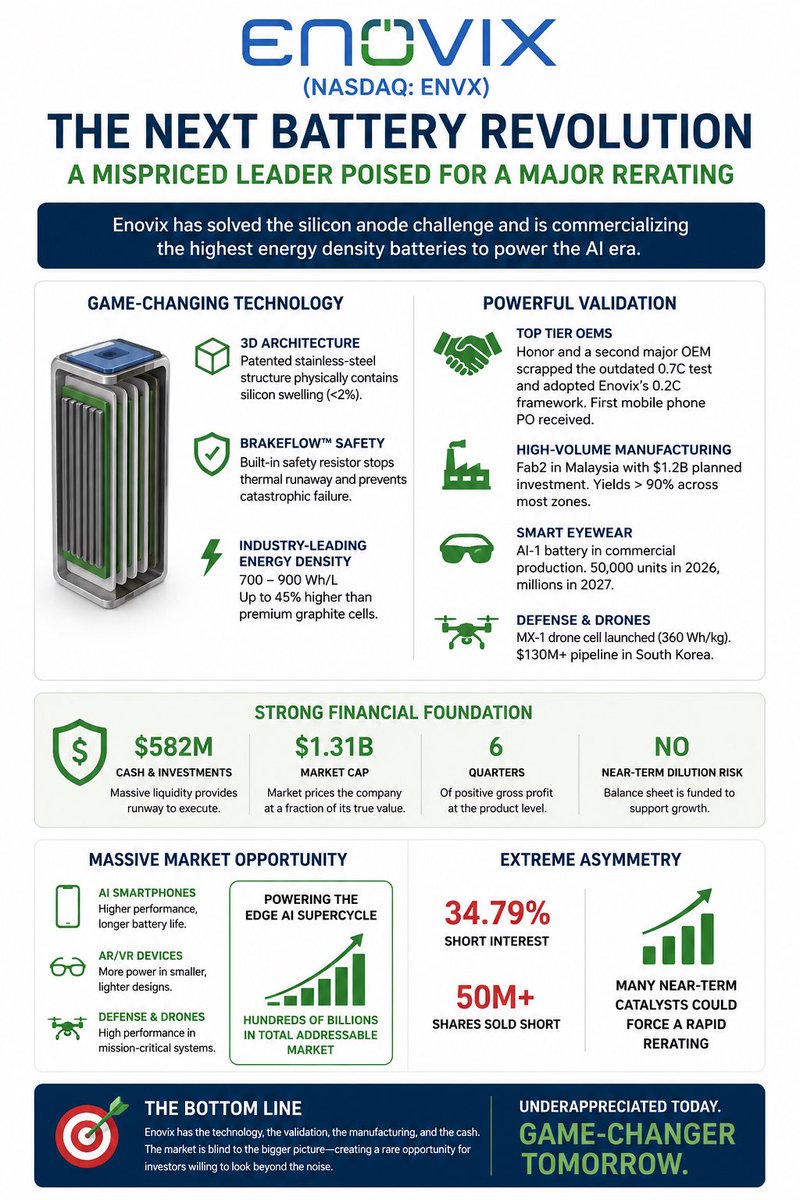
The company is $ENVX.
Enovix isn’t trying to build another lithium-ion battery. It’s attempting to solve one of the biggest physical constraints facing edge AI: how do you fit significantly more energy into the same device without making it thicker, heavier, or unsafe? If the company succeeds, it won’t just participate in the mobile AI cycle—it could become one of the critical enabling technologies behind it.
The Silicon Bottleneck:
The next generation of AI smartphones and smart glasses will consume far more power than today’s devices. Running LLMs locally, powering always-on AI assistants, and supporting increasingly complex on-device inference all require dramatically higher energy density, yet consumers still expect devices to become thinner rather than thicker.
Traditional graphite anodes are approaching their practical limits.
Enovix replaces graphite with a high-silicon anode built around its proprietary 3D cell architecture and BrakeFlow safety system, allowing substantially higher energy density while addressing the expansion problems that have historically prevented silicon from being commercialised at scale.
The moat isn’t simply the silicon chemistry. Numerous companies have experimented with silicon anodes for years. The difficult part has always been controlling silicon expansion over hundreds of charge cycles while manufacturing the cells consistently at commercial scale. That is where Enovix believes its 3D constraint architecture, patent portfolio, and manufacturing process create the real competitive advantage.
If mobile AI requires batteries that are 20-45% more energy-dense while remaining thin enough to accommodate increasingly powerful AI chips and cooling systems, then the bottleneck shifts away from battery assembly and toward the enabling cell architecture itself. That’s the layer Enovix is trying to own.
The 0.7C Story:
The market largely interpreted the removal of the 0.7C qualification test as a delay.
I think it represented something much more important.
Honor and a second Tier-1 OEM abandoned the 0.7C requirement and moved Enovix into the standard 0.2C qualification framework used for commercial smartphone batteries. That wasn’t simply a procedural change—it removed what had become the largest qualification barrier preventing Enovix from entering the smartphone market.
Major OEMs do not rewrite qualification pathways for technologies they believe have no future. If anything, it suggests the discussion has shifted from proving whether the battery works to validating it for volume production.
That distinction is easy to miss, but it fundamentally changes where Enovix sits in the commercialisation process.
From Technology To Manufacturing:
For years, investors questioned whether Enovix could manufacture these batteries economically at scale.
That question is becoming increasingly difficult to argue.
Fab2 in Malaysia has already been built, yields have exceeded 90% across most production zones, commercial production for AI smart eyewear has begun, and the company has already shipped EX-2M samples into the smartphone ecosystem. The debate is becoming less about whether the technology works and more about how quickly production ramps.
Conclusion:
What makes Enovix interesting is not simply that it has developed a better battery.
The larger thesis is that edge AI may require a step-change in battery technology just as much as it requires better processors. AI models will continue becoming more capable, but unless battery technology improves alongside them, much of that capability cannot be delivered inside thin, consumer devices.
If that proves true, companies enabling the next generation of battery architecture become infrastructure providers for the mobile AI ecosystem rather than just component suppliers.
Enovix is attempting to build exactly that position.
NFA. Do your own DD
In terms of personal notes:
1. Priortech owns 21% of $CAMT, ~1.35x their MC, seems more like holding co.
2. Bit Digital people kept shouting, but NAV discount is not clean $WYFI, lot of dilution + not AI parent.
3. Wistron (3231) is the best one I've seen since $SIVE + Ayar + Wiwynn are one of my favorite trio.
~$16.2B MC, Q1 revenue up a ridiculous amount with 144% Y/Y growth.
Owns 35.46% of Wiwynn, which is ~0.66x of MC. I'd expect Wiwynn to keep on growing.
4. Sin-American Silicon 5483 does own 46.64% of GlobalWafers (6488).
MC is $3.5B, stake value is ~$7.9B, but not exactly growing too fast independently, though it's heavily trading heavily discount to NAV.
5. Iljin Holdings owns 42.99% of Iljin Electric, it's ~$0.22B MC vs. ~$1.13B NAV holding. This was transformer/cable DC related.
But again idk if I trust korean stocks for NAV unlock, probably better for activist investors.
6. Simmtech Holdings was ~$0.17B MC vs. ~$1.0B of parent, which also looks ridiculous.
So 6x+ NAV. PCB substrate related name. Also another prob don't trust korean governance type name.
I think both $ACMR and WUS have H-Share subsidiary listing soon, and those were the biggest NAV discounts with independent growth.
Then you have a highly successful activist going after WUS so I'd expect some middle ground there.
So maybe I'll put more concentration into those on top of what I already own Monday, we'll see. And Wistron was growing very fast independently.
I'm still doing research, normally this goes in shower thoughts since I haven't formally made a conclusion, but thought others might be interested.
TSMC Teams Up with Ibiden and Innolux to Push CoPoS — Reportedly Flooring the Accelerator in Glass Substrates
To meet robust AI chip demand, TSMC is not only ramping CoWoS advanced packaging capacity but has, for the first time, disclosed progress on its "glass substrate" technology. The company further signaled that the next-generation advanced packaging battle is gradually shifting from CoWoS to CoPoS (Chip-on-Panel-on-Substrate), as it moves to build out a complete ecosystem ahead of the curve.
According to equipment-side sources, TSMC recently shared a "Glass Substrate Development for CoWoS" program with its supply chain. It has confirmed a partnership with ABF substrate giant Ibiden and panel maker Innolux to jointly validate the feasibility of introducing glass substrates into next-generation CoWoS advanced packaging. The aim is to address the warpage, thermal management, signal transmission, and power delivery challenges that loom over future large-die AI chip packaging.
At the same time, the move reflects rapidly intensifying customer demands around technical specifications and capacity, as well as mounting competitive pressure from Intel and Samsung Electronics. That pressure has finally pushed TSMC—long known for advancing R&D on a "cautious, not aggressive" basis—to step on the accelerator.
Glass substrates are viewed as a key technology for the "post-CoWoS era" thanks to their low warpage, low thermal expansion, high rigidity, and excellent signal and power-delivery characteristics. Supply chain sources say the three-way collaboration among TSMC, Ibiden, and Innolux, together with simulation validation, has shown that glass substrates can improve the package-warpage indicator COP (Chip on Package) by 16%, lower the effective coefficient of thermal expansion (Effective CTE) by 19%, and raise the effective modulus (Effective Modulus) by 31%.
On power integrity, resistance fell by 27% and inductance by 42%. Overall, introducing glass substrates can deliver a marked improvement in package performance (PKG Improvement).
TSMC nonetheless stressed that continued research and validation are still needed on glass thickness (Glass Thickness) and large-size CoWoS layout (Large-size CoWoS Layout). While full-scale mass production remains some distance away, this marks the first time TSMC has publicly disclosed joint glass-substrate validation results with Ibiden and Innolux—signaling that glass substrates have formally entered the industrialization-validation phase.
Industry observers added that the 16% COP improvement indicates package warpage is being effectively controlled. As AI GPU dies grow ever larger—with NVIDIA's GB200, GB300, and the now-ramping Rubin platform all expanding in package size—the importance of package flatness and warpage control has risen sharply. The performance glass substrates show in reducing warpage should help lift the yield and reliability of large packages.
In addition, the 19% reduction in SBT effective CTE shows improved matching between the glass material and the silicon die.
Today, silicon's CTE differs substantially from that of conventional organic substrates, making it prone to stress under temperature swings that can compromise package reliability. By contrast, glass has a CTE closer to that of silicon, which helps reduce thermal stress and mitigate cracking and solder-joint fatigue. The 31% gain in effective modulus means higher overall rigidity, providing better structural support. In particular, as HBM stack heights keep increasing, substrate rigidity is becoming a critical condition for supporting large packages.
The test sample TSMC used this time featured a 0.8mm glass core substrate, a package spec of 5x reticle CoW, and an overall package size of 85×110mm—an AI GPU package-class footprint. TSMC specifically emphasized "No SeWaRe (severe warpage) & Delamination," meaning no severe warpage or delamination/peeling—both yield killers—occurred during testing.
For glass substrates, material bonding reliability has always been a key challenge, so maintaining a stable structure at large package sizes demonstrates considerable progress in technical maturity.
Another focus of the program was the comparison between Glass-SBT and Organic-SBT. TSMC noted that Glass-SBT achieves "thin but better COP," whereas Organic-SBT shows "thick but worse COP"—glass substrates can stay thinner while simultaneously improving package flatness and reliability.
The partner roster also hints at the direction of the future supply chain.
Ibiden currently sits in the critical substrate supply chain for NVIDIA and AMD AI chips and is regarded as a key player in industrializing glass substrates. It previously announced a ¥500 billion investment to expand its new Ono plant in Gifu Prefecture, dedicated to high-end packaging substrates for AI servers—underscoring its strong ambitions in the AI advanced-packaging market. Innolux's inclusion on the partner list is likewise seen as an important step toward staking out the next-generation glass-substrate battlefield.
Industry sources say the biggest challenge for glass substrates is not the glass itself but Through Glass Via (TGV) technology. Because glass is fundamentally an insulator, tens of thousands of TGVs must be formed to create vertical conductive paths before signal and power transmission becomes possible.
Glass is also both hard and brittle, making it prone to micro-cracks during processing that can affect reliability and yield. As a result, via forming, copper-fill quality, and long-term thermal reliability are considered the three core hurdles to mass-producing glass substrates.
Separately, Intel began investing in glass-substrate R&D more than a decade ago and is regarded as the earliest and deepest player globally. Its glass-substrate pilot line in Arizona is gradually moving toward commercialization, and Intel is aiming to win AI GPU and ASIC customer orders through glass substrates and ultra-large chiplet packaging.
Samsung Electro-Mechanics (Semco) established a glass-substrate pilot line in 2025 and has set up a joint venture with Japan's Sumitomo Chemical group to build out a glass-substrate supply chain ahead of the market.
$TSM
Is SMIC N+3’s Metal Pitch Smaller than Intel 18A’s?
SMIC N+3 Node Deep Dive vs TSMC N6, TechInsights Private Equity Sale,
SemiAnalysis Teardown Engineering & Evaluation Lab, HiSilicon Kirin 9030, Process Technology,
Pattering, Cell Architecture
https://t.co/Pytg7SCipN
《GF Overseas Electronics & Communications》
☄️ CCL: PTFE material adopted for orthogonal backplanes
👉 Nvidia has confirmed the adoption of PTFE as the core material for Rubin Ultra orthogonal backplanes. Below is our related analysis.
☀️ Orthogonal backplanes officially adopt PTFE material
According to our industry-chain checks, the previous M9 + Q-glass cloth solution failed to meet the required electrical performance standards. As a result, PTFE was ultimately selected as the core material for orthogonal backplanes.
PTFE offers excellent high-frequency transmission characteristics, with lower signal loss, and can support 337G and above SerDes signal transmission on the Rubin Ultra platform.
Traditional PTFE materials are relatively soft, making them prone to burr formation during drilling, which creates challenges for mass production. However, the newly developed silicon dioxide, SiO₂, filler-modified PTFE has significantly improved mechanical rigidity. This material has now successfully passed electrical performance testing and mass-production feasibility validation.
☀️ PTFE to gradually replace traditional glass-fiber materials
PTFE CCL no longer uses glass-fiber cloth. The production process involves coating hydrocarbon resin onto the PTFE surface, then directly laminating it with copper foil.
According to our checks, the unit price of the modified PTFE material is around RMB 150,000 per ton, and each CCL sheet uses approximately 800g of PTFE. The selling price of a finished PTFE CCL sheet can reach RMB 2,500.
At present, the final design of the orthogonal backplane has not yet been determined. Candidate designs include mixed-stack combinations of 78-layer and 108-layer structures using PTFE CCL / M9-Q cloth / ABF-filled CCL. The final design is expected to be confirmed in July.
☀️ Summary of PTFE industry-chain beneficiaries
We expect Shengyi Technology, https://t.co/MyWBLDCSCJ, to become the primary supplier of PTFE CCL. Taiflex, https://t.co/J88n54Nui2, is currently in the product qualification stage and has a high chance of becoming a secondary supplier.
On the upstream raw-material side, Dongyue Group, https://t.co/GCCsVNbOdg, is currently Shengyi Technology’s key PTFE raw-material supplier. Daikin, https://t.co/ZAZYazoMw4, and Haohua Chemical, https://t.co/O0itg20aMk, are potential raw-material suppliers.
Based on the initial order scale, the PTFE CCL TAM corresponding to the 2027 Kyber platform could reach RMB 8 billion. Subsequent volume ramp from the Feynman platform is expected to drive additional demand.
Due to the complexity of the manufacturing process, mass production of midplane-related products is expected to begin from the end of 2026.
The new process is also positive for PCB manufacturers. In current HLC PCB products, the ratio of total PCB value to CCL material value is around 2–2.5x. Under the new design, this ratio could rise to 3–3.5x, significantly increasing the product value for PCB manufacturers.