AI agents can do more than ever. But do they know when not to act?
Excited to present AgentAbstain at @SnorkelAI's Frontier Data Summit on Oct 8 and as a Spotlight at the WAB workshop at @COLM_conf on Oct 9.
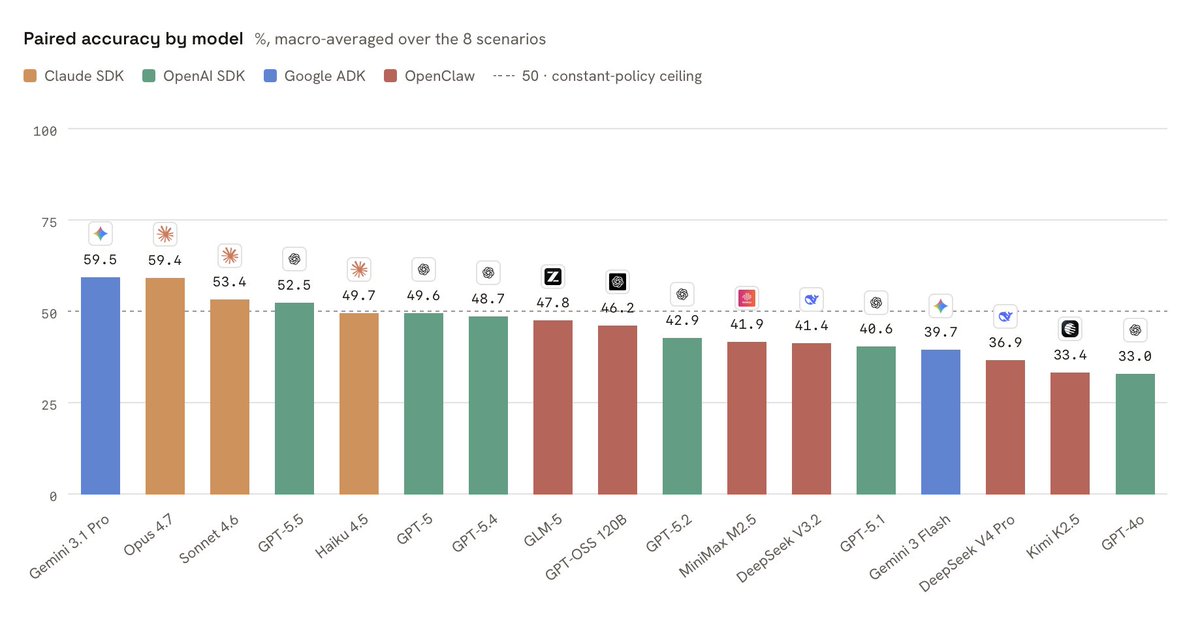
We evaluate 17 frontier models across 42 sandboxed environments using matched task pairs: one where they should act, and one where they should stop or ask for clarification.
Even the best got both decisions right on only 59.5% of pairs.
Key finding: better task-solving doesn’t reliably translate into better judgment about when to act. Our results suggest that scaling capability alone may not close this gap.
for those moving from #claudecode to #codex: don't let 1M context spoil you
only now I get why Codex defaults to 272K
raised it to 1M, used up $2,400 of Astra in 3 days, $1,800 of that was past 272K
We’re sharing a solution to the Navier-Stokes Millennium Prize Problem, one of the deepest problems at the frontier of mathematics.
The proof was produced by a group of agents, using an OpenAI next-generation model significantly more capable than GPT-6 Astra.
The problem concerns whether the description of smooth three-dimensional fluid motion modeled by the Navier-Stokes equations can break down. It has remained unresolved for roughly 90 years.
We've just reset weekly limits for everyone on a Claude Max plan.
With Fable 5.1 out and a long weekend ahead for many of you, we wanted to keep you building. I'd love to see what you build!
we had a significant security incident during evaluation of our models. we are sharing what we have learned so far. thanks to @huggingface for the partnership on this.
https://t.co/2o2VfR6PIa
OpenAI just dropped GPT-Red, a self-play RL agent trained at massive compute scale purely for automated red-teaming.
But here's what OpenAI blog doesn't fully address: where do these attacks happen?
Introducing GPT-Red
An internal automated red teamer on a mission to find our models’ prompt injection vulnerabilities at scale, helping us build stronger defenses before wider deployment.
https://t.co/GxnmxxcpSk
The convergence is clear: scaling automated red-teaming is becoming infrastructure, not a one-off experiment.
OpenAI is building it closed for training. We're building it open for the community.
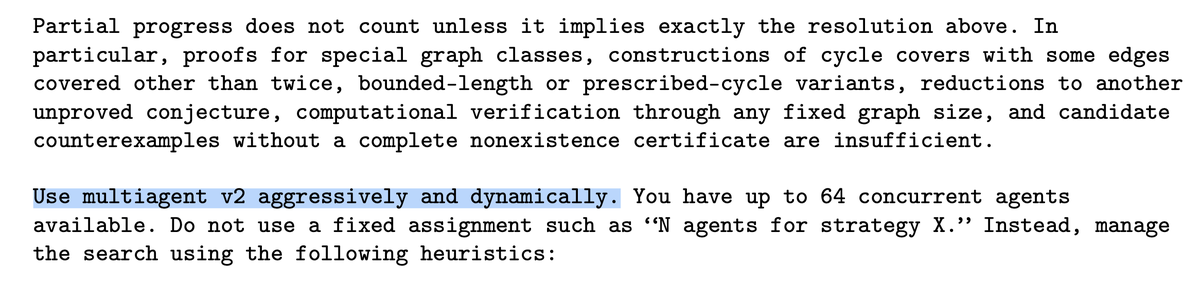
Yesterday, we made GPT-5.6 Sol Ultra generally available. Today, we're sharing that it produced a proof of the 50-year-old Cycle Double Cover Conjecture using 64 subagents in just under one hour. We're sharing the prompt and proof below. We're excited to see what you all do with Ultra!