Judging by my tl there is a growing gap in understanding of AI capability.
The first issue I think is around recency and tier of use. I think a lot of people tried the free tier of ChatGPT somewhere last year and allowed it to inform their views on AI a little too much. This is a group of reactions laughing at various quirks of the models, hallucinations, etc. Yes I also saw the viral videos of OpenAI's Advanced Voice mode fumbling simple queries like "should I drive or walk to the carwash". The thing is that these free and old/deprecated models don't reflect the capability in the latest round of state of the art agentic models of this year, especially OpenAI Codex and Claude Code.
But that brings me to the second issue. Even if people paid $200/month to use the state of the art models, a lot of the capabilities are relatively "peaky" in highly technical areas. Typical queries around search, writing, advice, etc. are *not* the domain that has made the most noticeable and dramatic strides in capability. Partly, this is due to the technical details of reinforcement learning and its use of verifiable rewards. But partly, it's also because these use cases are not sufficiently prioritized by the companies in their hillclimbing because they don't lead to as much $$$ value. The goldmines are elsewhere, and the focus comes along.
So that brings me to the second group of people, who *both* 1) pay for and use the state of the art frontier agentic models (OpenAI Codex / Claude Code) and 2) do so professionally in technical domains like programming, math and research. This group of people is subject to the highest amount of "AI Psychosis" because the recent improvements in these domains as of this year have been nothing short of staggering. When you hand a computer terminal to one of these models, you can now watch them melt programming problems that you'd normally expect to take days/weeks of work. It's this second group of people that assigns a much greater gravity to the capabilities, their slope, and various cyber-related repercussions.
TLDR the people in these two groups are speaking past each other. It really is simultaneously the case that OpenAI's free and I think slightly orphaned (?) "Advanced Voice Mode" will fumble the dumbest questions in your Instagram's reels and *at the same time*, OpenAI's highest-tier and paid Codex model will go off for 1 hour to coherently restructure an entire code base, or find and exploit vulnerabilities in computer systems. This part really works and has made dramatic strides because 2 properties: 1) these domains offer explicit reward functions that are verifiable meaning they are easily amenable to reinforcement learning training (e.g. unit tests passed yes or no, in contrast to writing, which is much harder to explicitly judge), but also 2) they are a lot more valuable in b2b settings, meaning that the biggest fraction of the team is focused on improving them. So here we are.
Having a broad range of knowledge across different fields will get you farther than hyperfocused knowledge on one subject (like LLMs). Innovation often comes from cross-discipline insights.
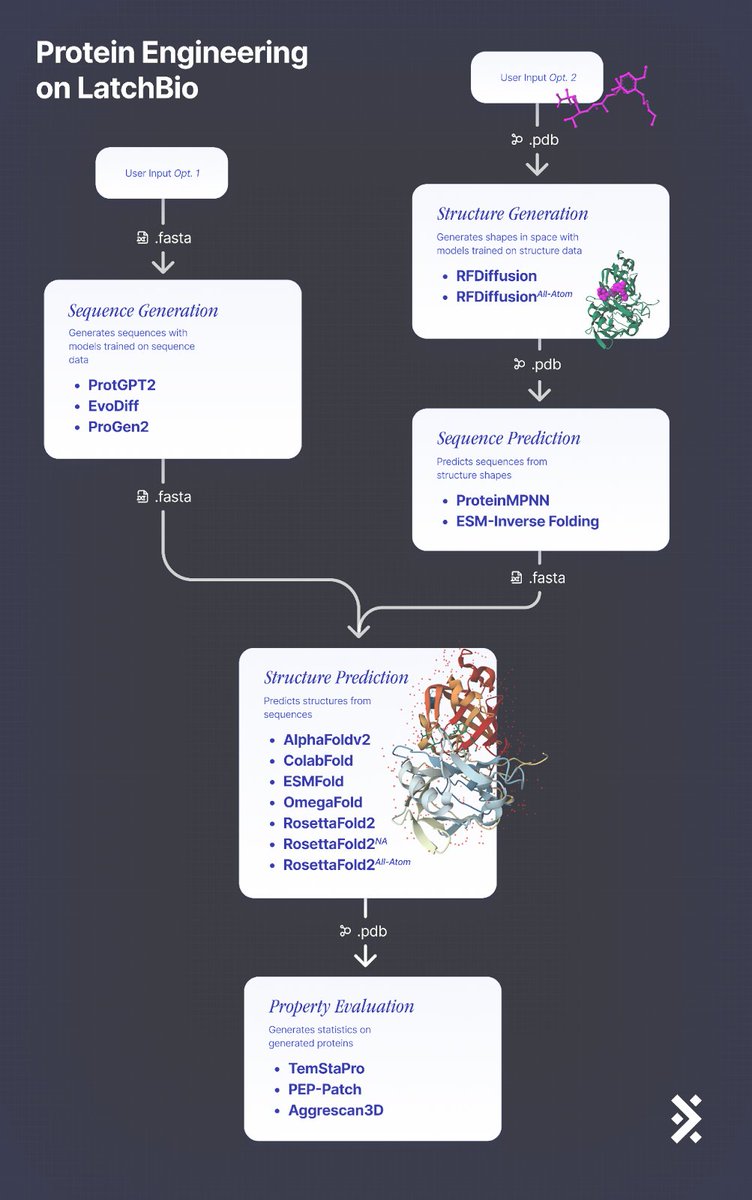
Does every lab need to develop their own wrapper over RFDiffusion, proteinMPNN and AF2? What happens when you want to add Boltz2 in the mix and replace proteinMPNN with ligandMPNN?
We are starting a mailing list to discuss protein design workflows!
1/13 🧵 Today, Bindcraft was published in @Nature , one of the most famous AIs in biology for designing protein–protein interactions (PPI). In my opinion. Bindcraft represents one of the most important advances in the post–AlphaFold2 era.
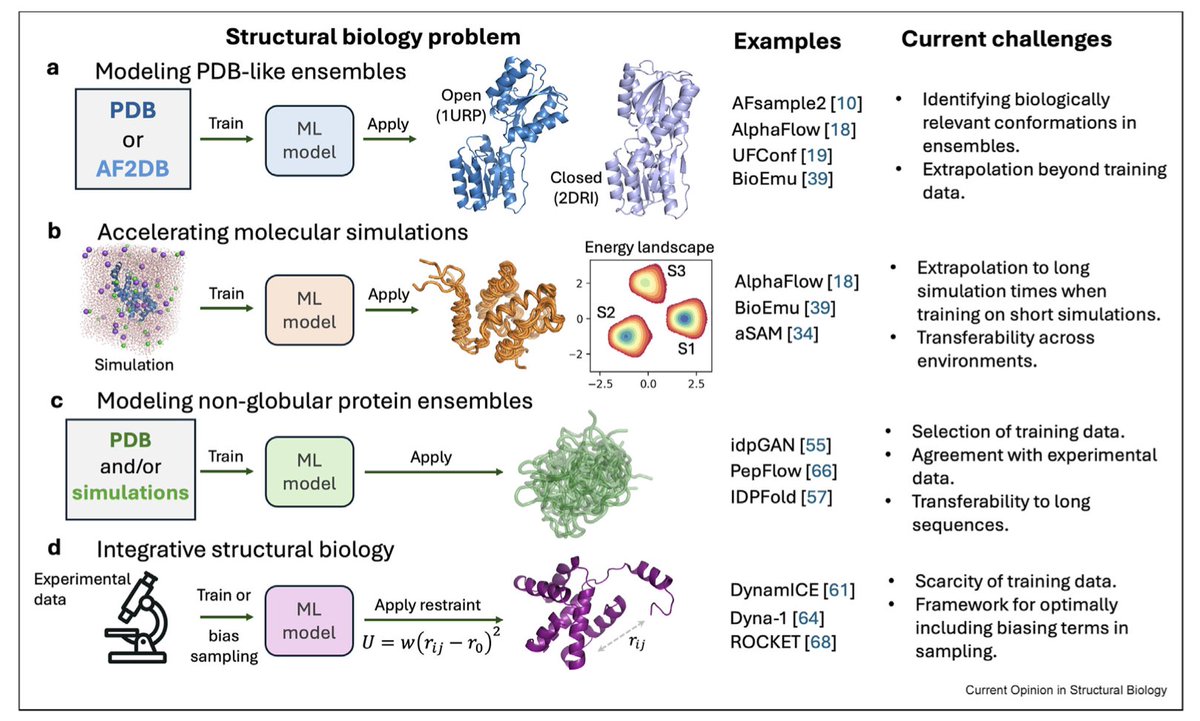
Generation of protein dynamics by machine learning
1. Machine learning, particularly generative models, is revolutionizing the prediction of protein dynamics by enabling the generation of structural ensembles beyond traditional simulations. This review highlights emerging approaches that capture protein dynamics in various forms, including PDB-like ensembles and acceleration of molecular simulations.
2. One significant innovation is the development of deep generative models (GMs) based on AlphaFold2, such as AlphaFlow and UFConf, which can generate multiple conformations from a single protein sequence. These models outperform traditional sampling methods in capturing PDB-like conformations.
3. The review emphasizes the importance of hybrid models that integrate experimental and simulation data. BioEmu, a diffusion model, demonstrates unprecedented performance in modeling both PDB and MD ensembles by leveraging a hybrid training strategy. This approach captures large and biologically significant conformational changes.
4. For non-globular proteins, especially intrinsically disordered regions (IDRs), ML methods are crucial for generating ensembles. Models like IDPFold and BioEmu show promise in capturing experimental observables of IDRs, such as chemical shifts and radius-of-gyration, using a combination of PDB structures and simulations.
5. The integration of experimental data directly into the generative process is another key advancement. Methods like DynamICE and DEERFold incorporate NMR and other experimental data during training, enhancing the accuracy of generated ensembles. This approach is essential for guiding ML models towards biologically relevant conformations.
6. Despite these advancements, challenges remain, including the transferability of models beyond training data and the generation of states with correct relative probabilities. The scarcity of long MD simulation datasets and the need for larger, more diverse training sets are also highlighted as critical areas for future work.
📜Paper: https://t.co/RlcASWEmx6
#MachineLearning #ProteinDynamics #StructuralBiology #GenerativeModels #Bioinformatics
Gave an intro to Docker + @huggingface Spaces + @Gradio at European Rosettacon 2024 for protein people. Maybe my slides are also interesting to the wider community: https://t.co/KjVueAaiZf
Many new machine learning tools for protein engineering have popped up in the last year.
In these early days, it might be unclear how to actually use them for real molecular design tasks in industry.
We demonstrate how to engineer a cholesterol drug and plastic degrading enzymes in detail. 1\N