Vision-Language Models Do Not Understand Negation
CLIP-based models exhibit a strong affirmation bias, finetuning with synthetic negation data can help address the challenge.
🎥 Today we’re premiering Meta Movie Gen: the most advanced media foundation models to-date.
Developed by AI research teams at Meta, Movie Gen delivers state-of-the-art results across a range of capabilities. We’re excited for the potential of this line of research to usher in entirely new possibilities for casual creators and creative professionals alike.
More details and examples of what Movie Gen can do ➡️ https://t.co/M19x2ndwnr
🛠️ Movie Gen models and capabilities
Movie Gen Video: 30B parameter transformer model that can generate high-quality and high-definition images and videos from a single text prompt.
Movie Gen Audio: A 13B parameter transformer model that can take a video input along with optional text prompts for controllability to generate high-fidelity audio synced to the video. It can generate ambient sound, instrumental background music and foley sound — delivering state-of-the-art results in audio quality, video-to-audio alignment and text-to-audio alignment.
Precise video editing: Using a generated or existing video and accompanying text instructions as an input it can perform localized edits such as adding, removing or replacing elements — or global changes like background or style changes.
Personalized videos: Using an image of a person and a text prompt, the model can generate a video with state-of-the-art results on character preservation and natural movement in video.
We’re continuing to work closely with creative professionals from across the field to integrate their feedback as we work towards a potential release. We look forward to sharing more on this work and the creative possibilities it will enable in the future.
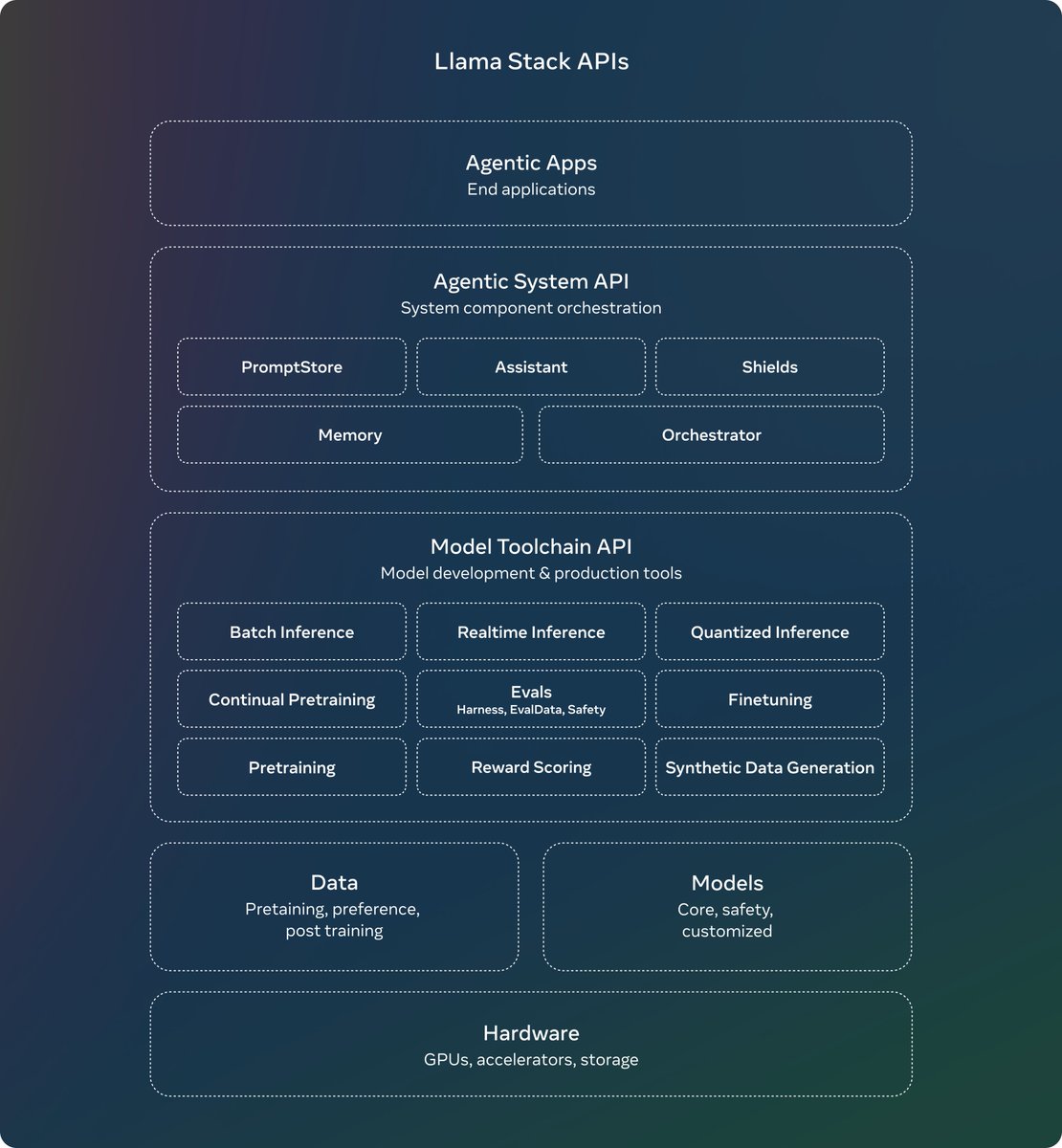
We’re excited to share the first official distribution of Llama Stack! It packages multiple API Providers into a single endpoint for developers to enable a simple, consistent experience to work with Llama models across a range of deployments.
Details ➡️ https://t.co/vlsLh6w1hY
📣 Introducing Llama 3.2: Lightweight models for edge devices, vision models and more!
What’s new?
• Llama 3.2 1B & 3B models deliver state-of-the-art capabilities for their class for several on-device use cases — with support for @Arm, @MediaTek & @Qualcomm on day one.
• Llama 3.2 11B & 90B vision models deliver performance competitive with leading closed models — and can be used as drop-in replacements for Llama 3.1 8B & 70B.
• New Llama Guard models to support multimodal use cases and edge deployments.
• The first official distro of Llama Stack simplifies and supercharges the way developers & enterprises can build around Llama to support agentic applications and more.
Details in the full announcement ➡️ https://t.co/1bnEeLY9qf
Download Llama 3.2 models ➡️ https://t.co/DZoTQvESbG
These models are available to download now directly from Meta and @HuggingFace — and will be available across offerings from 25+ partners that are rolling out starting today, including @accenture, @awscloud, @AMD, @azure, @Databricks, @Dell, @Deloitte, @FireworksAI_HQ, @GoogleCloud, @GroqInc, @IBMwatsonx, @Infosys, @Intel, @kaggle, @NVIDIA, @OracleCloud, @PwC, @scale_AI, @snowflakeDB, @togethercompute and more.
With Llama 3.2 we’re making it possible to run Llama in even more places, with even more flexible capabilities. We’ve said it before and we’ll say it again: open source AI is how we ensure that these innovations reflect the global community they’re built for and benefit everyone. We’re continuing our drive to make open source the standard with Llama 3.2.
Excited to share our latest work: Distortion Recovery: A Two-Stage Method for Guitar Effect Removal, published at #DAFx 2024! 🎸 This work is in collaboration with @PositiveGrid.
🔗 Demo page: https://t.co/8D1z0TyE8U
📄 Paper: https://t.co/EBy9ObSSZD
Accepted to oral #ICLR2024!
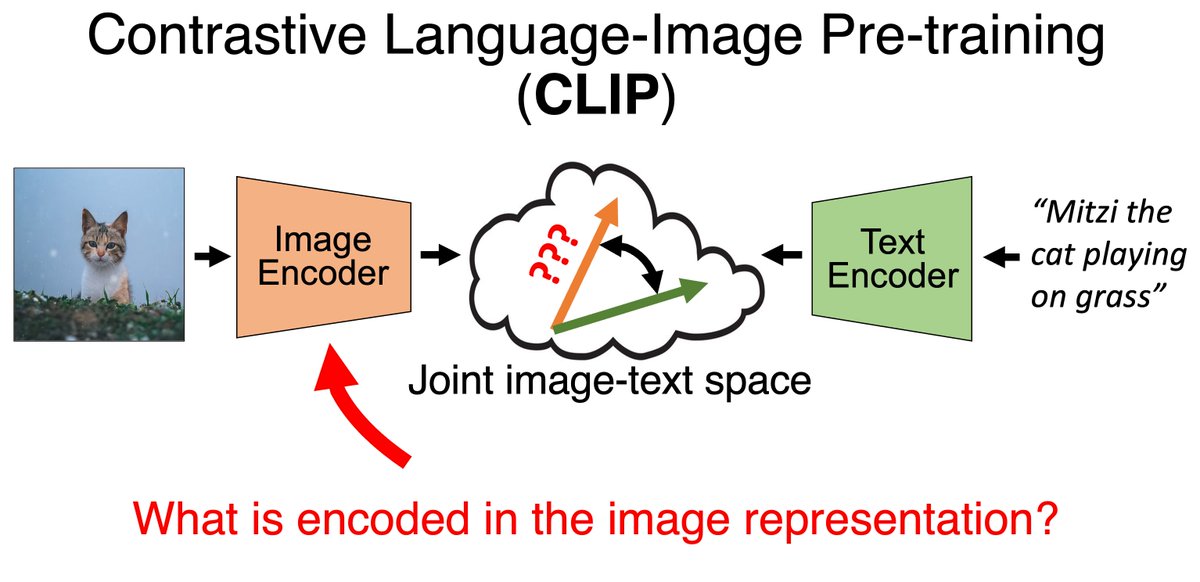
*Interpreting CLIP's Image Representation via Text-Based Decomposition*
CLIP produces image representations that are useful for various downstream tasks. But what information is actually encoded in these representations?
[1/8]
Today we’re releasing Code Llama, a large language model built on top of Llama 2, fine-tuned for coding & state-of-the-art for publicly available coding tools.
Keeping with our open approach, Code Llama is publicly-available now for both research & commercial use.
More ⬇️
Today we're sharing details on AudioCraft, a new family of generative AI models built for generating high-quality, realistic audio & music from text. AudioCraft is a single code base that works for music, sound, compression & generation — all in the same place.
More details ⬇️
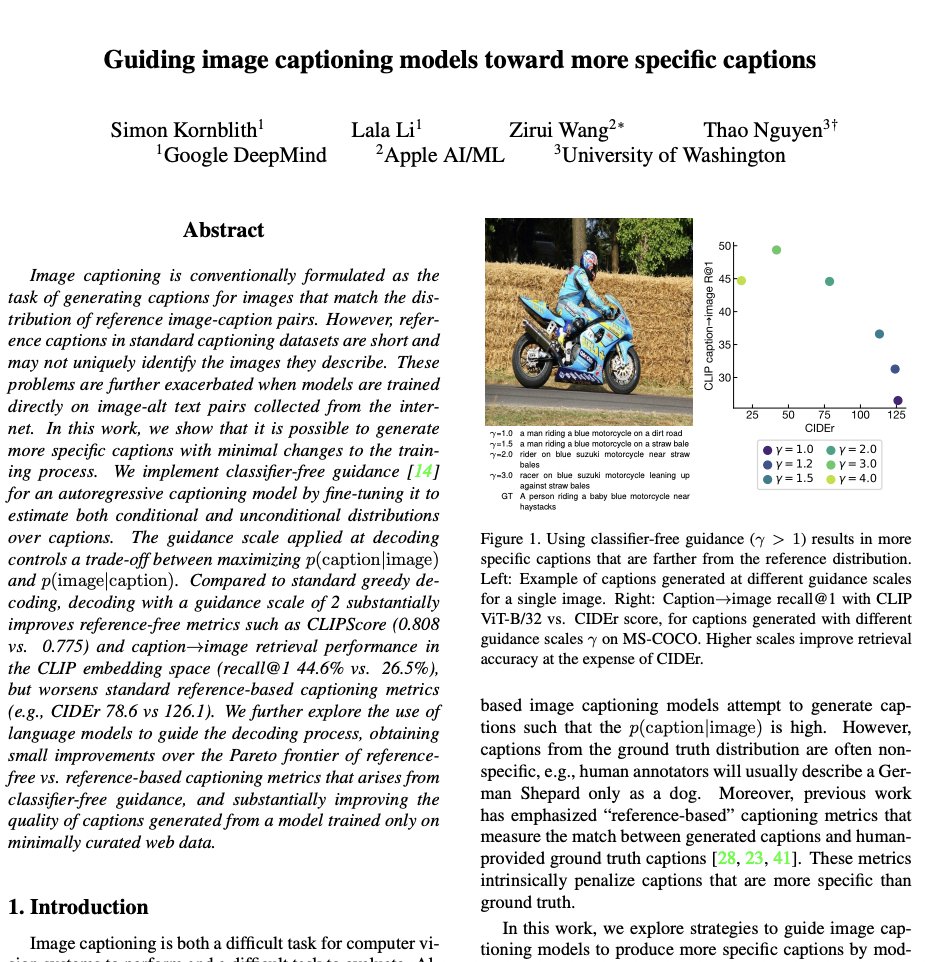
Guiding Image Captioning Models Toward More Specific Captions
paper page: https://t.co/ZcwzoSAV6x
Image captioning is conventionally formulated as the task of generating captions for images that match the distribution of reference image-caption pairs. However, reference captions in standard captioning datasets are short and may not uniquely identify the images they describe. These problems are further exacerbated when models are trained directly on image-alt text pairs collected from the internet. In this work, we show that it is possible to generate more specific captions with minimal changes to the training process. We implement classifier-free guidance for an autoregressive captioning model by fine-tuning it to estimate both conditional and unconditional distributions over captions. The guidance scale applied at decoding controls a trade-off between maximizing p(caption|image) and p(image|caption). Compared to standard greedy decoding, decoding with a guidance scale of 2 substantially improves reference-free metrics such as CLIPScore (0.808 vs. 0.775) and captiontoimage retrieval performance in the CLIP embedding space (recall@1 44.6% vs. 26.5%), but worsens standard reference-based captioning metrics (e.g., CIDEr 78.6 vs 126.1). We further explore the use of language models to guide the decoding process, obtaining small improvements over the Pareto frontier of reference-free vs. reference-based captioning metrics that arises from classifier-free guidance, and substantially improving the quality of captions generated from a model trained only on minimally curated web data.