Nesses tempos de ChatGPT, importante lembrar as dicas de Italo Calvino para o novo século:
1. Aprenda poemas de cor;
2. Faça contas a mão;
3. Combata a abstração da linguagem;
4. Saiba que tudo que você tem pode lhe ser tirado de uma hora para outra.
I said this about AI well over a year ago. Using it to diagnose and fire people with medical conditions so they lose their insurance AND their income is somehow even more heartless and evil than I’d predicted.
reading densely for an hour a day completely rearranges your nervous system. the urge to scroll and other high-dopamine activities fades away. your thinking becomes calmer and deeper. i experienced this today after a long time: i was deeply immersed in the writer’s thoughts; the whys, hows, and whats going through their mind. your frequency shifts to a meta, high-order cognition that lets you observe both your own thinking and the writer’s.
Claude: “Boredom is where unprompted thinking happens, and a population that never experiences it stops generating its own ideas and starts consuming pre-packaged ones”
Strong suggestion:
Do watch Nadal's documentary on Netflix. Suffering is necessary in order to achieve big things in life. Nothing comes easily.
Human brain is wired to seek comfort, but the real development happens in solitude and ability to put in the reps again & again.
Follow the DCP framework to achieve your goals
Discipline
Consistency
Patience
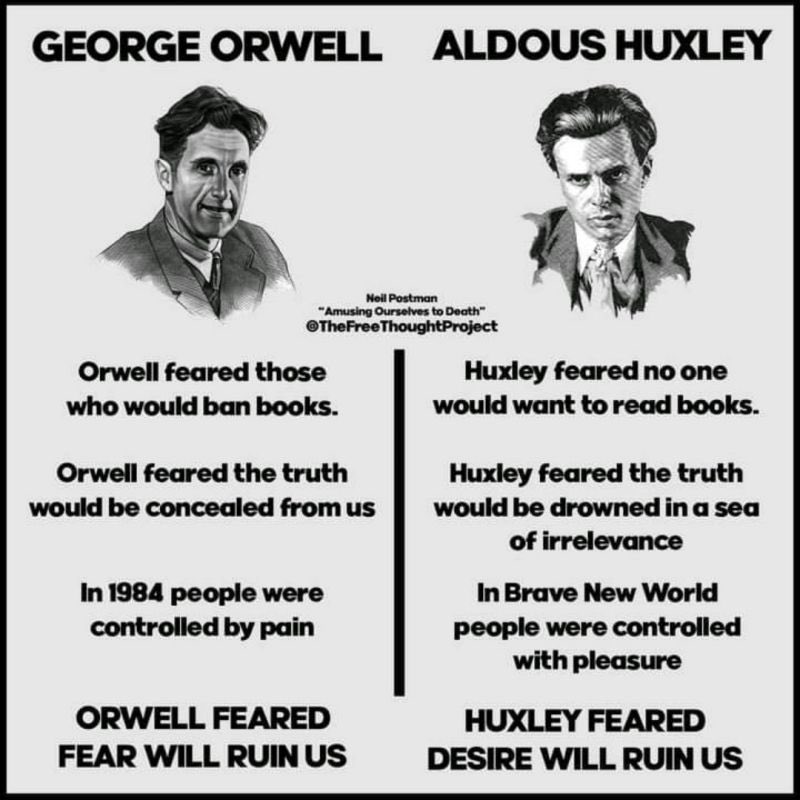
One of my longest-standing arguments is that we are not living in Orwell’s 1984, where truth is centrally suppressed and censored by force (that’s former communist societies, modern-day China, Russia, North Korea).
We are living in something much closer to Huxley’s Brave New World.
The truth is not hidden - it is almost always readily available. But it is buried beneath an industrial quantity of noise: propaganda, outrage, half-truths, conspiracy theories, influencer theatre, algorithmic rage bait and an endless stream of content designed not to inform us, but to keep us emotionally stimulated.
The modern information system does not need to censor the truth when it can simply drown it in noise.
A fact no longer has to be disproven - it only has to be surrounded by a hundred competing claims, stripped of context and nuance, turned into partisan ammunition and pushed into the same feed as celebrity gossip, memes and 15 second videos engineered to deliver the fastest possible dopamine hit. By the time the truth reaches us, it appears as just another piece of content competing for our attention.
That is the more sophisticated form of control: not preventing people from knowing, but exhausting their capacity to care.
Orwell feared a world in which people would be deprived of information. Huxley feared a world in which they would be given so much distraction, stimulation and triviality that they would lose the desire to seek it.
The defining struggle of our age is therefore not simply between truth and censorship, but between truth and indifference.
Pick one real problem. Spend 4 hours a day for six months trying to solve it and document everything publicly. That is genuinely all it takes. The right people are always watching for someone who goes that deep on something that matters. You do not need a degree, a network or a perfect resume. You need proof that you can lock in and do the work. Six months of obsessive focused effort documented in public will open more doors than years of conventional job hunting ever could.
the average person spends all day negotiating with themselves: should i work out, should i eat this, should i check my phone, etc.
this is so expensive because willpower isn't a trait, it's a battery and every negotiation drains it (whether you decide yes or no). you eventually give in on something not because you're lazy, but because you've been swimming upstream all day
i liked this essay because it's about removing the options entirely, not negotiating with yourself better. discipline comes from having no choice
https://t.co/HIYzrAnst0
MathAcademy, Alpha School, Mentava, Recess, and yes I'm throwing PhysicsGraph in there are lighting the world of education on fire and I couldn't be more excited.
There is a process that I have used, and still use, to reignite life...
Create two timelines—6 months and 12 months—and list up to five things you dream of having (including, but not limited to, material wants: house, car, clothing, etc.), being (be a great cook, be fluent in Chinese, etc.), and doing (visiting Thailand, tracing your roots overseas, racing ostriches, etc.) in that order.
If you have difficulty identifying what you want in some categories, as most will, consider what you hate or fear in each and write down the opposite.
Do not limit yourself, and do not concern yourself with how these things will be accomplished. For now, it’s unimportant. This is an exercise in reversing repression.
Be sure not to judge or fool yourself. If you really want a Ferrari, don’t put down solving world hunger out of guilt. For some, the dream will be fame, for others fortune or prestige. All people have their vices and insecurities. If something will improve your feeling of self-worth, put it down.
Drawing a blank? In that case, consider these questions:
1) What would you do, day to day, if you had $100 million in the bank?
2) What would make you most excited to wake up in the morning to another day?
Don’t rush—think about it for a few minutes.
If still blocked, fill in the five “doing” spots with the following:
— one place to visit
— one thing to do before you die (a memory of a lifetime)
— one thing to do daily
— one thing to do weekly
— one thing you’ve always wanted to learn
What does “being” entail doing?
Convert each “being” into a “doing” to make it actionable. Identify an action that would characterize this state of being or a task that would mean you had achieved it. People find it easier to brainstorm “being” first, but this column is just a temporary holding spot for “doing” actions.
Here are a few examples:
1) Great cook —> make Christmas dinner without help
2) Fluent in Chinese —> have a five-minute conversation with a Chinese co-worker
Determine three steps for each of the dreams in just the 6-month timeline and take the first step now.
Define three steps for each dream that will get you closer to its actualization.
Set actions—simple, well-defined actions—for now, tomorrow (complete before 11 A.M.) and the day after (again completed before 11 A.M.). Once you have three steps for each of the four goals, complete the three actions in the “now” column.
Do it now. Each should be simple enough to do in five minutes or less. If not, rachet it down. If it’s the middle of the night and you can’t call someone, do something else now, such as send an e-mail, and set the call for first thing tomorrow.
If the next stage is some form of research, get in touch with someone who knows the answer instead of spending too much time in books or online, which can turn into paralysis by analysis.
The best first step, the one I recommend, is finding someone who’s done it and ask for advice on how to do the same.
I don't think people realize how ground-breaking what Ben said is, so I'm gonna explain it without all his fancy words.
Alpha School was revolutionary by testing different resources against one another to find the best one for their kids. Basic optimization is pretty standard for tech companies, but this was totally new for education. By doing this, they were able to identify the best curricula out there for each subject. It's why every kid uses Math Academy and why they've been able to sell 2-hour school. Go Alpha!
At Recess, we're going two steps further. First: Every single topic a kid learns has a mastery graph. Basic skills build to more complex ones, and you can only move forward once you've mastered the pre-req skills. It sounds slow, but it's the opposite: It ensures kids only ever study exactly what they need to be studying, and it's why AI-based learning has been so rapid!!
Second: Alpha identified the best curricula for a wide audience of kids, but we are now identifying the best resource for each kid and for each topic.
Picture it like this: Maya just reached order of operations in math, meaning she has now mastered basic exponents, multiplication, division, addition, and subtraction. The only thing new for her to learn now is how these operations combine and how parentheses override the expected order. Right in her zone of proximal development!
Instead of giving her the same explanation as every other kid, the algorithm surfaces a 3Blue1Brown YouTube video, an interactive Applet our AI built around her interests, a Quest where she has a debate about the concept -- she is both given the option to learn how she wants and gets better recommendations suited to her learning style over time.
Everything Maya learns from in the app is there precisely for her. And so too with every student.
I know I'm always repeating myself, but we're seriously on the cusp of something great here.