Making some progress on simplifying the '#ETH false' proof, I think. In latest version, the key algebraic construction comes from elementary analysis of Boolean functions.
https://t.co/9hlynt6lLj
AI is now taking on some of the hardest open problems that scientists have posed. But research is broader than solving problems. Can AI also propose research questions that experts find genuinely interesting?
We built After42 to find out. Experts judged 45 of its 135 final questions genuinely interesting, across mathematics, statistics, theoretical computer science, and physics, with wide variation across subfields.
The key idea: develop questions by trying to solve them.
We also asked whether AI can judge which questions are interesting. We find that model judges' top choices align with expert consensus but do not consistently capture individual experts' preferences.
We release the expert-assessed questions as an open resource for researchers to discuss, refine, and pursue, as a step toward integrating AI into the broader research enterprise.
https://t.co/iOrs6L7E9Y
1) I am learning we are extremely bad at designing algebraic/spectral algorithms. And probably significantly better in "combinatorial" algorithms. Even in the past we knew if an algorithm needs a potential function it is hard to find the right one. With AI this is more apparent.
Our letter to the community invites ideas for organizing this effort and, separately, for addressing the broader questions raised by AI-generated results:
https://t.co/AafK0vsBgn
OpenAI's announcement is here: https://t.co/rWbWjOIoNf
@GuanyangW After reading your paper on 0/1 entries, I spent most of my summer trying to simplify it and then prove the KTV conjecture 😭 At least OpenAI saved me some time 😅
Turns out that your favorite Leetcode problems 3SUM and All-Pairs Shortest Paths both have faster (worst-case) algorithms (n^1.9992 and n^2.9995 time respectively). @LeetCode time to update your database 😂
Congrats to my cool advisor @firebat03 and @pinkfloydie! Also congrats to @claudeai.
https://t.co/XkrtFNju4d
I can see the end-game in the current quest for the mathematical foundations of deep learning:
A neural network will find a (very long) proof that deep learning works. No human will be able to understand it, but the proof will be formally verified.
In a field moving this fast, forming opinions too quickly is hard and risky. Amid the flood of AI4Math/AI4TCS news, I've tried to weigh many different views, and this essay is the one I agree with most. Thanks, Prof. Omer Reingold!
https://t.co/pbvzpEy3aa blog post by theoretical computer science prof at Stanford, Omer Reingold:
“Above all, we need to reevaluate our identity. What is it that makes mathematical knowledge and research valuable? What are we offering society, and how much of it survives in a world where models match or exceed humans in some or all relevant mathematical skills? For quite some time, the implicit social contract has been that society pays us to exercise our intellectual curiosity and we, in return, provide useful skills to the next generations and practical knowledge for the world. The current crisis is driven not only by the power of LLMs, but also by how rarely we have had to examine or articulate this contract. Now that the deal needs to be renegotiated, we should approach it with humility rather than entitlement.”
The computer scientist Václav Rozhoň has been taking advantage of a connection between set theory and network science to solve problems he’s interested in. https://t.co/tcvXutA3XG
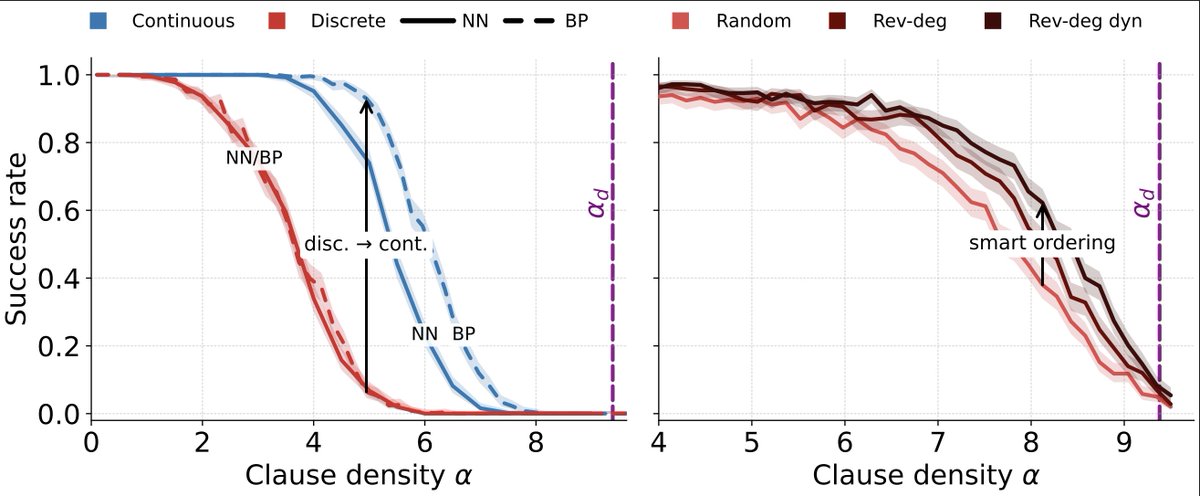
There is growing interest in generating discrete data via diffusions. If you have an approach, consider benchmarking it on generating uniform solutions of (random) k-SAT. It is a clean example in which continuous beat discrete diffusions and the diffusion process matters.
We are clearly moving to a world that will be without open problems, but this doesn't mean math is going away. Interesting work will correspond to discovering new questions and coherent theoretical frameworks. Well defined agreed-to-be-interesting problems won't last long.