Claude Fable 5 changed how we work on the Claude Code team day to day.
We used to verify that Claude did the work right. Now we verify that it's doing the right work.
Here’s the 3 biggest changes:
This is a super exciting release - Claude Fable 5 is the same underlying model as Mythos but with added safeguards. The benchmarks are great and it's SOTA on everything by a margin but I'll add that *qualitatively* also, this is a major-version-bump-deserving step change forward (imo of the same order as Claude 4.5 was in November), peaking especially for long problem-solving sessions on very difficult problems. You can give it a lot more ambitious tasks than what you're used to, the model "gets it" and it will just go, and it's never felt this tempting to stop looking at the code at all (but don't do this in prod!). The model still has quirks that people will run into and the safeguards are configured to be a little too trigger happy for launch, which can hopefully be tuned over time.
I feel a lot of things changing as working software increasingly comes out on a tap. The Jevon's paradox kicks in and I feel my own demand for software growing substantially. You can ask for anything - explainers, visualizers, dashboards, bespoke single-use apps (e.g. a full wandb that is hyper-specific just for your project), you can 10X your test suite, auto-optimize code, run giant research projects with custom HTML for the results, anything! "Free your mind" (Matrix ref). Really looking forward to all the things people build!
Imagine every pixel on your screen, streamed live directly from a model. No HTML, no layout engine, no code. Just exactly what you want to see.
@eddiejiao_obj, @drewocarr and I built a prototype to see how this could actually work, and set out to make it real. We're calling it Flipbook. (1/5)
Today I passed my Microsoft Certified: Azure Administrator Associate @Microsoft. It made me realize how much I have actually learned over the past couple of months.
Honestly, a good chunk of the questions directly came from my day-to-day work.
Next up: Security+.
#Azure#AZ104 #Microsoft
Introducing the Google Workspace CLI: https://t.co/8yWtbxiVPp - built for humans and agents.
Google Drive, Gmail, Calendar, and every Workspace API. 40+ agent skills included.
Introducing Cinematic Video Overviews, the next evolution of the NotebookLM Studio. Unlike standard templates, these are powered by a novel combination of our most advanced models to create bespoke, immersive videos from your sources.
Rolling out now for Ultra users in English!
how to build a bootstrapped startup without funding:
1. pick a problem you personally have. if you don't use your own product daily, quit now
2. skip the pitch deck. open your code editor. ship something ugly in a weekend
3. charge money from day 1. free users give you nothing but support tickets
4. use boring tech. PHP, SQLite, vanilla JS. frameworks are a trap that mass waste your time
5. host on cheap VPS ($5-20/mo). not AWS. you don't need kubernetes for 1,000 users
6. do customer support yourself. it's the fastest product feedback loop that exists
7. automate everything you do more than twice. cron jobs > employees.
8. grow on Twitter/X by building in public. your journey IS the marketing
9. keep your burn rate near zero so you never need to raise. ramen profitable > series A
10. say no to investors, cofounders, and "advisors" who want equity for intros
i've been doing this for 10+ years now. no employees, no funding, no board meetings
the entire VC game is designed to make you think you need permission to start
you don't
The @DarioAmodei interview.
0:00:00 - What exactly are we scaling?
0:12:36 - Is diffusion cope?
0:29:42 - Is continual learning necessary?
0:46:20 - If AGI is imminent, why not buy more compute?
0:58:49 - How will AI labs actually make profit?
1:31:19 - Will regulations destroy the boons of AGI?
1:47:41 - Why can’t China and America both have a country of geniuses in a datacenter?
Look up Dwarkesh Podcast on Youtube, Spotify, Apple Podcasts, etc.
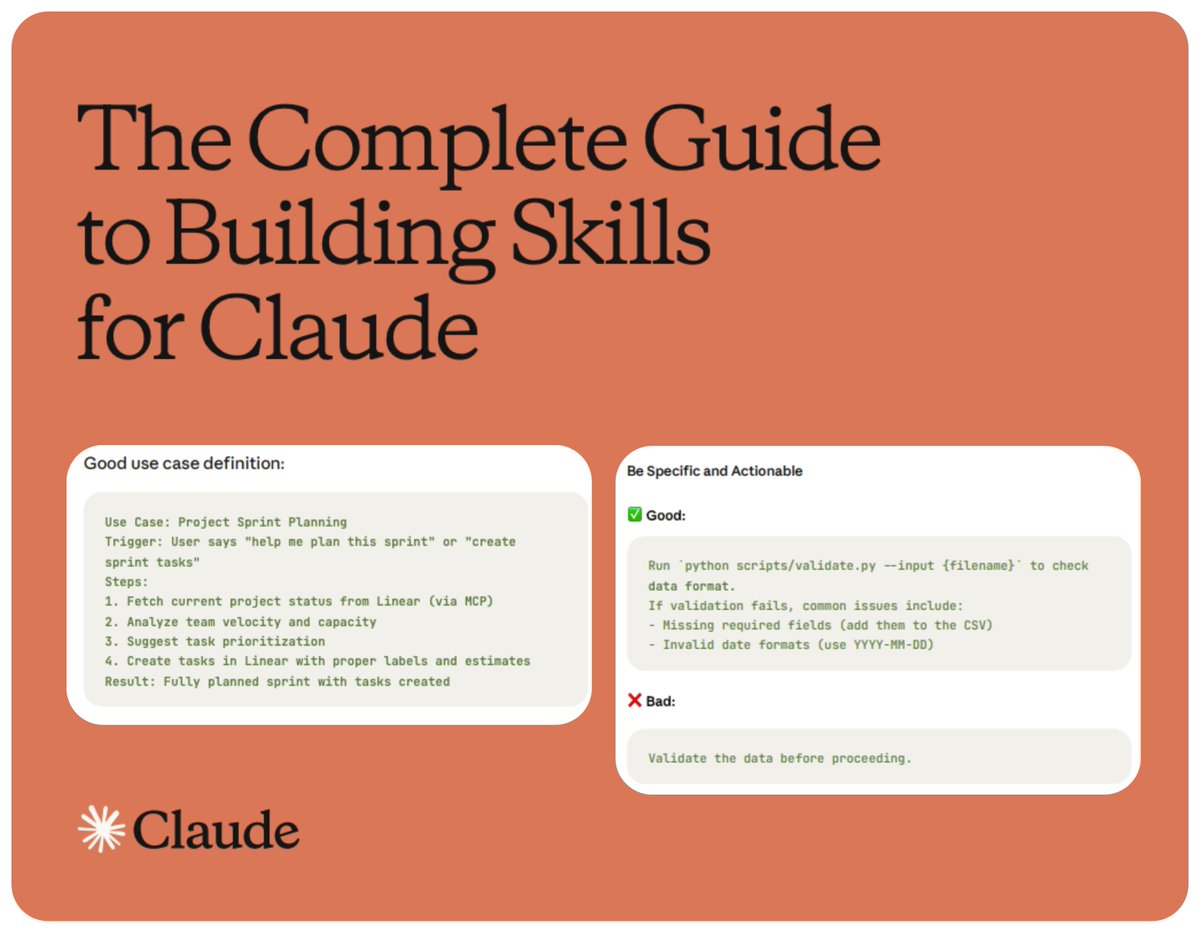
Another fantastic guide from Anthropic👇
🌟The Complete Guide to Building Claude Skills🌟
• How to structure your skill folder correctly
• What makes a skill trigger reliably (and what breaks it)
• How to write clear, effective https://t.co/oXwCYNWfC1 instructions
• How to test, iterate, and ship production-ready skills
https://t.co/zWWH2xJVkv
New podcast on AI (full episode). Links below.
A Motorcycle for the Mind
0:00 If you want to learn, do
2:13 Vibe coding is the new product management
6:49 Training models is the new coding
10:13 Is traditional software engineering dead?
13:07 There is no demand for average
14:12 The hottest new programming language is English
18:36 AI is adapting to us faster than we are adapting to it
22:56 No entrepreneur is worried about AI taking their job
26:46 The goal is not to have a job
29:49 AIs are not alive
32:55 AI fails the only true test of intelligence
36:49 Early adopters of AI have an enormous edge
39:37 AI meets you exactly where you are
43:02 Always leverage the best intelligence
44:37 If you can't define it, you can't program it
49:37 The solution to AI anxiety is action
The cost of code is coming down, so we will consume more of it.
The productivity of coders is going up, so they will become more valuable.
Coding now includes training and driving models.
Bought a new Mac mini to properly tinker with claws over the weekend. The apple store person told me they are selling like hotcakes and everyone is confused :)
I'm definitely a bit sus'd to run OpenClaw specifically - giving my private data/keys to 400K lines of vibe coded monster that is being actively attacked at scale is not very appealing at all. Already seeing reports of exposed instances, RCE vulnerabilities, supply chain poisoning, malicious or compromised skills in the registry, it feels like a complete wild west and a security nightmare. But I do love the concept and I think that just like LLM agents were a new layer on top of LLMs, Claws are now a new layer on top of LLM agents, taking the orchestration, scheduling, context, tool calls and a kind of persistence to a next level.
Looking around, and given that the high level idea is clear, there are a lot of smaller Claws starting to pop out. For example, on a quick skim NanoClaw looks really interesting in that the core engine is ~4000 lines of code (fits into both my head and that of AI agents, so it feels manageable, auditable, flexible, etc.) and runs everything in containers by default. I also love their approach to configurability - it's not done via config files it's done via skills! For example, /add-telegram instructs your AI agent how to modify the actual code to integrate Telegram. I haven't come across this yet and it slightly blew my mind earlier today as a new, AI-enabled approach to preventing config mess and if-then-else monsters. Basically - the implied new meta is to write the most maximally forkable repo and then have skills that fork it into any desired more exotic configuration. Very cool.
Anyway there are many others - e.g. nanobot, zeroclaw, ironclaw, picoclaw (lol @ prefixes). There are also cloud-hosted alternatives but tbh I don't love these because it feels much harder to tinker with. In particular, local setup allows easy connection to home automation gadgets on the local network. And I don't know, there is something aesthetically pleasing about there being a physical device 'possessed' by a little ghost of a personal digital house elf.
Not 100% sure what my setup ends up looking like just yet but Claws are an awesome, exciting new layer of the AI stack.