@sologmy09RKT The mid-task corrections are the interesting part of those traces. They show where the operator is compensating, which is useful signal for quality scoring but easy to lose if labels only mark final success. Standardization across embodiments helps a lot here.
@MeckaAI The flip-three-times failure is telling. These contact-rich sequences are where temporal consistency in labels matters most, small drifts in grasp timing or orientation compound quickly.
Good to see the numbers on real hardware.
@NVIDIARobotics@huggingface 100K open hours with head/hand tracking + language is immediately useful. The tracking cuts a lot of the usual pose estimation work on raw ego video. Curious how well the language labels hold up for finer action segmentation downstream.
@iamericpereira License check first is underrated. We’ve spent time annotating a solid ego set only to hit non-commercial walls when trying to ship.
Hours and diversity matter, but usable rights decide whether the data actually enters the training loop.
The unlabeled video result in Dyna 2 stands out. Models can pick up useful dynamics from raw ego footage even with sparse or noisy action labels.
The practical question is which frames still need dense temporal labels versus what can be inferred. How are you deciding that mix in collection?
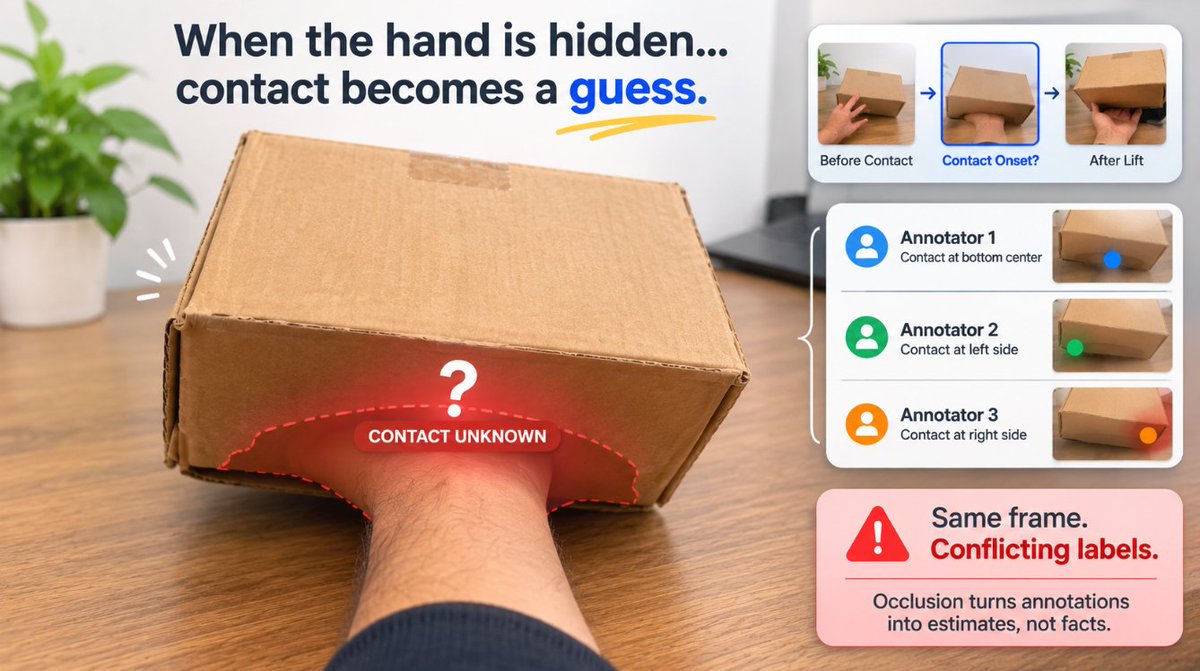
The moment the object fully covers the hand is when your contact labels stop being data and start being guesses.
You scrub the clip.
The bottle or box hides every finger.
Then the object simply starts to move.
No visible contact point, no clean frame where touch begins.
Three annotators land on three different onsets and three different spots under the object.
Those conflicting marks become the supervision the policy actually learns from.
@guilleflorvs World models help with scene variety, but generated trajectories still need action label validation. Contact dynamics and object state changes are where the sim-to-real gap shows up most clearly during labeling.
@GroundedSI@BitRobotNetwork Dense pose on every frame is a strong start. In practice the hard part is converting those poses into consistent action labels across long sequences drift and occlusion still force manual temporal fixes.
@EgoScale Adding tactile to stereo ego is useful, but the annotation lift is real.
Aligning force peaks to visual action boundaries is noisy, especially on soft objects. Most pipelines still do that temporal sync by hand.
@cattttang@substratemag The recursive loop is real, but annotation is the bottleneck inside it. Labeling clean sim trajectories is cheap. Transferring those action labels onto noisy real ego video still needs human review for temporal boundaries and contact events.
@DataScienceHarp Using the robot’s own cameras for teleop is the right constraint. Third-person demos create a view gap we then spend cycles bridging in labeling. Even at 45 Hz the action boundaries still need manual cleanup for consistent labels.
@michellelsun@OpenAI@nvidia Recording method beating raw hours tracks with annotation reality. Glove or wrist-cam data gives cleaner contact and force signals than head-ego. Aligning those to robot proprioception is still where most of the temporal cleanup time goes.
This matches what we see in ego labeling pipelines. Whole-clip rejection is crude failures are usually local (bad framing, occlusion, dropped grasp). Interval-level QC plus temporal consistency checks let us keep most of the clip for action labeling without another collection run.
Action boundaries in egocentric robot data aren't real.
Two annotators looking at the same hand closing on a mug will mark the transition from approach to grasp 8-15 frames apart.
Offline success stays high. The policy still fails at contact because those frames are the only ones that matter.
The annotator training + UX loop is the real bottleneck. We burned weeks on inter-annotator drift on hand activity boundaries before locking a tight guideline + keyboard shortcuts. Temporal consistency still slips on occlusions. What failed first in your discarded versions, schema or the tool itself?
Leader/follower force is a classic gotcha. In annotation we see the same drift: contact events and grasp-success timestamps shift by frames on position-only traces without force or slip cues. Deformable tips help but still need per-stiffness checks. How are you quantifying residual slip across object types?
@pjasethi The permissible subsegment idea is useful. We’ve seen the same issue where one team’s “grasp” is another’s “approach + contact + lift.” Did you notice any systematic bias in the free-form captions versus the closed-vocab hand actions?
@DJiafei@GroundedSI@BitRobotNetwork@NokovMocap Optical mocap at 120 Hz with ~10 mm error is excellent ground truth. The practical question is how you synchronized the ego cameras to the mocap world frame across 200+ hours without drift. Any residual misalignment left for downstream users to handle?
@LeoKharon@Kai_Robotics Dropping fingertip error to 0.66 cm is the difference between usable and noise. In our pipelines the remaining error still shows up as systematic bias on precision grasps. Did the wrist tracker also improve temporal consistency of the contact labels?
@shawnshenjx Internet-scale ego video is only useful if the action segments and contact events are clean. What fraction of the raw uploads survive your quality filters, and how are you labeling the temporal boundaries at that volume?