Today we announce our new unified multi-agent framework that provides creators with a system for generating temporally consistent, long-form video narratives while mitigating visual drift and pipeline error propagation. Learn more: https://t.co/FWbKBvca3s
Just a reminder that GLM 5.3 Flash, DeepSeek V4.1 Flash, Qwen 3.8 Next Flash, and even Qwen 3.8 27B are all outperforming (in both intelligence and capabilities) every model that was considered "frontier intelligence" in Xmas 2025 (just 10 months ago)
Opensource AI is on fire
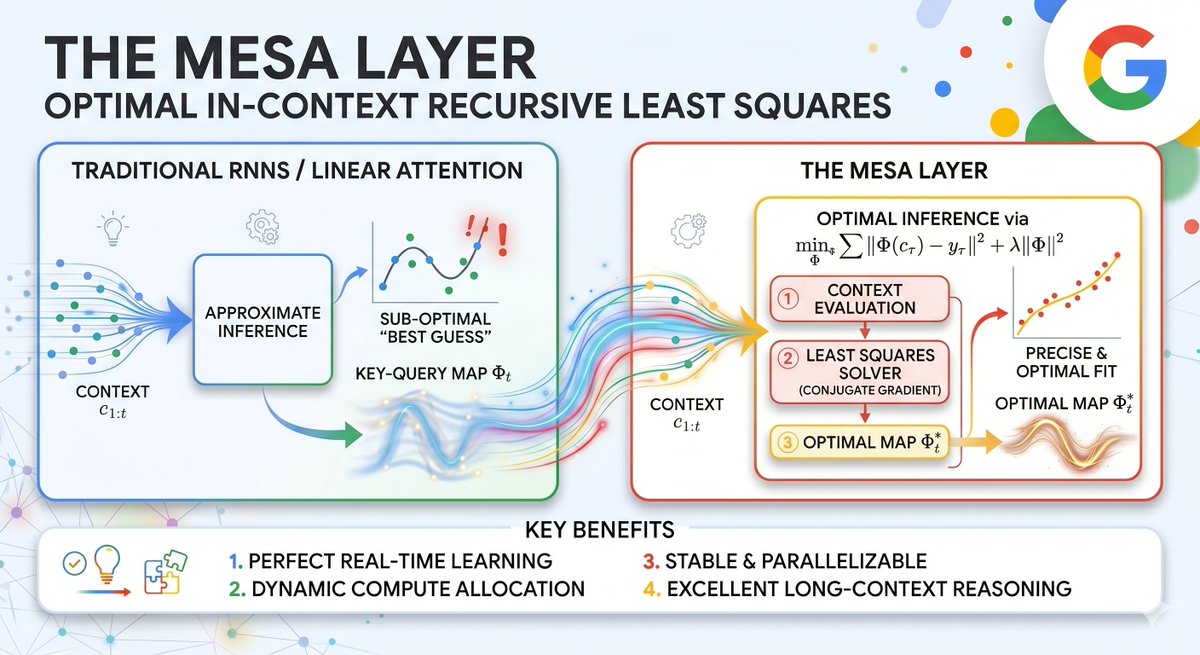
Google presents a new Transformer alternative at #ICLR2026! Join Nino Scherrer & Yanick Schimpf at the Google booth (#411) at 10AM to learn about MesaNet, proposing a new linear sequence layer that optimally learns in-context given a fixed memory budget.
Software horror: litellm PyPI supply chain attack.
Simple `pip install litellm` was enough to exfiltrate SSH keys, AWS/GCP/Azure creds, Kubernetes configs, git credentials, env vars (all your API keys), shell history, crypto wallets, SSL private keys, CI/CD secrets, database passwords.
LiteLLM itself has 97 million downloads per month which is already terrible, but much worse, the contagion spreads to any project that depends on litellm. For example, if you did `pip install dspy` (which depended on litellm>=1.64.0), you'd also be pwnd. Same for any other large project that depended on litellm.
Afaict the poisoned version was up for only less than ~1 hour. The attack had a bug which led to its discovery - Callum McMahon was using an MCP plugin inside Cursor that pulled in litellm as a transitive dependency. When litellm 1.82.8 installed, their machine ran out of RAM and crashed. So if the attacker didn't vibe code this attack it could have been undetected for many days or weeks.
Supply chain attacks like this are basically the scariest thing imaginable in modern software. Every time you install any depedency you could be pulling in a poisoned package anywhere deep inside its entire depedency tree. This is especially risky with large projects that might have lots and lots of dependencies. The credentials that do get stolen in each attack can then be used to take over more accounts and compromise more packages.
Classical software engineering would have you believe that dependencies are good (we're building pyramids from bricks), but imo this has to be re-evaluated, and it's why I've been so growingly averse to them, preferring to use LLMs to "yoink" functionality when it's simple enough and possible.
Terence Tao put it plainly: there is no evidence that LLMs exhibit genuine creativity.
Yes, they have solved some Erdős problems. But these are low-hanging fruit, questions that attracted little attention and that yield once the right existing techniques are applied. That is not creativity. That is search plus recombination.
Yes, LLM outputs can look impressive. But look at who is impressed: typically non-experts. Experts know very well that LLM performance gets terrible when you approach the frontier of human knowledge.
And this is not a temporary gap. It reflects a structural limitation.
We do not fully understand human creativity. But we do know a key property:
Conceptual leaps: the ability to generate new representations, not just recombine existing ones.
LLMs do not do this. They interpolate in representation space. They operate within existing conceptual frameworks; they do not create new ones.
This is why we haven’t “yet seen them take the next step”.
ML interview question:
Here are the weights for Llama 3.1 70B. Generate a token by executing the forward pass manually using pen and paper. You have 30 minutes.
Introducing TurboQuant: Our new compression algorithm that reduces LLM key-value cache memory by at least 6x and delivers up to 8x speedup, all with zero accuracy loss, redefining AI efficiency. Read the blog to learn how it achieves these results: https://t.co/CDSQ8HpZoc
JEPA are finally easy to train end-to-end without any tricks!
Excited to introduce LeWorldModel: a stable, end-to-end JEPA that learns world models directly from pixels, no heuristics.
15M params, 1 GPU, and full planning <1 second.
📑: https://t.co/cpTzgvbTS0
A Distributed Ant Colony Optimization Applied in Edge Detection
#computerscience
More @ https://t.co/BOrVQbbVv2
Article by Min Chen, from State University of New York at New Paltz, USA.
Stone walls do not a prison make, Nor iron bars a cage: Minds innocent and quiet take That for an hermitage. If I have freedom in my love, And in my soul am free, Angels alone, that soar above, Enjoy such liberty