I taught JEE physics for years. That paper breaks strong kids in three hours.
This exam is five hours of theory and five hours of lab work, and these five did close to perfect scores on it.
Let me tell you what actually happened.
The International Physics Olympiad is the world championship of school physics. It was the 56th edition. Held in Bucaramanga, Colombia, from July 5 to 12.
381 students. More than 85 countries. Every one of them the best physics student their country could find.
India sent five kids.
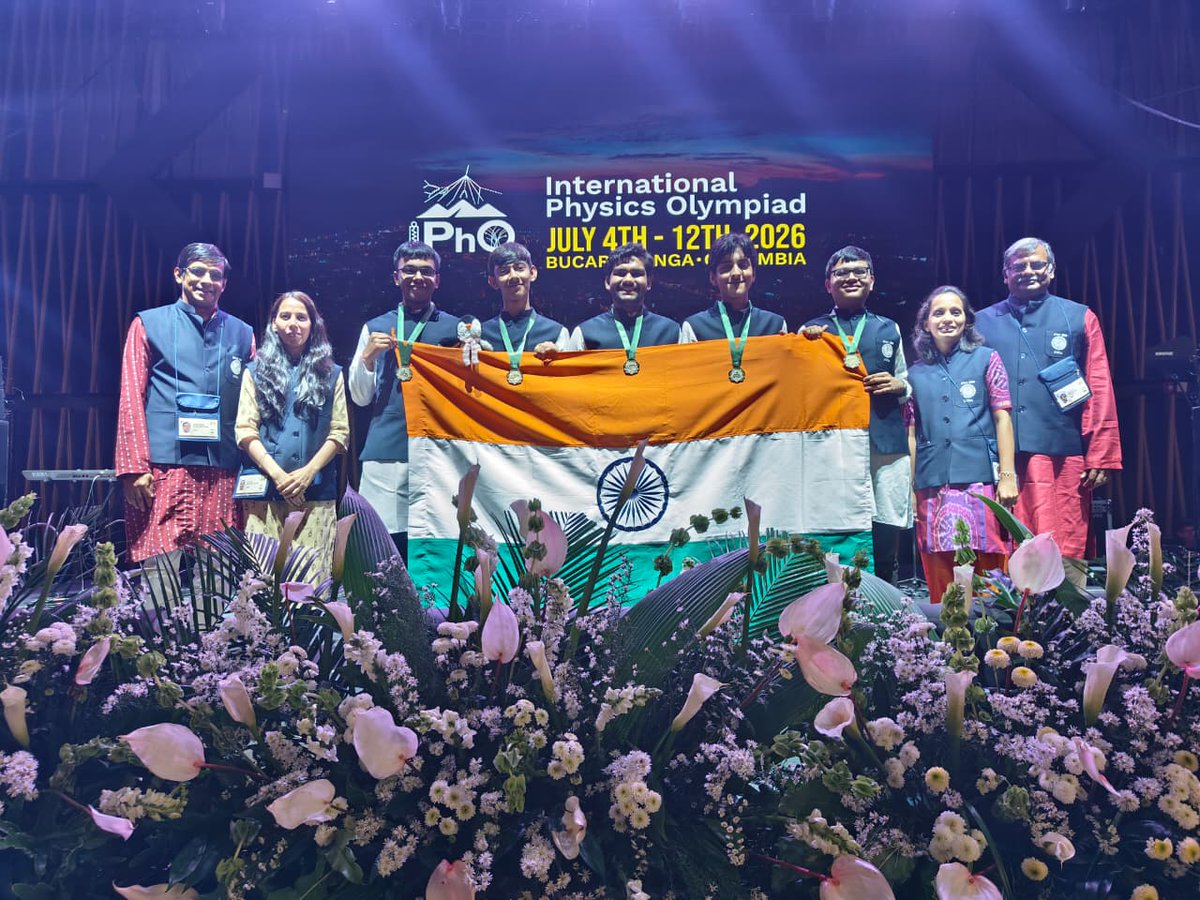
All five came back with gold.
Their names are Kanishk Jain from Pune. Riddhesh Anant Bendale from Indore. Rishit Garg from Dwarka in Delhi. Shresth Suraiya from Mumbai. Svarit Joshi from Ahmedabad.
We know a hundred cricketers by their nickname and not one of these boys. :)
That clean sweep put India at joint World Number One. Tied with China, Russia, Kazakhstan, South Korea and Taiwan.
Those are countries that pour serious money and national pride into science education. We are standing level with them.
Now here is what the exam actually was.
Two papers. Each five hours long.
The theory paper had three problems. One on the thermodynamics of paramagnetic cooling. One on the photoionisation of ozone. One on the dynamics of electron positron pairs.
The experimental paper was another five hours in a lab, working through heat transfer and thermodynamic processes in fluids.
That means you get given equipment you have never seen, and you have to design your own experiment, take your own readings, handle the errors, and reach a real answer.
Not multiple choice. No shortcuts. No pattern recognition. You either understand physics or you sit there for five hours.
HBCSE says the Indian students were near perfect on theory and excellent on the practical too.
Now, this was India's 27th appearance at the IPhO.
Across all those years, about 44 percent of Indian students have won gold, 41 percent silver, 10 percent bronze.
In the last ten years, every single Indian student has come home with a medal. 62 percent gold, 38 percent silver.
Not one kid has gone and come back empty handed in a decade.
Five golds in one year has happened only twice. This year, and in 2018.
So who built this.
The programme is run by HBCSE, the Homi Bhabha Centre for Science Education. It sits under TIFR, which sits under the Department of Atomic Energy.
They run the whole funnel. A national exam, then a national olympiad, then a brutal selection and training camp, and out of everyone in the country, five kids get on a plane.
The team was led by Professor Anwesh Mazumdar of HBCSE-TIFR and Dr Leena Joshi from St Xavier's College, Mumbai.
The scientific observers were Professor Ananda Dasgupta from IISER Kolkata and Nisha Kelkar from Gogate-Joglekar College in Ratnagiri.
Yes. Ratnagiri. A college in a small coastal town in Maharashtra.
This is public education doing something the private coaching industry could never do on its own.
The coaching industry is very good at one thing. Teaching you to solve a known problem fast.
That is what JEE and NEET reward, and I say that with love because I was part of that world.
But an olympiad paper does not have a known type. There is no shortcut chapter. There is no formula sheet that saves you. You have to sit with a problem you have never seen and think.
That is a completely different muscle. And a government funded centre has been quietly building it in Indian teenagers for 27 years.
So yes, be proud. Loudly.
HBCSE also shared that around 64 percent of India's olympiad medallists go on to do a PhD.
But only about 32 percent of medallists end up settling in India.
I do not say that to spoil the moment. These kids owe the country nothing. They earned every option they have.
But it should tell us something. We are excellent at finding this talent. We are excellent at training it. We are still not great at giving it somewhere worth staying.
Congratulations Kanishk, Riddhesh, Rishit, Shresth and Svarit. This is one of the best things an Indian did this year and most of the country will never hear about it.
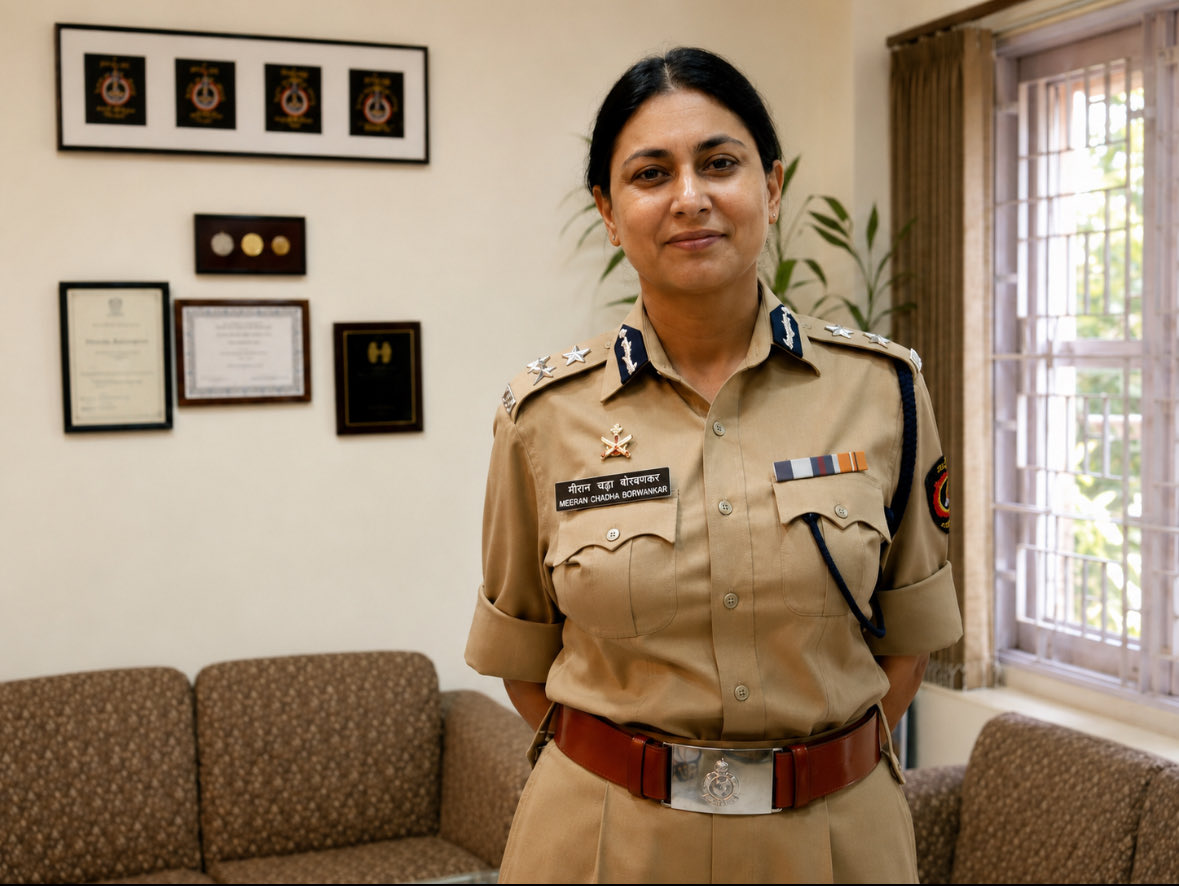
Her name is Meeran Chadha Borwankar.
A minister sat across a table from her and ordered her to hand over three acres of police land to a private bidder.
She said no.
He lost his temper and hurled the map across the glass table between them. She stood up, saluted him, and walked out.
She joined the Indian Police Service in 1981, at a time when a woman in a police uniform in India was almost a curiosity. She went on to become the first woman to head the Mumbai crime branch, and the first woman to lead the Pune police.
In 2010, soon after she took charge in Pune, she was told to complete the handover of a valuable piece of police land in the heart of the city. The land had already been auctioned off to a private bidder before her time. She was expected to simply sign it away.
She looked at it and refused. The land, she said, was needed for the police themselves, for their offices and for homes for the constables and their families, the men and women who guard the city and often cannot afford to live in it. Handing it to a builder, she said plainly, would look like the new commissioner had sold herself out.
The minister overruled her and told her the matter was closed. She told him, gently and finally, that she would not do it.
The map came flying across the table. She saluted, and left.
It cost her. The posting she wanted did not come. But she wrote to the government demanding the whole deal be cancelled, and she kept fighting until the land was returned to the police, where it belonged.
Years later, the bidder who had been due to receive that land was named as an accused in one of the biggest corruption cases in the country.
She had no way of knowing that at the time. She simply refused to hand over what was not hers to give.
शोभते तुलसी बाला
वृद्धवृन्दावनान्तरे।
सद्योजाता यथा श्रद्धा
निगमागमसंनिधौ ।।
Shines this young Tulasī
In the middle of an old vṛndāvana,
like śraddhā just born
in the presence of the veda and śāstra.
Professor is murdered. Squatters take over his house.
"the squatters reported their own burglary to establish occupancy in the house."
California Kafkaesque dysfunction.
https://t.co/LAZP9AYaKV
and the entire Phy Olympiad Cell & mentor pool @HBCSE for their dedication through the orientation and pre-departure camps. Deep gratitude to @dae.connect, DST and Ministry of Education, Govt. of India for their continued support in helping India shine on the world stage. 5/5
Massive congratulations to our young physicists and to team leaders Prof. Anwesh Mazumdar (HBCSE-TIFR) & Dr. Leena Joshi (St. Xavier's College, Mumbai), scientific observers Prof. Ananda Dasgupta (IISER Kolkata) & Ms. Nisha Kelkar (Gogate-Joglekar College),
4/5
This is India's 27th appearance at IPhO — and the legacy keeps growing. In the last 10 years, EVERY Indian student has come home with Gold or Silver.
3/5
#IPhO2026#ScienceEducation
🇮🇳GOLDEN SWEEP FOR INDIA 🏆
All 5 Indian students win GOLD at the 56 International Physics Olympiad (IPhO) 2026 in Bucaramanga, Colombia -placing India at Rank #1 in the world (jointly with China, Kazakhstan, Russia, South Korea & Taiwan) among 381 students from 87 countries 1/5
When I first started at X, this is one of the things I did a deep dive on because I felt it was critical to the integrity of the experienced.
I tasked our Threat Disruption team to investigate a number of trends that seemed artificial.
The findings:
We could not find meaningful examples of foreign interference in US policy discussions, except people gaming rev share in developing countries. This is what motivated the release of the Country of Origin feature and significant changes to the rev share algorithm.
The most deranged & divisive replies generally were from residential IPs in the United States—with no signs of using a VPN.
Ultimately, X is a reflection of the internet. And that means you will see the full spectrum of human thought. And sometimes the most outrageous takes will catch fire.
Having said all of this, there can still be cases of narratives being boosted but the origin of the initial post is almost always domestic and we have hardened our systems in the last 3 months to prevent this.
We are entering a completely new era of science
Here is Yuji Tachikawa from Japan (Mathematical Physics, String Theory, QFT) on recent progress in his own work using Fable 5 :
"I've been trying out Claude Fable recently, and last night, on a whim, I showed it my research notes about a collaborative project that's seen no progress in the past six months or so and asked for its thoughts. To my surprise, it made a non-trivial observation and essentially solved it."
"I was also surprised that it was using sympy to automatically write code and verify his own predictions."
"Fable probably seems like it properly understands string theory and has intuition too—that's my impression"
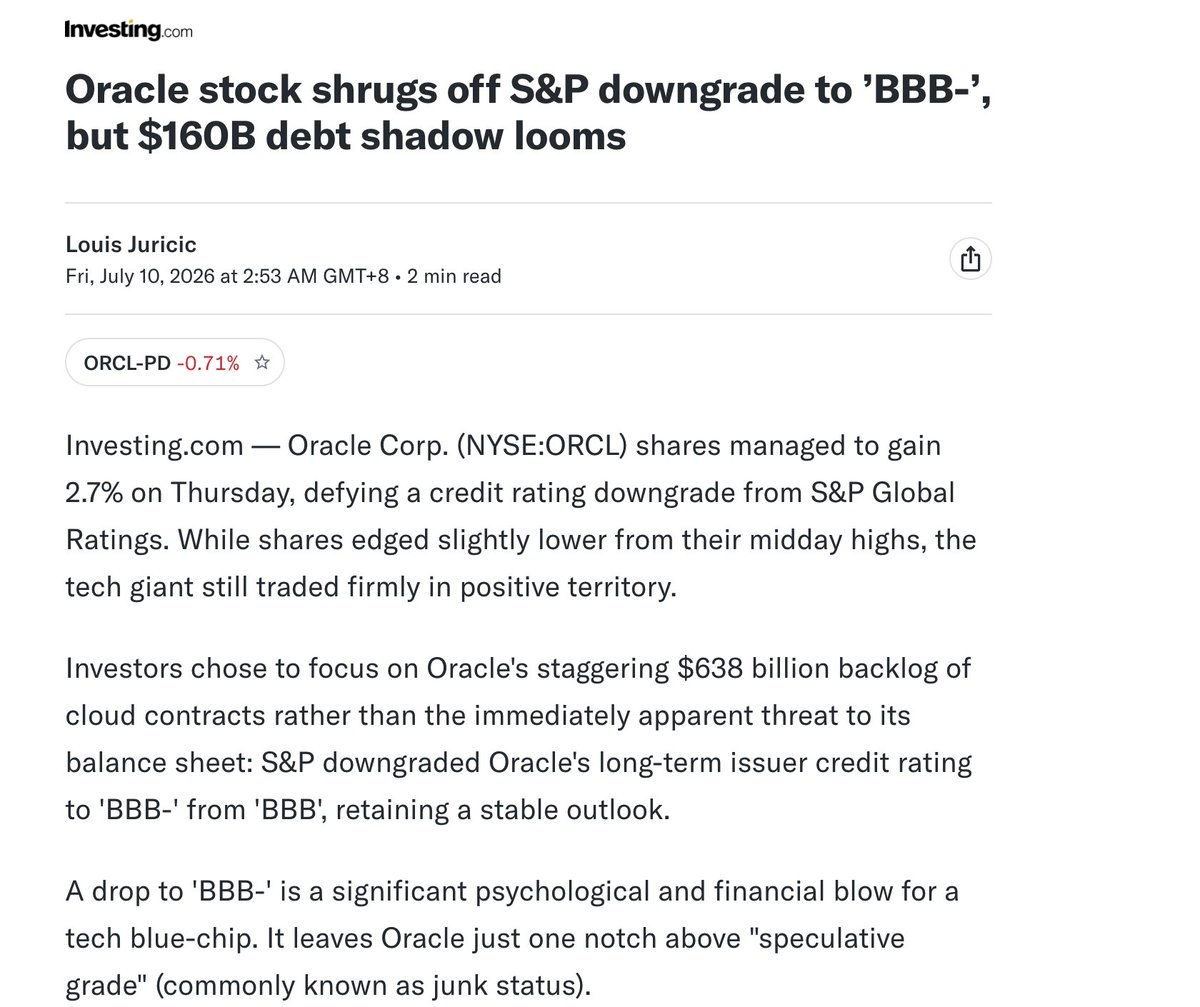
S&P downgraded Oracle's long-term issuer credit rating to 'BBB-' from 'BBB', citing exploding capex. The ratings agency now projects Oracle's fiscal 2027 capital expenditures to rocket to $90 billion to $95 billion, a massive leap from its previous $60 billion forecast, driven by soaring AI chip costs and new data center builds.
That's exactly what I said: with each Nvidia generation, data center cost keeps rising, and that's excluding other rising components. Now add memory and storage, turbines, cooling, and so on, all rising too.
At some point, projects will start getting cancelled, scaling planned capacity down (say from 5 GW to 1 GW), and we'll even see abandoned projects selling for pennies.
That scenario could bring us the great write off period.
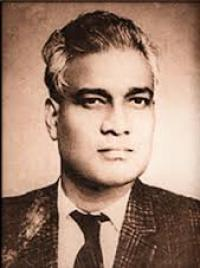
Next in who after the Ramanujan series? A peasant boy from a tiny village in Midnapore, West Bengal, who went on to fix the blind spots of the world's most famous statistical formulas.
In the 1940s & 50s, the Western world believed it had fully tamed data. Led by titans like Ronald Fisher at Cambridge, statistics had transitioned into a hard science. The bedrock metric of the entire field was the Pearson product-moment correlation coefficient, the exact mathematical eqn used by every global industry, lab & govt to determine if 2 variables were linked (e.g., crop yield vs. rainfall/drug dosage vs. patient recovery).
While Cambridge was celebrating its statistical mastery, Anil Kumar Gain was navigating a completely different reality. Born in 1919 in Lakkhi, a tiny, impoverished peasant village in Midnapore, West Bengal, he lost his father when he was a young child. He was raised by his widowed mother under crushing economic hardship. He learned his 1st lessons in mathematics & English directly from her in a dirt-floor, informal local school.
His brilliance, however, could not be suppressed by poverty. He swept the academic awards at the University of Calcutta, earning a Gold Medal in Applied Mathematics in 1943. By 1947, he landed at the University of Cambridge as a senior research scholar.
At Cambridge, working alongside Henry Ellis Daniels & interacting with Ronald Fisher himself, Gain did not try to blend into the established British academic orthodoxy. Instead, he systematically exposed its foundational vulnerability.
Gain published a series of monumental papers in Biometrika (most notably in 1949, 1950 & 1951) titled "The frequency distribution of the product-moment correlation coefficient in random samples of any size drawn from non-normal universes."
He did not just point out that real-world data was skewed; he used brutal, masterful mathematical analysis to derive the exact behavior of correlation coefficients, variance ratios & Student's t-distributions under completely non-normal conditions.
When a young man escapes rural poverty in a colonized nation, conquers Cambridge, gets elected a Fellow of the Royal Statistical Society & fixes the math of the world's leading scientists, the standard script dictates that he takes a prestigious chair in Europe/America & enjoys a life of global luxury. Gain completely tore up that script.
In 1954, he packed his bags & quietly returned to India. He worked briefly with P.C. Mahalanobis at the Indian Statistical Institute, then took a position at IIT Kharagpur. He spent his remaining decades using his statistical mastery for a completely unglamorous, exhausting mission: reforming educational measurement & quality control for the working class of Bengal.
He became obsessed with the idea that the traditional, rigid Western model of education was failing rural children, the same kind of peasant children he grew up with. He weaponized a regional citizens' forum to design a radically non-traditional, inclusive university model. His relentless, quiet lobbying eventually led to the founding of Vidyasagar University in Midnapore, bringing higher education straight to the rural heartland that birthed him.
Anil Kumar Gain died quietly in Calcutta in 1978 at the age of 59, just 3 yrs before the university he envisioned was formally chartered by law.
Today, if we walk into any data science firm/tech conglomerate/pharma lab anywhere in the world, the algos automatically executing robust inferences on messy, heavily skewed, non-normal data are running on the ancestral intellectual lineages he mapped out at Cambridge.
Yet, if we go to his home district/ask his old neighbors, he is a ghost. They do not know that the quiet, soft-spoken prof who spent his twilight yrs fighting for rural schools was the man who single-handedly straightened the curved spine of modern statistical science.
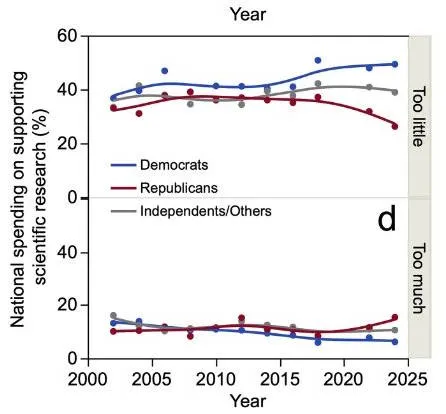
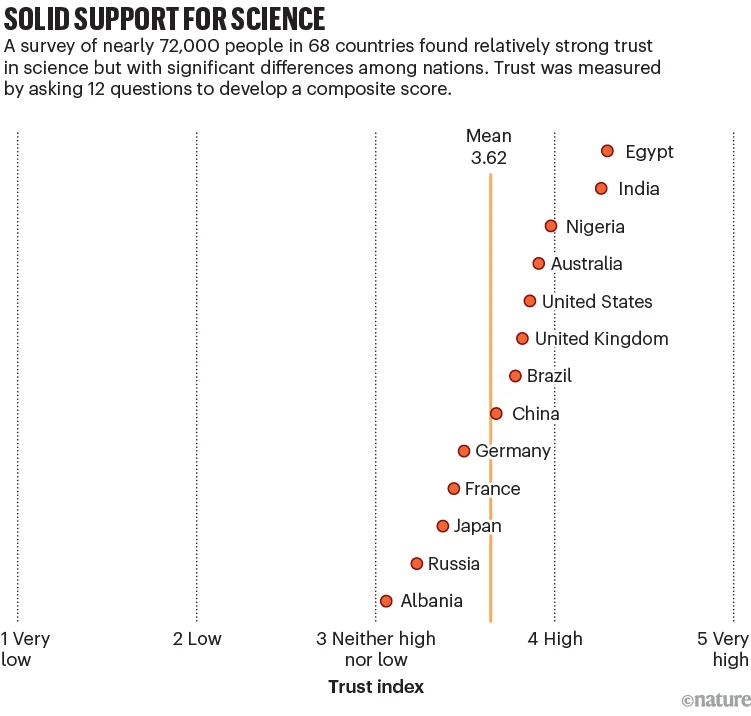
When MAGA people tell you America has lost trust in science, THEY ARE LYING TO YOU.
Even most REPUBLICANS still trust scientists!
Americans trust scientists more than almost any other country!
Most REPUBLICANS want to spend more on science!
Sanae Takaichi is attempting Japan's first real industrial strategy in decades. Her growth plan is an eco-security response to China's might. But the real fight will be against fiscal hawks in Tokyo who think Japan can save its way to growth. My latest:
https://t.co/dLfrSUp5lD