VLA generalization is hard in part because we ask a robot policy to solve two under-specified problems at once, with far less data than today’s VLMs.
From coarse goals and full images alone, it must infer both what to do now and what in the scene matters for control, then turn that into precise actions from scarce, embodiment-specific robot data.
In See Less, Specify More, we reduce that burden. S2 uses an off-the-shelf VLM for broader reasoning and goal-preserving local guidance, including trajectory-aware execution details, then trains the action policy to act from annotation-free, task-sufficient visual evidence instead of broad scene context.
Across 8 real-robot tasks on TX-G2 and HSR, S2 raises mean subtask success from 54.2% to 79.0% over pi05
Not every latent is reasoning.
We’re releasing Continuous Reasoning for Vision-Language-Action.
Our claim is simple: if a robot policy is truly reasoning, another policy should be able to decode the same thought, verify it, and use it to make better action predictions.
(1/6)
VLA generalization is hard in part because we ask a robot policy to solve two under-specified problems at once, with far less data than today’s VLMs.
From coarse goals and full images alone, it must infer both what to do now and what in the scene matters for control, then turn that into precise actions from scarce, embodiment-specific robot data.
In See Less, Specify More, we reduce that burden. S2 uses an off-the-shelf VLM for broader reasoning and goal-preserving local guidance, including trajectory-aware execution details, then trains the action policy to act from annotation-free, task-sufficient visual evidence instead of broad scene context.
Across 8 real-robot tasks on TX-G2 and HSR, S2 raises mean subtask success from 54.2% to 79.0% over pi05
Exactly! That is very close to our view. The policy is often asked to infer both the “what” and the “how” from full visual context, but with far less data than modern VLMs. S2 tries to reduce that burden from both sides: more specific local guidance on the “what,” and annotation-free evidence budgeting on the “how.��
Thanks! That is exactly the bottleneck we were trying to target.
On noisy local cues, HSR already gives us a fairly challenging case: during grasping, the wrist camera is often partially occluded by the grasped object itself, which reduces the available light and makes the wrist-view signal quite noisy. Even so, we still learn a strong policy there, especially on tasks that require two locomotion phases plus relocation.
On hardware changes, so far we have trained separate multi-task policies on HSR and TX-G2, and the gains remain strong within each embodiment. A unified policy across embodiments — and understanding how different embodiments learn different visual evidence under the same environment — is definitely a very interesting next direction for us.
Not every latent is reasoning.
We’re releasing Continuous Reasoning for Vision-Language-Action.
Our claim is simple: if a robot policy is truly reasoning, another policy should be able to decode the same thought, verify it, and use it to make better action predictions.
(1/6)
Continuous Reasoning is not only effective on TX-G2, a bimanual manipulation platform. It also works on HSR, where the policy must combine locomotion, navigation, transport, and placement.
Across real-robot evaluation, it improves mean subtask success over pi05 by:
• +40.4% on TX-G2
• +26.3% on HSR
🏁 Call for Competition Participants
Our competition focuses on evaluating performance in realistic robotic settings. 🦾
Please check our website for more details!
https://t.co/R9H3NttgLE
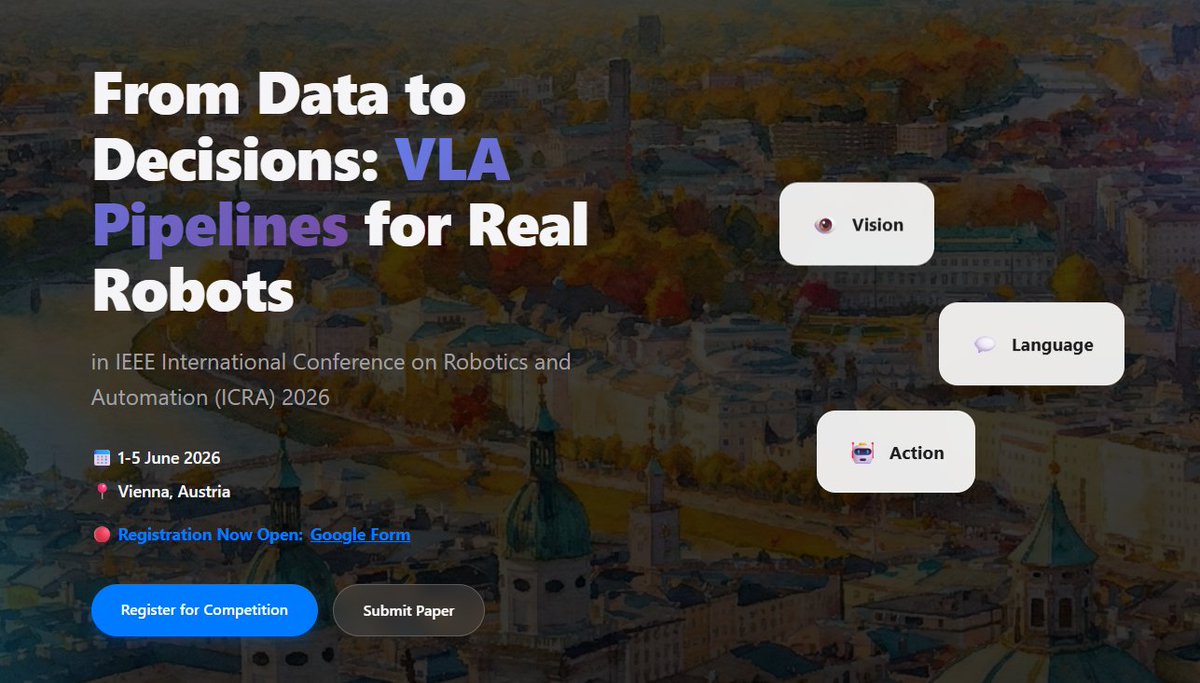
Excited to announce the ICRA 2026 Workshop on Visual-Language-Action (VLA) Pipelines in Vienna!
Building effective VLA systems involves complex, multi-stage pipelines. Join us to discuss the future of robotic intelligence! 🤖 (1/n) #ICRA2026
📣 Call for Papers
We welcome contributions on any component of the VLA pipeline:
📊 Data & Representations
🧠 Models & Training
✅ Evaluation & System Integration
🔗 End-to-end connections
Submit your novel methods, benchmarks, and applications!