Ever analyze a scRNAseq dataset and wonder if a specific cell state has been seen before? And if so, where in the human body? Under what conditions? Well, now you can use our lightning fast SCimilarity search and foundational model for that! ⚡️🔎🧬 https://t.co/t8L1xFOffd (1/11)
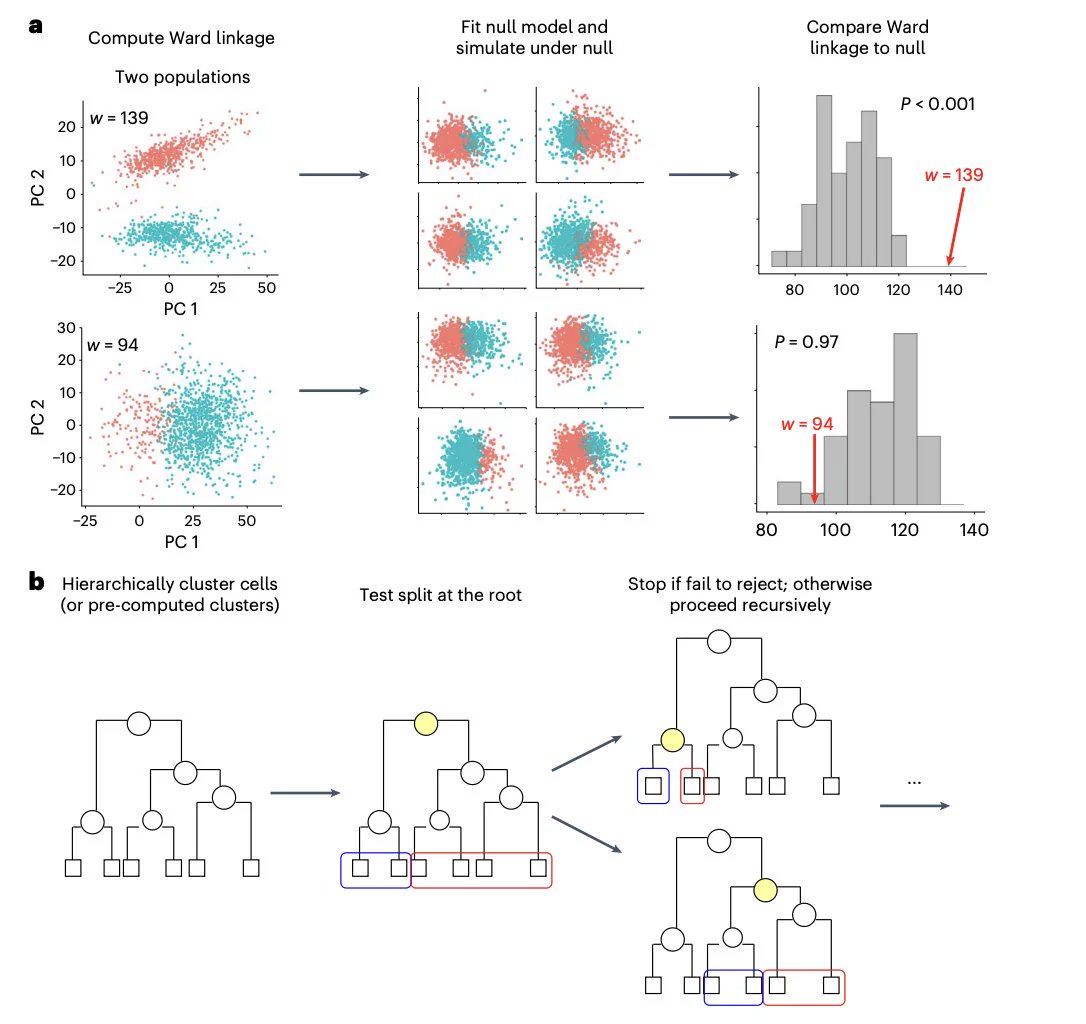
Clustering algorithms report clusters even when none exist. In single-cell RNA-Seq pipelines, novel cell types are often identified by clustering algorithms. Expanding on Kimes et al.'s work, we introduce significance analysis for single-cell RNA-Seq data: https://t.co/ut1kPjKVCM
#Bioinformatics colleagues! Take a quick look at the top 75 Bioconductor packages.
I discovered some I should've known about but didn't.
The ones I clicked are tied to pathway analysis.
Congratulations to @TheodorisLab on the recent study, demonstrating the power of AI learning from big data to make meaningful predictions on limited data.
From small molecules (here: imidazolium salts) to bioactive RNA degraders - promising story, just published in Nature.🧬😀⚗️
International collaboration of @disney_lab & Herbert Waldmann & @GloriusGroup & John Cleveland
@UFScripps @mpimoph@WWU_Muenster
https://t.co/afPQKP2KbW
How accurate are 'gene regulatory networks' inferred from scRNA-seq data?
This comprehensive analysis in @naturemethods concludes:
1. The areas under the precision-recall curve are moderate
2. Methods not using pseudotime-ordered cells are more accurate
@harshameghadri Maybe have them build a simple biological database on a topic that interests them or that they have learned in school, using a tool like MySQL or MongoDB?
Single-cell or spatial?
Our new technology - Slide-tags - allows both in the same experiment, enabling true single-cell multi-modal spatial genomics
➡️ https://t.co/i1m5T4bEme
☕️ Fresh out of the press in @NeuroCellPress!!
Happy to share our manuscript “Mapping human adult hippocampal neurogenesis with single-cell transcriptomics: reconciling controversy or fueling the debate?” @LabSalta@NIN_knaw
https://t.co/EsJk9mojDw
🧵1/n