New work from Pasi A. Jänne, us, and 23andme; led by Jackie LoPiccolo and Steven Micheletti. Characterizing a highly penetrant germline founder mutation for lung cancer.
CIGMA is out in Nature — A linear mixed model to unbiasedly characterize cell-type-specific eQTLs. Work advised by @andywdahl and a lot of help from @xinpei_w
https://t.co/uT8Ot6mnzs
Survey data document US visa types and burdens of time, cost and mental health among international postdocs https://t.co/JMrhrxTHlB
https://t.co/Qv9BtHqn0A
One of my first consults as a cardiology fellow: a 34-year-old, textbook MI. A day earlier, no risk model would have flagged him for prevention. That paradox has driven my work ever since — our models miss how disease actually evolves, dynamically, on top of a genetic background. @Nature https://t.co/PHDOjmGxE3
New work from us pooling together clinical sequencing data to identify large effect common risk variants for rare cancer types. This included a novel HLA locus that interacts with HPV infection to increase Anal Cancer risk.
Happy to share our new preprint from @SashaGusevPosts and @nmancuso_ labs! We introduce Mr. PEG, a framework integrating perturbational screens, eQTL, and GWAS data to identify mediating genes for complex traits. (1/n) https://t.co/YShpOyKLw0
Excited to share our new work of regulatory effects in the brain using sc-RNASeq data. Importantly, we argue that besides analyzing single cell eQTLs, it is important to look beyond cell types and better dissect shared and distinct effects between cell types.
https://t.co/zUh2BxjUEO
How do GWAS and rare variant burden tests rank gene signals?
In new work @Nature with Jeff Spence, @jkpritch, and our wonderful coauthors we find the key factors are what we call Specificity, Length, and Luck!
🧬🧪🧵
https://t.co/rNzekB06la
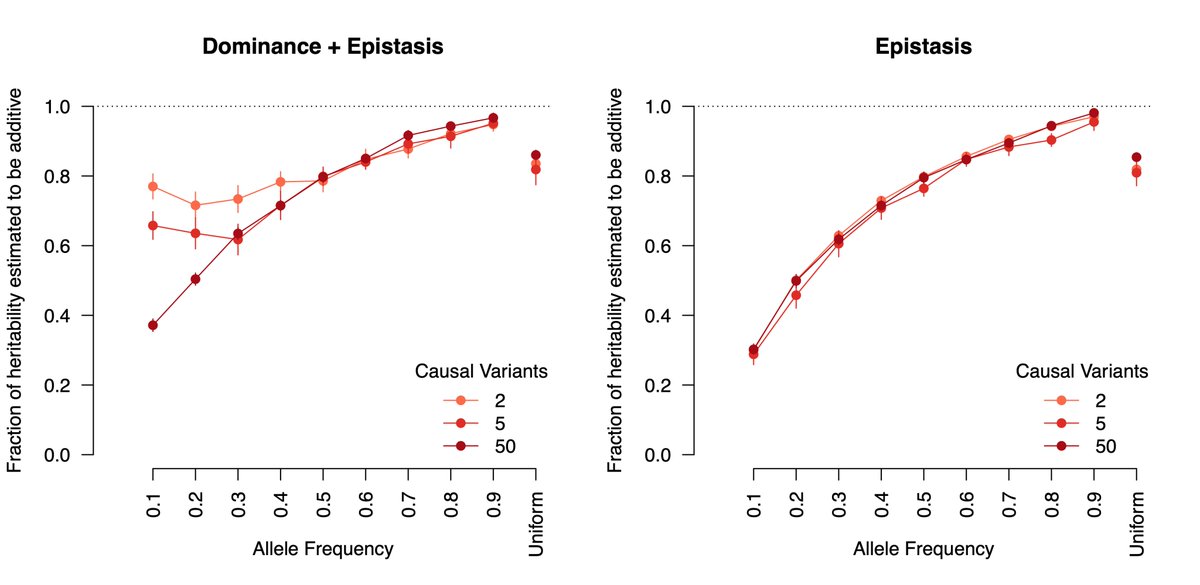
The proportion of epistatic heritability that is estimated as additive by quantitative genetic models. Epistasis deviates more from additivity for lower frequency causal alleles, but on average >80% of biological GxG will just look like statistical G.
Check out our scPrediXcan paper
https://t.co/Pcni6LfrNg
Led by talented @Charles_Zhou12, supervised by @MengjieChen6
and me, with thanks to many contributors
scPrediXcan integrates deep learning and single cell expression data into a powerful cell type specific TWAS framework.
I am thrilled to share one of the most important projects from my PhD! We developed the method JOBS (JOint model of Bk-eQTLs as a weighted sum of Sc-eQTLs) and applied it to blood bulk (eQTLGen) and sc-eQTL (OneK1K). 1/3
I am excited to share our new work that generates a single cell eQTL atlas for immune cell types. The work integrates bulk eQTLs with sc-eQTLs, which boosts the power for identifying sc-eQTLs for up to 4 folds. As such, we have the power equivalent to sc-RNASeq of 4K individuals.
I'm excited to share a wonderful collaboration with @LD_matrix: JOBS integrates bulk and single-cell eQTLs to boost eQTL discovery. Integrated with GWAS, it identified more disease-linked loci for 14 immune disorders & fueled drug-repurposing. #immunology#drugdiscovery#genomics
Our method significantly boosts the power to identify sc-eQTLs—equivalent to expanding the sample size by 4 times. This enhancement benefits all downstream analyses, leading to more colocalized loci and more cell-type-specific TWAS genes. 2/3