Another sweet treat right after MAI 😭
Nemotron 3 tech report: https://t.co/3eSXsJuJ5E
Their SFT distills from so many different open source models (GPT OSS, Minimax 2.5, GLM, Qwen3 Coder, Deepseek). Feels very awkward after reading the MAI report; 2 very different recipes published just 2 days apart.
Your heart is the organ that won’t heal. Adults replace under 1% of their heart muscle cells a year, a number Olaf Bergmann pinned down by carbon-dating the cells. So a heart attack kills about a billion of them for good, and the scar it leaves never fills back in. That’s why heart failure is a one-way door.
Here’s what the new gene therapy is trying to do. Heart cells can divide before birth, then switch that ability off and never turn it back on. A protein called YAP is the switch. The lead therapy, YAP101, flips it back on, telling surviving heart muscle to grow new muscle.
The field has been burned chasing this. The cardiac stem cell era collapsed in fraud, 31 papers flagged for retraction. The big gene therapy after it, SERCA2a, failed in 250 patients.
YAP101 has dosed three people so far. Safety only, no efficacy yet.
Worth watching. Worth not overselling.
23.5 hours later... there's an app and it's open source.
It tracks activities & sleep. It has full sensor support: HR, SpO2, HRV, Temperature, Motion, etc.
As a non-oncologist, i feel quite comfortable jumping on the bandwagon here. I can count the number of times I've seen unsolvable problems in medicine get solved in my lifetime. No, this is not a cure, but there has been no greater challenge than pancreatic cancer. Nothing worked. Now this...
These results are simply spectacular
Daraxonrasib or Chemotherapy in Previously Treated Metastatic Pancreatic Cancer | New England Journal of Medicine https://t.co/a52WwDQ2Ju
Big progress vs cancer, folks.
The kind of event curves from randomized trials that we've not seen before for a couple of the most deadly cancers. Congrats to the oncology research community for getting these trial done. #ASCO26, @ASCO
I can tell you why Anthropic wants to go public so badly:
OpenAI is putting Anthropic under so much pressure that Anthropic is being forced to release Mythos soon.
And since it will become clear that it’s more marketing and hot air than substance, they need to push this through quickly.
Mythos is NOT a model that can be used sustainably and economically in a company long-term.
Not even in an enterprise.
Yes, it’s suitable for impressive case studies and benchmarks, but it is NOT economically viable.
At the end of the day, it’s all just a numbers game.
Great meeting at West China Hospital’s radiology department. Excited to follow up with joint work between FAU and Siemens Healthineers. Looks like we’ll tackle key neurological challenges soon.
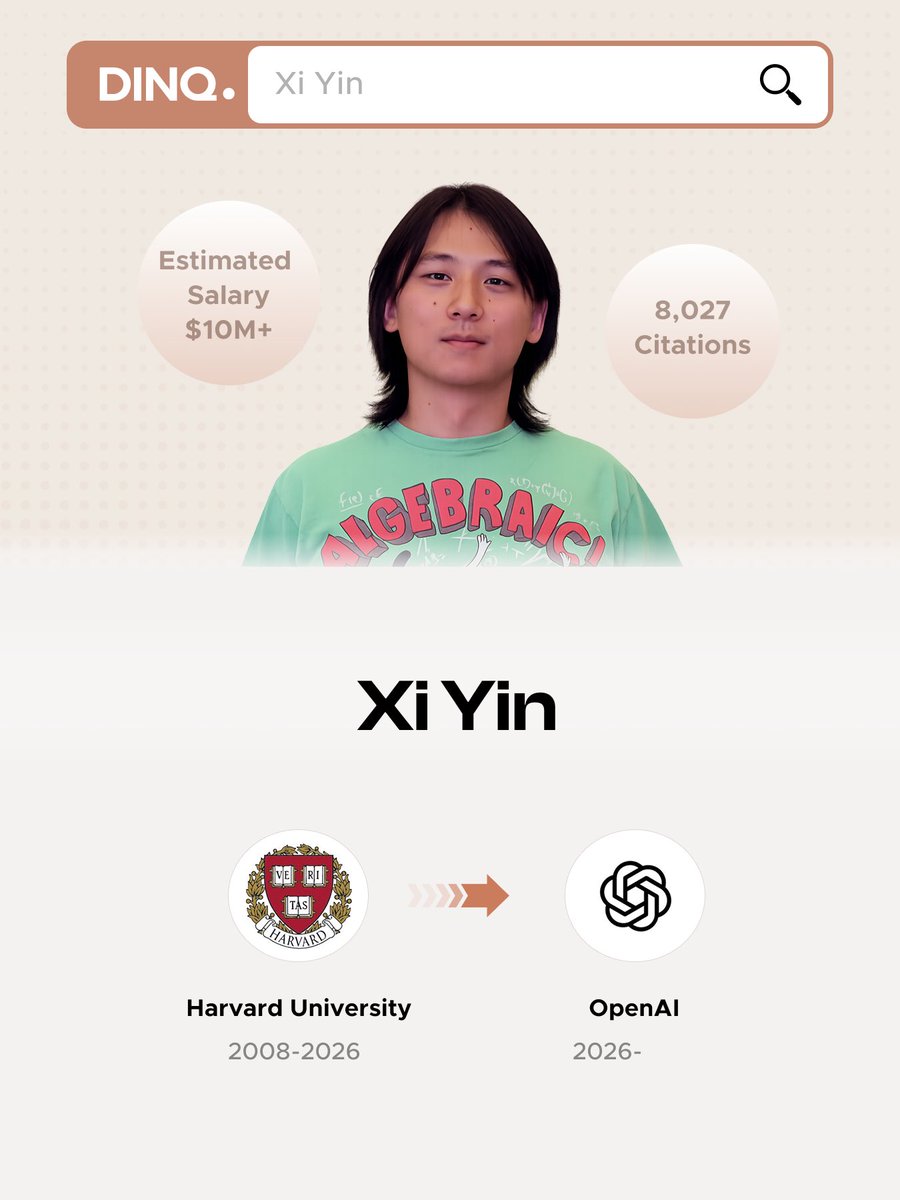
Xi Yin just left Harvard for OpenAI.
String theorist. Youngest full professor in Harvard history.
His words: "AI gives me 100x speedup. Weeks of output would take me 10 years."
Then: "I don't believe there's any human intellectual ability AI cannot replicate."
The man who said that is the one who would know.
#DINQ #AI #OpenAI
@maier_ak I tried RAM before and the zero-shot performance on my data is bad…still need to fine tune. https://t.co/HCKSITPbcA, this review paper show that if we can fully train a model like SwinIR, it can outperform diffusion based methods…and RAM is even worse then diffusion 😂
🦔 Court filings unsealed last week reveal Anthropic ran a secret project called "Project Panama" to "destructively scan all the books in the world." An internal document stated: "We don't want it to be known that we are working on this." The company spent tens of millions buying millions of books, slicing off their spines, scanning the pages, then recycling them. Anthropic paid $1.5 billion to settle the copyright lawsuit in August. Authors whose books were downloaded can claim about $3,000 per title.
The filings also show Anthropic co-founder Ben Mann personally downloaded pirated books from LibGen over 11 days in 2021. When a new piracy site launched in 2022, he sent colleagues a link with the message "just in time!!!" Anthropic says it never trained a commercial model using the pirated data.
Meta employees raised concerns internally that downloading millions of books without permission would violate copyright law. A December 2023 email said the practice was approved after "escalation to MZ," apparently referring to Mark Zuckerberg. Chat logs show employees used Amazon servers instead of Facebook's to avoid "risk of tracing back" the activity. OpenAI has acknowledged downloading from LibGen but says it deleted the files before ChatGPT launched.
My Take
These companies built products worth hundreds of billions of dollars on content they took without permission, and they knew exactly what they were doing. Internal messages show employees worried it was wrong. They did it anyway. They discussed how to hide it.
Anthropic's pivot to buying and scanning physical books was described by a law professor as "a more restrained approach." That's the bar now. Buying millions of books, cutting them apart, and recycling them is the ethical option compared to just downloading pirated copies.
The judge ruled that using books to train AI is legal under fair use because it's "transformative." The companies got in trouble for how they acquired the books, not for using them. Anthropic settled for $1.5 billion without admitting wrongdoing. Authors get about $3,000 per book. The AI models trained on those books power products generating billions in revenue. The math tells you who won.
Hedgie🤗
https://t.co/b01h1PZygT