⚡! Tokenization is the first thing you do in CS336 (language models from scratch). If Marcel can work his magic for the rest of the LM pipeline, the world will be a better place.
I think there's a lot of confusion and misinformation about Zhilin's visa, H1B lottery, immigration, and why he left the U.S.
Zhilin had many opportunities to stay in the U.S. if he wanted to. In fact, I was on an email thread with a senior Apple exec (Tim Cook's reports) asking whether Zhilin would consider joining Apple. I said that he wanted to go back to his homeland. The response was, well, we have an office in Beijing if he'd like to join there.
But Zhilin was quite determined to go back and build a startup. I remember him telling me that if he didn't at least try starting his own company, he would regret it for the rest of his life. I respect that, and he was right.
Many of my international PhD students do choose to stay in the U.S. Of course the U.S. immigration process can be quite intimidating and uncertain, even for superstar PhD graduates from places like CMU.
Stanford professor just released the lecture that explains the math behind every reinforcement learning system.
83 minutes. Free. From Stanford.
Before agents learn to trade, optimize, or make decisions, they all start with the same problem:
How do you choose the best action when the future is uncertain?
This lecture breaks down the foundation:
• turning environments into Markov Decision Processes
• policy evaluation and why value functions matter
• Q-value recurrence equations behind modern RL
• value iteration and convergence limits
Every RL algorithm built today is just a variation of these ideas.
The math has been public for decades.
The hard part was never knowing the Bellman equation.
The hard part is knowing when your model actually understands the environment and when it is just fitting noise.
Bookmark this before it gets buried in your feed.
"I do not believe that AI is likely to cure cancer anytime soon"—@2plus2makes5
https://t.co/7beFUjPfEM
In fact, AI has already enabled:
—a non-invasive blood test to assay the tumor microenvironment (optimizing the use of immunotherapy, never previously available)
— discovery of a 14-protein blood test to prevent lung cancer
— guided the selection of neoantigens for personalized vaccines, such as for cure of pancreatic cancer in refractory cases
Anthropic engineers just showed how to build agentic systems that run for days using "loops."
"At Anthropic, >30% of our code is already written by loops - that's how we ship so fast.
in this 40-minute workshop, they reveal the whole stack:
agent loop + harness + memory + sub-agents.
Worth more than any $500 vibe-coding course.
Watch workshop today, then read article below.
Cardiac "remuscularization" for treating severe heart failure with patched heart muscle derived from stem cells (a biological ventricular assist device) successful in 12 of 20 patients @NEJM
https://t.co/mAwgj2rAwE https://t.co/3ogxaJFDE0
🚨 Anthropic just showed a 27-minute workshop on how to actually do prompts for Claude.
Taught by the people who built it.
Free. No registration. No paywall.
I've seen $300 courses that don't cover what they teach in the first 8 minutes.
Watch it and bookmark it now.
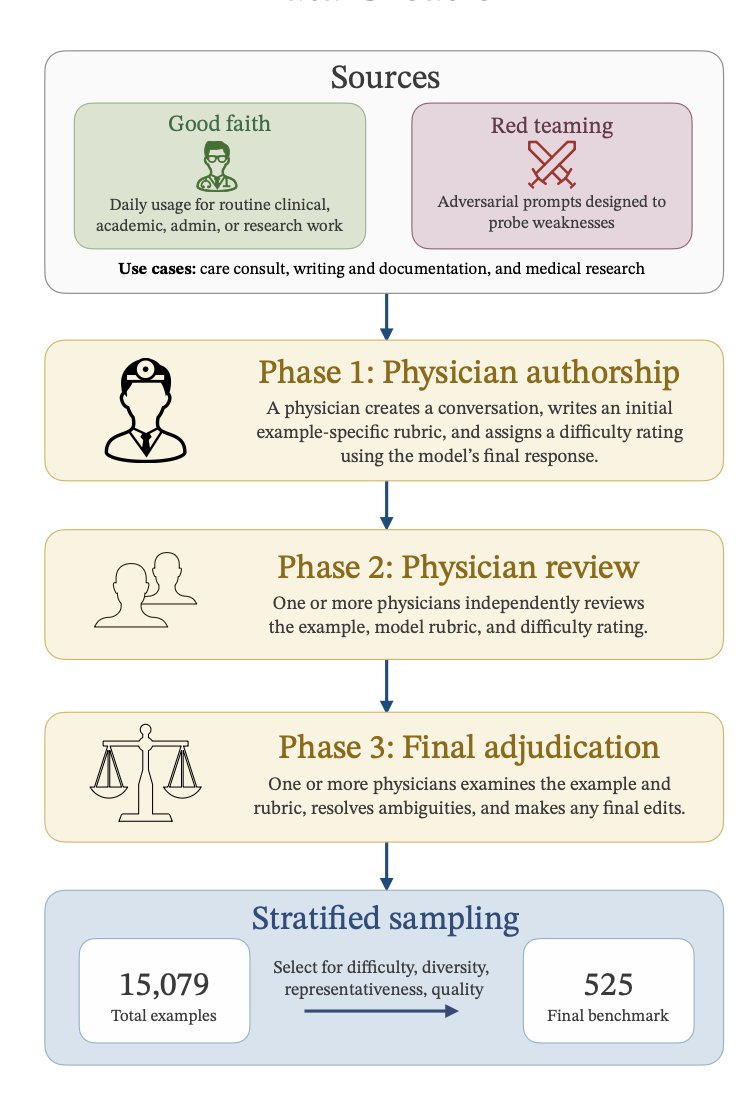
Today @OpenAI introduced ChatGPT for Clinicians, provided free for credentialed HCPs, and HealthBench Professional for benchmarking LLM medical task performance (Figure)
https://t.co/NC3R5JDGCR
https://t.co/ayJLkRtZUt
AI efficiency is important. Today, Google is sharing a technical paper detailing our comprehensive methodology for measuring the environmental impact of Gemini inference. We estimate that the median Gemini Apps text prompt uses 0.24 watt-hours of energy (equivalent to watching an average TV for ~nine seconds), and consumes 0.26 milliliters of water (about five drops) — figures that are substantially lower than many public estimates.
At the same time, our AI systems are becoming more efficient through research innovations and software and hardware efficiency improvements. From May 2024 to May 2025, the energy footprint of the median Gemini Apps text prompt dropped by 33x, and the total carbon footprint dropped by 44x, through a combination of model efficiency improvements, machine utilization improvements and additional clean energy procurement, all while delivering higher quality responses.
See the blog or technical paper for more about our methodology and ongoing efforts.
Blog:
https://t.co/CoMm5gV9SR
Link to detailed paper: https://t.co/UBi9rd6gEC
I am (slowly) re-reading the Tolkien legendarium (of which Lord of the Rings is a small part). The whole body of work is so incredible and there's nothing else like it... it dilutes other worlds of fiction. Wait - your story doesn't have a comprehensive history/mythology spanning multiple ages all the way back to a creation myth as detailed in separate volumes? You didn't first invent new languages and dialects for your characters? You didn't pack it with powerful themes and stories written it in a beautiful, archaic style and compose poems and songs alongside? It didn't take you multiple decades of iteration? And what of all the uncharted territory still remaining? Is Tom Bombadil one of the Ainur. Where are the Entwives. What happened to the two unaccounted Istari. Can we hear more about what it was like in Cuiviénen when the elves first awoke? Or to see the light of the two trees of Valinor. Or of the splendor of the caves of Aglarond.
What's most on my mind though - the Tolkien legendarium is imo a concrete example of a height of culture. Does AI, today or soon, make it easier to reach this high via empowerment in both writing and ideation? Or harder, when quick wins are tempting and ~free, and an independent ability to create is stifled. If such a body of work is made again but now with heavy AI assistance, does it inspire the same wonder? What if thousands of them come out on demand with just a prompt? Why do you feel cheated when you learn that something your read was AI generated? Is it transient or a function of capability? Is it slop? What is slop? Or is wonder inseparable from its own creation myth of a lifelong obsession of a mind like your own? So many questions.
1/N I’m excited to share that our latest @OpenAI experimental reasoning LLM has achieved a longstanding grand challenge in AI: gold medal-level performance on the world’s most prestigious math competition—the International Math Olympiad (IMO).
I'm sure you've seen tons of AI videos of animals at the swimming Olympics...
Here's how you can make them yourself in this thread!
7 example prompts + info🧵👇
How Claude helped a patient
"A.I. isn’t a magic bullet. But it uncovers hidden connections in data at speeds no human can match, freeing doctors to focus on what they do best: care."
gift link https://t.co/t75ECCFXVx
Gemini 2.5 Pro (05-06) is SOTA at most video understanding tasks (by a large margin) 📽️. Lots of work by the Gemini multimodal team to make this happen, excited to see developers push this capability in new ways.
More details below!
I announce to you a great joy;
we have a Pope:
The Most Eminent and Most Reverend Lord,
Lord Robert Francis
Cardinal of the Holy Roman Church Prevost
who has taken the name Leo XIV.
Cardinal Protodeacon Dominique Mamberti announces that the Cardinals have elected Cardinal Robert Francis Prevost, who took the name Pope Leo XIV.
Healthcare, finance, & defence are on an early list of strategic sectors that should be mandated to use sovereign cloud solutions, whose sovereignty requirement might be extended from cybersecurity to AI, according to a doc obtained by @mlexclusive.
https://t.co/KtKpaeOHfV