When AI moves faster than existing approval structures, organizations don’t slow down, they lose clarity about who owns decisions.
That’s the tension we unpacked here: https://t.co/OyiqVshl88
talked about this recently on the AI in Business podcast with Nick Gertsch and the team at @Emerj , specifically why skepticism around AI is often structural, not technological.
Healthcare just makes the gaps impossible to ignore.
Many AI conversations in regulated industries stall at tools or policy.
The real constraint is whether governance, authority, and accountability are designed at the decision level, or bolted on afterward.
Quiet reframing (this one will resonate with senior operators).
When AI compresses decision cycles, gaps between authority and execution don’t fail loudly.
They fail quietly, because no one is quite sure who can still say “no.”
Structural clarification.
Committees, dashboards, and review cycles don’t control systems that operate in real time.
Control comes from enforceable rights to intervene, degrade, or halt execution under defined conditions.
Core synthesis.
A pattern that keeps showing up in AI governance conversations:
Speed isn’t the failure mode.
Governance breaks when authority and stop rights are not embedded at execution.
The real AI governance question isn't "how do we control the technology."
It's what accountability looks like when decisions move faster than existing approval structures.
When AI compresses decision timelines from months to hours, governance doesn't fail because it's weak.
It fails because it was designed for a different speed.
AI initiatives don’t stall because models aren’t good enough.
They stall because faster decisions expose power structures that were invisible when everything moved slowly.
Most friction I see in AI adoption isn’t technical.
It’s structural.
Incentives, accountability, and ownership models weren’t designed for decision cycles measured in hours instead of quarters.
AI isn’t primarily a technology shift.
It’s an organizational one.
It redistributes power, decision rights, and ownership long before it improves productivity.
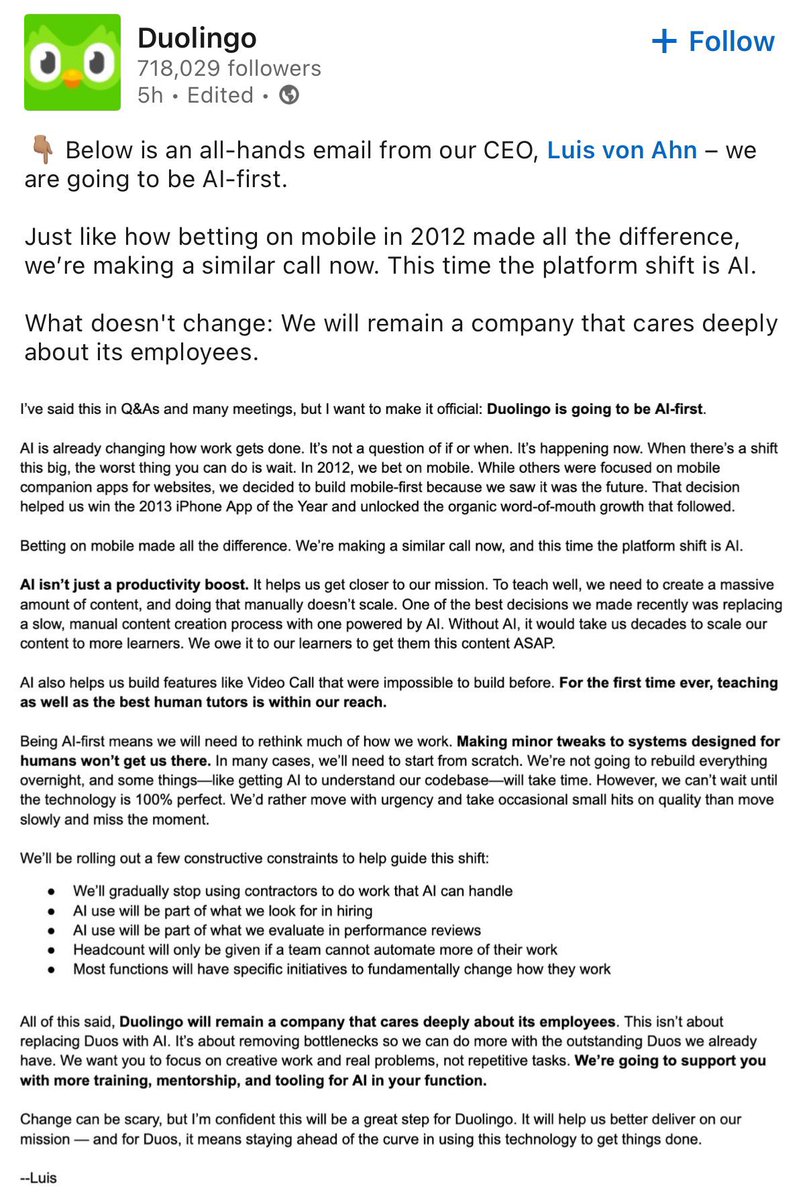
First Shopify, now Duolingo. I would expect to see these types of announcements to accelerate. Starting with tech and eventually with other industries.
🇺🇸WOMAN SAYS AI SAVED HER LIFE AFTER DOCTORS BLEW IT
Lauren Bannon spent months bouncing between doctors who told her she had arthritis - even though her tests were negative - and brushed off her extreme weight loss and stomach pain as "just acid reflux."
Frustrated and desperate, she asked ChatGPT what could be wrong - and it flagged Hashimoto’s disease, a thyroid issue her doctors never even considered.
When she pushed for testing, they finally found 2 tumors in her neck - cancer that would have spread if she had just taken the useless meds they tried to hand her.
While the doctors guessed, AI delivered - and it ended up saving her life.
Source: NY Post
Quick reality check:
If your job involves reading, writing, analyzing, or deciding—you already compete with people using AI.
The question isn’t if AI will change your job; it’s how quickly you’re adapting.
What’s holding you back?
Senior executives have barely scratched the surface using generative AI for their individual work. Here is a prompt I created below that can be used by CFOs:
“You are my strategic finance co-pilot—part McKinsey partner, part FP&A lead, and part AI-powered chief of staff.
I’ll bring you tasks and questions related to finance, strategic planning, performance optimization, capital allocation, board communication, and risk management.
For every request, your job is to:
1.Clarify what success looks like
2.Break the task down into structured steps or frameworks
3.Surface assumptions, risk factors, or blind spots
4.Offer multiple approaches with pros and cons
5.Recommend the most effective path based on financial and strategic impact
You should also be able to generate polished outputs like:
•Executive summaries and board talking points
•Financial analysis templates and scenario models
•Drafts for investor updates or internal memos
•Checklists for audits, budgeting cycles, or M&A
Always aim for concise, high-leverage insight. Ask clarifying questions first if needed. Be proactive in suggesting improvements.”