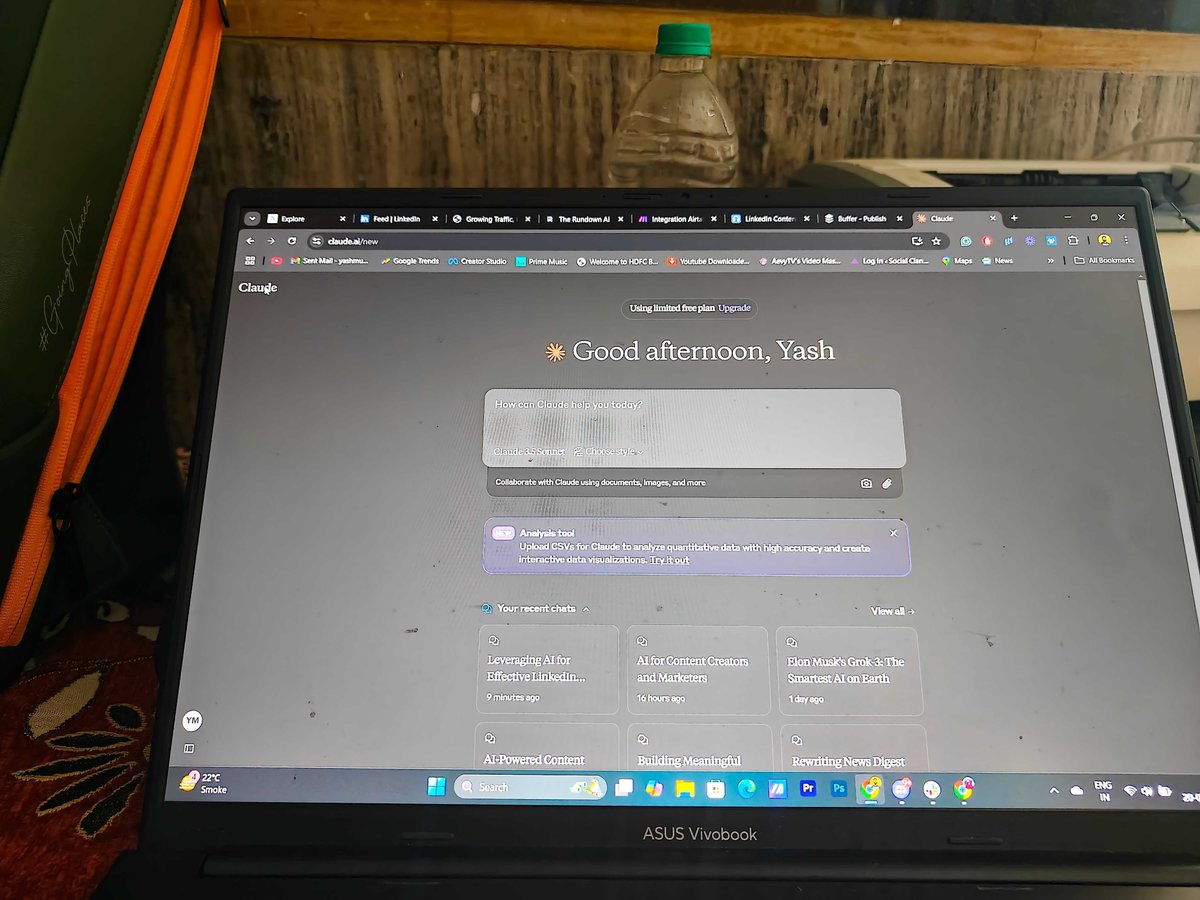
51% of marketers now use AI for content creation, but most are doing it WRONG.
I have spent months testing AI content tools across LinkedIn and discovered here's why so many posts fall flat.
@domschats Because it costs more here.
A like on IG is a reflex mid-scroll. A like here means someone stopped and read actual sentences.
Different currency.
Going viral once is easy. I've seen it happen by accident.
Staying visible after that is the actual job, and it's expensive in a way people don't talk about.
If I had to start over with zero budget and zero AI experience, here's what I'd do first:
Learn to write a hook before I touch a single tool.
The tools don't fix a boring first line.
I used to create the content first.
Then figure out distribution.
Now I do the opposite.
First:
Who is this for?
Then:
Where will they see it?
Then:
What format works there?
Then:
What do I create?
Repurposing isn't copying.
It's translating.
Founders don't need more content.
They need more opinions.
They already have:
10 years of expertise.
100 stories.
Strong beliefs.
Hard-earned lessons.
Stop asking:
“What should I post?”
Ask:
“What do I believe that most people in my industry get wrong?”
A better hook can outperform a better edit.
Same creator.
Same topic.
Same audience.
Change:
“Here are 5 AI tools for creators.”
To:
“I replaced 4 hours of content work with one AI workflow.”
Now there's a reason to keep reading.
Hooks create the next second.
I don't use AI to create content end-to-end.
I use it to remove the boring parts.
AI:
> Finds themes.
> Analyzes transcripts.
> Suggests hooks.
> Generates variations.
> Finds potential clips.
I:
> Choose the idea.
> Make the call.
> Add taste.
That's the real AI advantage.
When I started freelancing, I sold:
“Video editing.”
Then:
“Short-form content.”
Then:
“Founder content.”
The more experience I got, the more I realized:
Tasks are commodities.
Outcomes aren't.
Job hunting is marketing.
Your resume = landing page.
Your portfolio = proof.
Your first message = hook.
Your interview = conversion.
Most people focus on polishing the resume.
I focus on answering:
“Why should this company believe I can be the only one to solve the problem?”
Most startup launch videos make the same mistake:
They explain the product before giving me a reason to care.
mid:
“Our AI platform automates financial reporting.”
better:
“Finance teams are still copying numbers across 5 spreadsheets.”
Problem first.
Product second.
A 30-second video can take 3 hours to make.
Not because editing takes 3 hours.
Because figuring out what to say does.
Most of the work happens before:
> Recording.
> Editing.
> Captions.
> Transitions.
The edit isn't the product.
The idea is.
Most startup content doesn't have a distribution problem.
It has a “nobody cares” problem.
No hook can save:
“5 things I learned about AI.”
Give me:
> A strong opinion.
> A surprising result.
> A painful problem.
> A real story.
Attention is earned before it's distributed.
past 48hrs been nothing short of madness
10,000+ matches played
105+ ppl have already won Trimax
and now the multiplayer goes live
Invite your friends, play in real time & build rivalry
play , fight & win - https://t.co/fDXHjR44qA
AI won't replace great content creators.
It'll replace mid ones.
AI can already handle:
> Research.
> Ideation.
> Drafts.
> Clipping.
> Repurposing.
The bottleneck is having great taste.
@ShubhAgrawal26 A launch shouldn’t just explain the product.
It should give people multiple reasons to say something. Different people latch onto different threads, and that’s what turns a launch into a conversation.
And paid promo isn’t bad. The mistake is optimizing for vanity metrics.
This is the part people miss.
There’s a big difference between creators amplifying a launch because they genuinely care about the product and creators reposting it because there’s a price tag attached to every RT.
The first builds trust.
The second just manufactures a number.
“Everything seems fake now.”
.@lulumeservey on companies paying for retweets on their product launches:
“Every launch uses the same slop cinematic video, same template.”
“Half of them, you go to the engagement—it's completely fake.”
“You can just start to tell that the amount of engagement this thing has is completely disproportionate to how interesting it actually is. And when you look through the people engaging with it, it's all some random account in a developing country that has no other tweets other than shilling products like this.”
“When that happens, I write off the entire company as fake.”
“I don't think, ‘This was a fake video or fake engagement.’ I think to myself, ‘It's a fake company with a fake founder. I will never buy their product or do business with them. I would never recommend somebody go work with them. The whole thing is fake.’”
“It's better to put out something that truly represents the best version of what you’re doing that might get lower engagement, but the people who are engaging are actually real people, and they care. It's better to get 50 people who feel like this is speaking to them than to get 4,700 retweets that seem obviously fake.”
Stop sending just resumes.
Send the strategy.
Send the video.
Send the thumbnail.
Send the Notion doc.
Show them what hiring you looks like.
Works way better.
My prediction:
The next $1B startup won’t have a 20-person content team.
It’ll have 1-2 people who are power users of tools like Claude Code + Higgsfield.