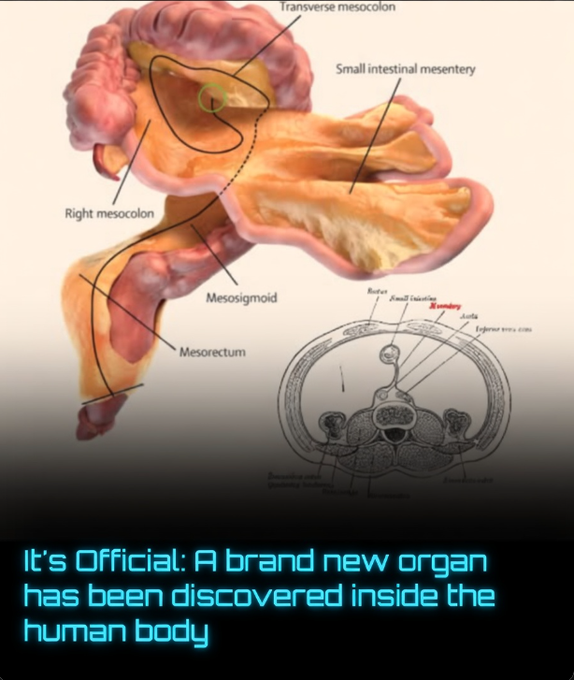
Scientists have officially discovered a brand-new organ in the human body.
The mesentery — a structure long thought to be a collection of fragmented tissues holding the intestines in place — has been reclassified as a single, continuous organ. This landmark discovery, led by researcher J. Calvin Coffey at University Hospital Limerick, has fundamentally changed our understanding of human anatomy.
For centuries, the mesentery was dismissed as insignificant. Now, thanks to detailed research, it is recognized as one unified structure. The finding was so significant that it has already been incorporated into the latest edition of Gray’s Anatomy, the world’s most respected medical textbook.
While the mesentery’s main function is to anchor and support the intestines, scientists believe it plays far more complex roles that are still not fully understood. Its formal recognition has given rise to an entirely new field called mesenteric science. Researchers hope that studying this organ will unlock new insights into digestive diseases, abdominal disorders, and potentially lead to better treatments for millions of patients.
This discovery is a powerful reminder that even today, the human body still holds remarkable secrets waiting to be uncovered.
SpaceX has exercised the option to acquire @cursor_ai in an all-stock transaction with the goal of building the world’s most useful AI models.
For the past few months, SpaceXAI has been jointly training a model with Cursor, which will be released in Cursor and Grok Build soon.
We look forward to working closely with the Cursor team to advance our frontier AI capabilities
Dear old people,
Tending to a garden is not boring. It’s one of the best ways to move the body while calming the nervous system.
I was wrong. You were right.
Artificial intelligences do not undergo experiences, do not possess a body, do not feel joy or pain, do not mature through relationships, and do not know from within what love, work, friendship or responsibility mean. Nor do they have a moral conscience, since they do not judge good and evil, grasp the ultimate meaning of situations, or bear responsibility for consequences. They may imitate or even simulate, but they do not understand what they produce, for they lack the affective, relational, and spiritual perspective through which human beings grow in wisdom. #MagnificaHumanitas
Russell Crowe handled this situation well. He's speaking to adults, not little kids, and set some boundaries. Everyone in public should be held to basic standards of conduct and manners.
No electricity, no fuel, just water. The Bunyip Pump is transforming the way irrigation works in Australian farms.
Gravity-powered, it uses the energy of falling water to pump a smaller volume of water uphill, without the need for electricity or fuel.
This is what I call "The Death of the Reader".
Authors write for readers, who aren't authors. Artists paint for non-artists. Musicians play for non-musicians.
This keeps fiction, art, and music grounded.
But when any group stops creating for an external audience, and starts trying to impress only each other, they create a weird, self-reinforcing feedback loop.
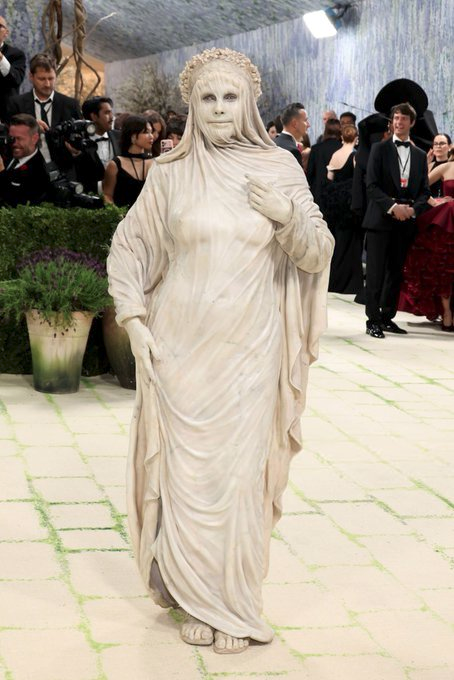
This isn't clothing, or even fashion. It's a costume party. They're all trying one-up each other with something weirder and more eye-catching.
So when an athlete, of recent and topical celebrity, who isn't a part of their Bored Billionaires' Club, shows up in a dress that's just a dress, of course they are going to mock her. She's just revealed that she didn't get the memo. That she's not an insider.
How she looks to the world at large is not the point.
This is why 99.999...% of copies of "Infinite Jest" have never been read. This is why John Cage "wrote" four minutes of silence. This is why competitive bodybuilders from the 80s looked like Greek gods, and modern ones look like gargoyle freaks.
It's all the Death of the Reader.
Hollywood doesn't make movies for you now. They hate you. They make movies for each other.
And then cry about how you didn't buy a ticket, because they think your only role is to pay for their onanistic circle of self indulgence.
This game isn't going to stop. It's just going to keep getting weirder until someone's dress malfunctions and catches fire, and the rest of us all have a good laugh.
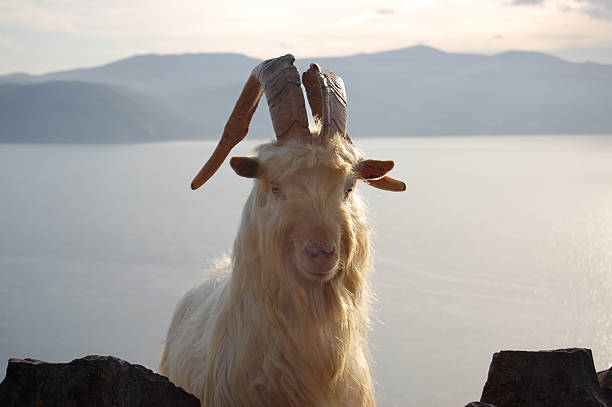
People ask me why I'm so fond of goats.
Here's why.
A goat will wander up the side of a Welsh cliff that a sheep wouldn't attempt and a hiker wouldn't survive, eat the brambles and gorse and thistles that nothing else on the farm can stomach, and turn the lot into milk so digestible that even the people allergic to cow's dairy can drink it without incident.
She thrives on land that grows nothing else. She fertilises it as she goes. She maintains scrubland that would otherwise become a fire hazard. She produces milk with smaller fat globules and a different protein structure to cow's milk, which is why human infants have been raised on it for ten thousand years when nothing else was on offer.
Her cheese is the oldest cheese on earth. Her meat fed the Mediterranean before olive oil was a brand. Her hide bound the first books. Her hair made the tents that crossed the Sahara. Her milk built the Maasai and the Berbers and the goatherds of every uplands the planet has.
And the modern response to all of this has been to tell us she is somehow the wrong animal.
The cheek of it.
I'll back the creature that has fed humans on every continent except Antarctica over an almond drink invented by a man with a blender in 1998.
As an avid cyclist, I was amused to see ChatGPT's “powerful new image engine" draw a bicycle with the "brake" label pointing to empty space where brakes are sometimes found on other bicycles. The point of these AI fails (regularly collected by @garymarcus) is not that LLMs are useless or unintelligent but that they think differently from humans, lacking explicit knowledge of reality and instead amalgamating billions of statistical generalizations. https://t.co/PzFsjgVVkx
A British egg in 1955 came from a hen that had been outside that morning.
The hen had eaten grass, slugs, beetles, worms, and whatever the farmer's wife had thrown into the run from the kitchen. The yolk of the egg was orange, occasionally so deep an orange it looked almost red. It stood up in the pan when you cracked it. The white was thick enough that you could lift the egg by its yolk on a fingertip if you were careful and the egg was fresh enough.
The hen produced perhaps 180 eggs a year. The flock was small, twelve to twenty birds, attached to the farm or the smallholding or the back garden. Eggs were seasonal, abundant in spring and summer, scarce in autumn, almost absent in winter. A British family in 1955 ate eggs when the hens were laying and ate something else when they weren't.
A British egg in 2026 comes, in the overwhelming majority of cases, from a barn of 16,000 birds confined under artificial light at carefully controlled temperature, fed a formulated diet of soy, wheat, and synthetic vitamins, producing 320 eggs a year per hen by extending the lay through the winter dark months.
The yolk is yellow because the feed contains a synthetic carotenoid called canthaxanthin, dosed to produce the colour the consumer expects. The yolk does not stand up in the pan. It collapses under its own weight, spreading thin across the surface like a slow puddle.
The pasture-raised egg contains roughly three times the omega-3, twice the vitamin E, considerably more vitamin A and D, and more folate than the commodity egg. The peer-reviewed literature has been saying this for twenty years.
The egg has been the standard breakfast protein on the British plate for four hundred years. The modern egg looks like the old egg, costs roughly the same, and delivers approximately a third of the nutrition.
The British shopper, examining the box at Tesco, has no way of knowing this. "Free range" means the hen had access to a door that was theoretically open at some point during her productive life.
A pasture-raised egg from a small producer at the farmers' market costs approximately 50p. A commodity egg from Tesco costs approximately 25p. The price difference is the entire reason the system exists.
Find a small producer. Pay 50p. The yolk will tell you what an egg used to be.