Our internal data shows Claude is accelerating AI development—a possible path to recursive self-improvement, or AI autonomously building a more capable successor.
It’s happening faster than we thought, and the implications deserve greater attention. https://t.co/OVVPJO7VQx
One of the new, buzzy jobs in Silicon Valley is the AI Forward Deployed Engineer (FDE), an engineer who is embedded within a client organization to help customize solutions, such as building and tuning agentic workflows that suit the client’s particular needs. I’ve heard from people who are wondering anew about the FDE career path since OpenAI and Anthropic started building new teams to place FDEs within client organizations.
The rise of FDEs for AI workloads is one way AI is creating new jobs (and why the jobpolcalypse narrative of upcoming job market collapse is false -- there will be many AI and non-AI jobs). However, I believe there will be far more AI Engineer jobs than FDEs, as I explain below.
The FDE role was pioneered about two decades ago by Palantir, which sent engineers to government locations to work on secure, air-gapped networks. In addition to having good technical skills, FDEs need communication skills and sometimes business skills. For example, they may need to speak with clients to understand their needs, formulate a strategy to prioritize projects, explain complex technology, and respectfully push back if a client asks for something unrealistic. They’re enjoying a resurgence because of the amount of work involved in taking an off-the-shelf LLM and building it into a custom agentic workflow that fits particular business needs.
However, I believe the number of AI Engineer jobs will be far larger. A company might accept a few FDEs to be embedded within its organization. But most companies will want far more of their own employees working on their projects. While my organizations do hire FDEs, we hire far more AI Engineers! Also, a common client concern is that it is hard to find vendor-neutral FDEs — they are, after all, there to deeply integrate a particular vendor’s product into a company. In this moment when it’s hard to predict which AI service will be the best one in a year’s time, optionality (the ability to pick whatever vendor turns out to fit best in the future) is very valuable. In contrast, letting FDEs tightly bind a company’s processes significantly reduces optionality.
Right now, I see surging demand for AI Engineers who can build software applications using AI software components (like LLM prompting, agentic frameworks, evals, etc.) and effectively use AI coding agents (like Claude Code, Codex, Antigravity CLI, and OpenCode). As the AI Engineer role matures, I expect it to fragment into more specialized roles, like the generic Software Engineer role from decades ago fragmented into frontend, backend, mobile, data engineering, devops, and so on.
What will be the future, specialized AI engineering roles? I don’t know. Perhaps there will be AI FDEs, LLMOps Engineers, Evals Engineers, AI Data Engineers, Harness Engineers, and other roles we don’t have names for yet. But for now, I see a lot of AI engineers who are generalists create a lot of value. Skilled AI Engineers are in very high demand! As our field continues to mature over the coming decade, I look forward to new specializations within AI Engineering that create even more job opportunities.
[Original text: The Batch newsletter]
💡Recent insight: gaslighting @claudeai seems to improve code quality >90% of the time.
“You overengineered this, there is a simpler way”
“There is a smaller delta that buys us most of the benefits”
“There is a more elegant way”
“This is not architecturally coherent”
…before I even read its code. 😆
Excited to share our most powerful new Claude Code feature: dynamic workflows!
Mention "workflow" in a prompt and Claude will dynamically create an orchestration plan that it strictly follows, allowing you to confidently trust that every stage happens in the right order even across 100s of agents.
introducing thermos in cursor
a deep security/correctness audit and a harsh code quality audit, run in parallel on your branch, synthesized into one prioritized list
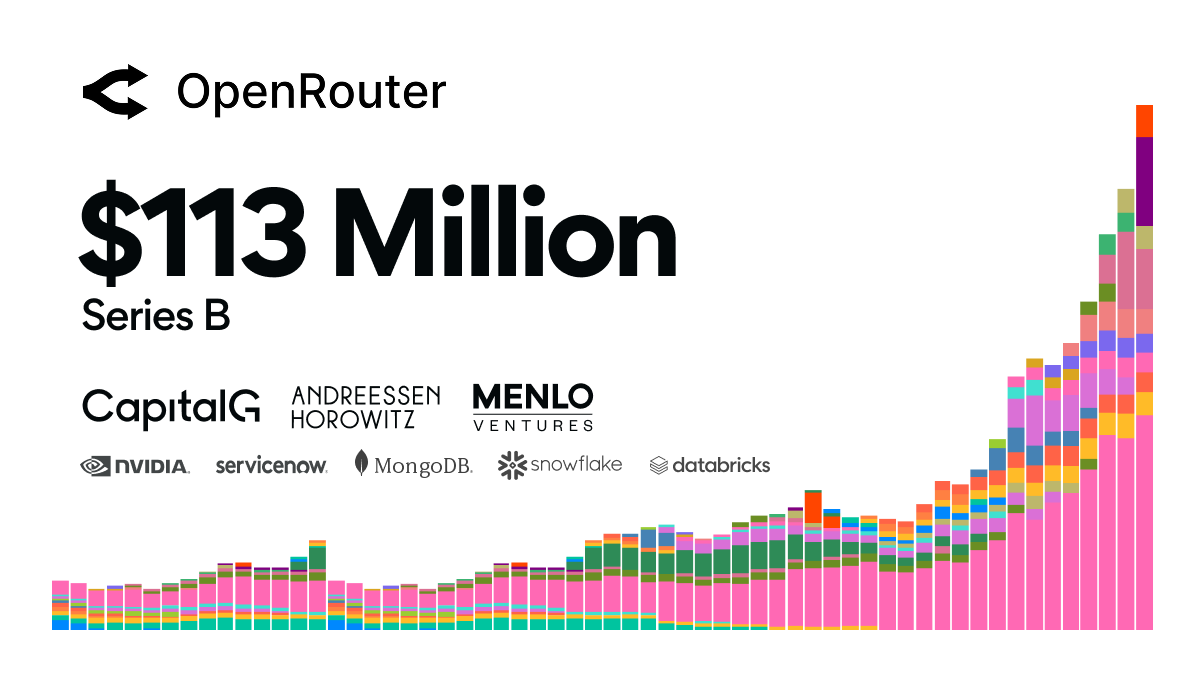
Today we’re announcing our $113M Series B led by @CapitalGVC.
Over the last 6 months, weekly volume on OpenRouter grew from 5T to 25T tokens as AI rapidly shifts from experimentation into production.
We’re excited for what comes next.
How to become expert at thing:
1 iteratively take on concrete projects and accomplish them depth wise, learning “on demand” (ie don’t learn bottom up breadth wise)
2 teach/summarize everything you learn in your own words
3 only compare yourself to younger you, never to others
the most used skill internally at cursor right now
/thermo-nuclear-code-quality-review
- deletes complexity instead of moving it
- blocks files over 1k lines
- flags thin wrappers and leaked logic
- rejects PRs that work but make code messier
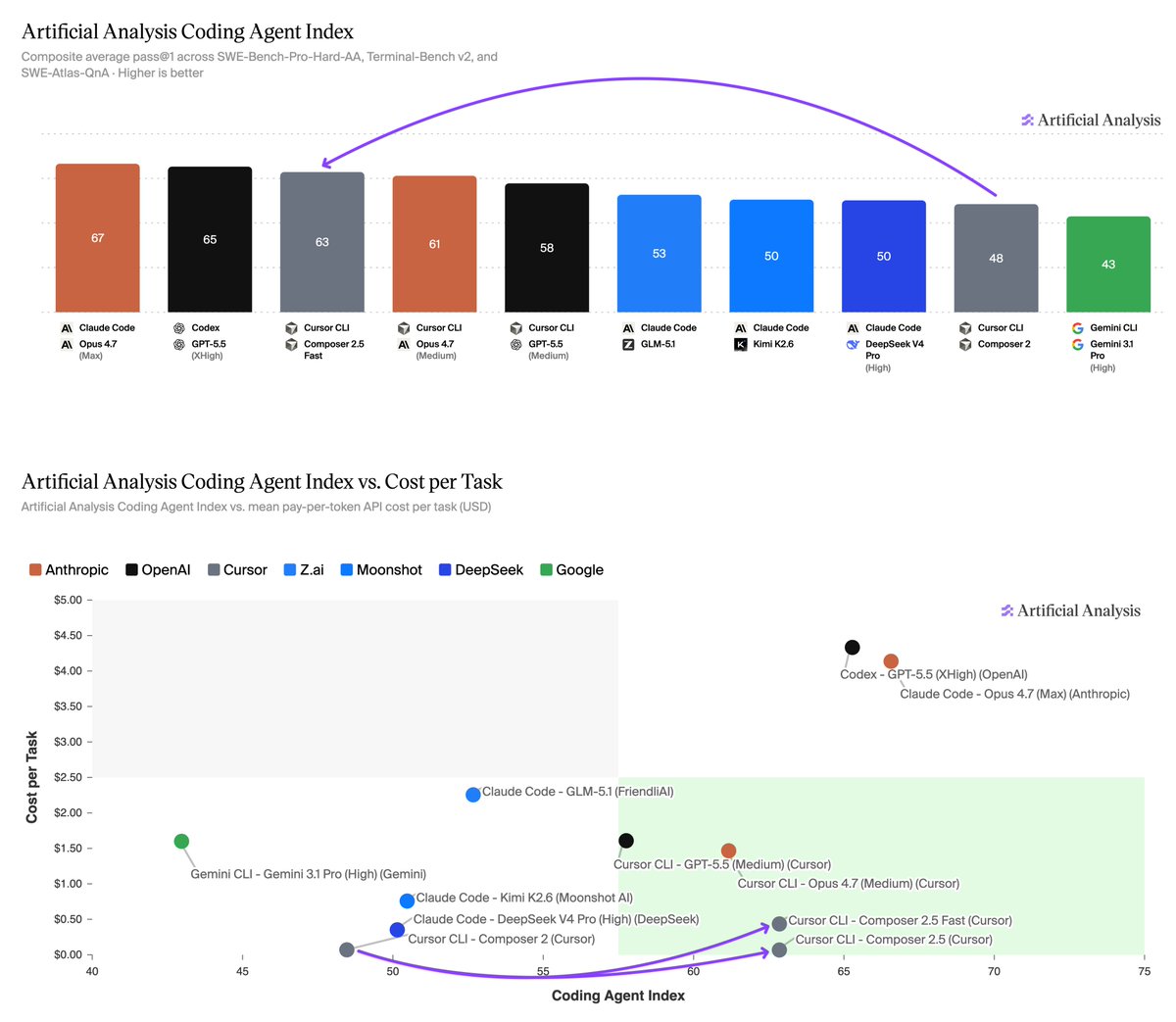
Cursor's new Composer 2.5 takes third on the Artificial Analysis Coding Agent Index and is ~10-60x lower cost than the higher-effort Opus 4.7 and GPT-5.5 variants above it. This release puts Composer among the leading coding agent models, something that wasn’t clear for past releases
@cursor_ai has released Composer 2.5, the latest model in its Composer line. Composer 2.5 scored 62 on our Coding Agent Index, a 14 point gain over Composer 2 (48). This puts it in third place of our tested agents, behind only Claude Opus 4.7 (max) in Claude Code (66) and GPT-5.5 (xhigh reasoning) in Codex (65). These cost $4.10 and $4.82 per task respectively, ~10x the cost of Composer 2.5 Fast ($0.44) and ~60x the cost of Composer 2.5 standard ($0.07).
Key results for Composer 2.5 in Cursor CLI:
➤ Cost-quality Pareto frontier: At $0.07 (standard) and $0.44 (Fast) per task, Composer 2.5 is cheaper than every other agent scoring above 60 on the Index. Medium-effort peers cost $1.24–$2.21 per task; higher-effort variants land 3-4 points above at $4.10–$4.82
➤ Per-benchmark gains vs Composer 2: +35 points on SWE-Bench-Pro-Hard-AA (12% → 47%), +2 points on Terminal-Bench v2 (64% → 66%), and +3 points on SWE-Atlas-QnA (69% → 72%). At 47%, Composer 2.5's score on SWE-Bench-Pro-Hard-AA is comparable to Claude Opus 4.7 (max) in Claude Code
➤ Among the fastest coding agents: Composer 2.5 Fast runs at an average wall time of 6.7 minutes per task, the third-fastest agent on the Artificial Analysis Coding Agent Index, behind only Claude Opus 4.7 (medium) in Claude Code (5.8m) and GPT-5.5 (medium) in Cursor CLI (6.2m)
➤ Fast mode enables better responsiveness at 6x pricing: Fast runs 30% faster than standard Composer 2.5, but is ~6x the cost per task ($0.44 vs $0.07). Token pricing is 6x higher for Fast: $3.00/$15.00 vs $0.50/$2.50 per million input/output tokens
Model details:
➤ Base model: Continued training on @Kimi_Moonshot's open weights Kimi K2.5 as with Composer 2, with Cursor reporting ~85% of total compute from its own additional training and reinforcement learning
➤ Pricing: $0.50/$2.50 per million input/output tokens for the standard variant; $3.00/$15.00 for the Fast variant (the default in Cursor)
➤ Available exclusively in Cursor: both Cursor IDE and Cursor CLI, an externally accessible API is not available
Congratulations @cursor_ai and @mntruell on the impressive release!
I built a todo list app simply by describing it to GPT-3.
It generated the React code for a fully functioning app within seconds.
I'm becoming more impressed and aware of its capabilities every single day.





![AndrewYNg's tweet photo. One of the new, buzzy jobs in Silicon Valley is the AI Forward Deployed Engineer (FDE), an engineer who is embedded within a client organization to help customize solutions, such as building and tuning agentic workflows that suit the client’s particular needs. I’ve heard from people who are wondering anew about the FDE career path since OpenAI and Anthropic started building new teams to place FDEs within client organizations.
The rise of FDEs for AI workloads is one way AI is creating new jobs (and why the jobpolcalypse narrative of upcoming job market collapse is false -- there will be many AI and non-AI jobs). However, I believe there will be far more AI Engineer jobs than FDEs, as I explain below.
The FDE role was pioneered about two decades ago by Palantir, which sent engineers to government locations to work on secure, air-gapped networks. In addition to having good technical skills, FDEs need communication skills and sometimes business skills. For example, they may need to speak with clients to understand their needs, formulate a strategy to prioritize projects, explain complex technology, and respectfully push back if a client asks for something unrealistic. They’re enjoying a resurgence because of the amount of work involved in taking an off-the-shelf LLM and building it into a custom agentic workflow that fits particular business needs.
However, I believe the number of AI Engineer jobs will be far larger. A company might accept a few FDEs to be embedded within its organization. But most companies will want far more of their own employees working on their projects. While my organizations do hire FDEs, we hire far more AI Engineers! Also, a common client concern is that it is hard to find vendor-neutral FDEs — they are, after all, there to deeply integrate a particular vendor’s product into a company. In this moment when it’s hard to predict which AI service will be the best one in a year’s time, optionality (the ability to pick whatever vendor turns out to fit best in the future) is very valuable. In contrast, letting FDEs tightly bind a company’s processes significantly reduces optionality.
Right now, I see surging demand for AI Engineers who can build software applications using AI software components (like LLM prompting, agentic frameworks, evals, etc.) and effectively use AI coding agents (like Claude Code, Codex, Antigravity CLI, and OpenCode). As the AI Engineer role matures, I expect it to fragment into more specialized roles, like the generic Software Engineer role from decades ago fragmented into frontend, backend, mobile, data engineering, devops, and so on.
What will be the future, specialized AI engineering roles? I don’t know. Perhaps there will be AI FDEs, LLMOps Engineers, Evals Engineers, AI Data Engineers, Harness Engineers, and other roles we don’t have names for yet. But for now, I see a lot of AI engineers who are generalists create a lot of value. Skilled AI Engineers are in very high demand! As our field continues to mature over the coming decade, I look forward to new specializations within AI Engineering that create even more job opportunities.
[Original text: The Batch newsletter]](https://pbs.twimg.com/media/HJvWmCHagAAnTxQ.jpg)