🥳Excited to share that our paper has been accepted to
@COLM_conf, which will be held next month!
Great thanks to my advisors @kojima_tks, Yusuke Iwasawa, and @ymatsuo.
Looking forward to meeting many researchers and having insightful discussions at @COLM_conf!
While LMs excel across domains, they risk generating toxic content. Detoxification methods exist but degrade performance.
Can model merging decouple noise/toxic parameters for detoxification? We explore this by comparing merged vs. existing models.
https://t.co/C3KL6FalfY
🧵
LFM2.5-2.6B is available today on @huggingface
First agentic model of its kind, it destroys our previous release on EVERYTHING 🥲
MOPD and agentic RL unlocked new capabilities we didn't think were possible. Try it today in your favorite harness!
Today we release LFM2.5-Encoder-230M and LFM2.5-Encoder-350M: bidirectional encoders that stay fast at long context, even on CPU.
> LFM2.5-Encoder-230M: about 3.7x faster than ModernBERT-base on CPU at 8,192 tokens. Under 30s per forward pass, versus over a minute and a half.
> LFM2.5-Encoder-350M: 4th of 14 models on GLUE, SuperGLUE, and multilingual classification, behind only three larger models, one of them nearly 10x its size.
🧵
We just released two new encoder models (MLM) in 2026 🚀🚀🚀
They're super fast, easy to train, and strongly multilingual.
Try them today: we created 5 demos on @huggingface
Finally, OrderGrad asks: why stop at the maximum?
ReMax is one order statistic. By changing rank weights, we can optimize top-m, medians, trimmed means, CVaR-like objectives, lower-tail objectives, and more.
The nice part is that the reward transformation can be one line of code, and can be combined with GRPO, DAPO, GSPO, or other REINFORCE-style policy-gradient methods.
Coauthors: @yongmin97, Kohsei Matsutani, Shota Takashiro, @nissymori1, @kojima_tks, Yusuke Iwasawa, Yutaka Matsuo
Introducing LFM2.5-230M: our smallest model yet, built to run fast anywhere (CPUs, NPUs, and GPUs) to enable agentic tasks on phones, robots, home and network automation devices.
> 230M parameters, built on the LFM2 architecture
> Pre-trained on 19T tokens, with a 32K context extension
> Post-trained with distillation from LFM2.5-350M
> 213 tok/s decode speed on Galaxy S25 Ultra (CPU)
> 42 tok/s on a Raspberry Pi 5 (CPU)
> Competes with and often beats models more than twice its size on instruction following, data extraction, and tool use.
> use it for large-scale data extraction pipelines or lightweight on-device agentic workloads.
🧵
Storing too many tools in your context window increases latency and can lead to wrong tool selection.
In this demo, we used LFM2.5-ColBERT-350M as a filter to only select the five most relevant tools among 151 options.
It's fast and reliable, even without any specific fine-tuning.
Try the demo on @huggingface! https://t.co/XhAMqTDzKT
And learn more on our blog: https://t.co/OG5MXl6Kuu
New preprint📣
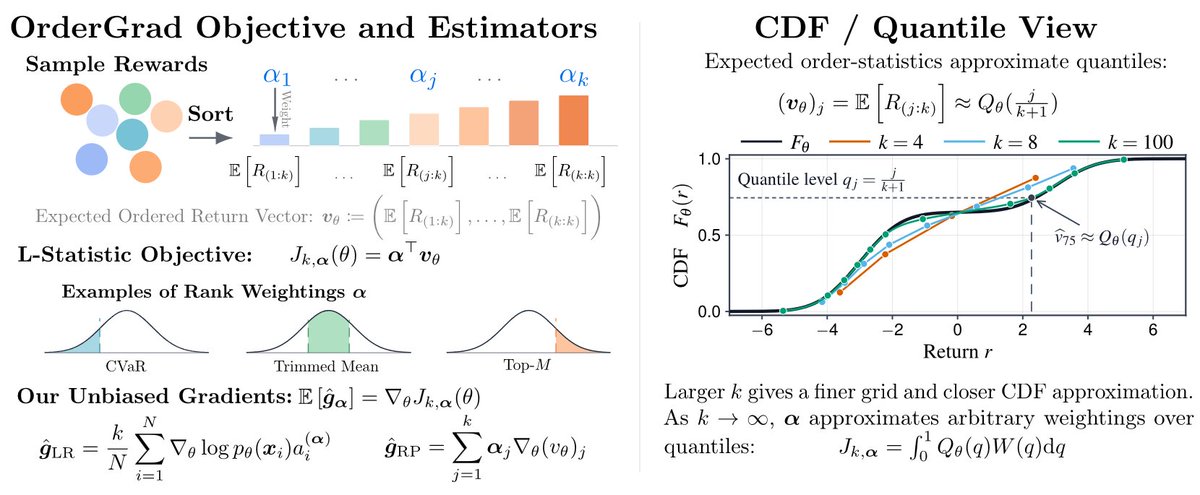
Typical reinforcement learning policy gradient algorithms target the mean reward E[R], while deployment often cares about other properties of the reward distribution: pass@k, max@k, tail risk like CVaR, robust metrics like medians, etc.
We introduce OrderGrad, a method that can flexibly optimize any of these targets via a one line of code reward transformation. Everything else about your code, whether you use GRPO, PPO, REINFORCE can remain unchanged.
Arxiv: https://t.co/aOdAMI5J8S
Code: https://t.co/nDssyjRl5D
🥇🥈🥉OrderGrad is based on order-statistic estimation. Specifically, consider a batch of K sampled rewards and sort them:
R_(1:K) < R_(2:K) < … < R_(K:K)
Now apply weights a_i and take the expected value at each rank:
Sum_i a_i * E[R_(i:K)]
This allows flexibly defining different objectives that target different regions of the reward distribution. Notably, putting all of the weight on the top rank becomes Pass@K / Max@K, but our approach generalizes this to arbitrary ranks. You can target TopM@K, Medians, CVaR, Winsorized means, or any other weighting of your choosing.
The order-statistics connect back to the original distribution in the sense that the j-th order-statistic corresponds roughly to the j/(K+1) quantile of the reward distribution (see the right figure). As K becomes large, the order-statistics converge to the CDF, so essentially, putting weights on the order-statistics is equivalent to weighting different regions of the reward distribution.
Our main contribution is an unbiased gradient estimator for the weighted order-statistic objective when the batch size is N and the subset size for ranking K. Increasing K improves the CDF approximation, but also increases variance (a classical bias-variance tradeoff). We give an estimator in both REINFORCE policy gradient and in reparameterized backpropagation form. Computation time is negligible (<1ms).
I still want to improve the preprint, so comments and suggestions are very welcome. The code is available so please try it out! 🙏
Many thanks to my collaborators:
Paavo Parmas
Yongmin Kim
Kohsei Matsutani
Shota Takashiro
Soichiro Nishimori
Takeshi Kojima
Yusuke Iwasawa
Yutaka Matsuo
“OrderGrad: Optimizing Beyond the Mean with Order-Statistic Policy Gradient Estimation”
Most RL optimizes average reward, but deployment often cares about the best sample, worst tail, median, CVaR, or shorter correct answers.
This paper makes policy gradients optimize sorted rewards directly, by weighting ranks instead of raw rewards.
So Max@K, Top-M@K, trimmed means, medians, and tail-risk objectives all become the same plug-in reward transformation.
On LLM math RL, OrderGrad improves pass@k over GRPO and MaxPO, while also cutting long outputs without collapsing accuracy.
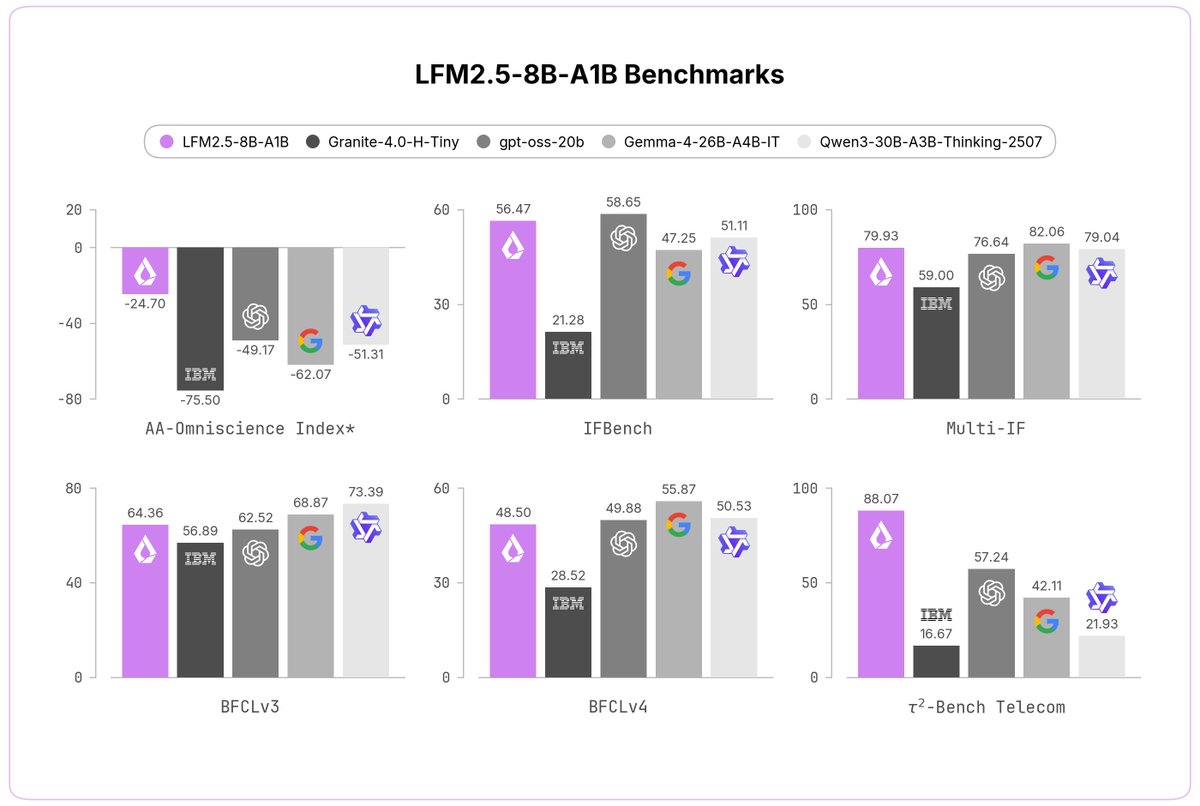
Today, we're releasing LFM2.5-8B-A1B, a device-optimized model designed to power real-life applications on phones, laptops, PCs, robots, and fast & lightweight server-side use-cases.
> 8B MoE, 1.5B active
> Expanded 128K context
> LFM2.5 flagship hybrid MoE architecture
> Trained on 38T tokens + large-scale RL
> fast, reliable tool calling, punching above its weight, comparable to models with up to 4x its size
> customizable on a single GPU for any specialized task
> LFM2 open-weight license
🧵
Our paper was accepted as a #ICML2026 Spotlight!
Reasoning in LLMs has improved largely by chaining local steps. But is that the whole story?
Humans occasionally make inferential "leaps" across domains, a faculty known as analogy.
We design a synthetic task to show how small Transformers acquire analogical reasoning, and find that the same signatures appear in pretrained LLMs.
arxiv: https://t.co/1WCizIKWly
code: https://t.co/82kOKCtJo7
Today, we release LFM2.5-350M. Agentic loops at 350M parameters.
A 350M model trained for reliable data extraction and tool use, where models at this scale typically struggle.
<500MB when quantized, built for environments where compute, memory, and latency are constrained.
🧵
Our paper “MultiBanana: A Challenging Benchmark for Multi-Reference Text-to-Image Generation” has been accepted at #CVPR2026 !🍌
Models like Nano Banana can now compose multiple references into a single scene—but how well do they really do so? We built MultiBanana to find out.
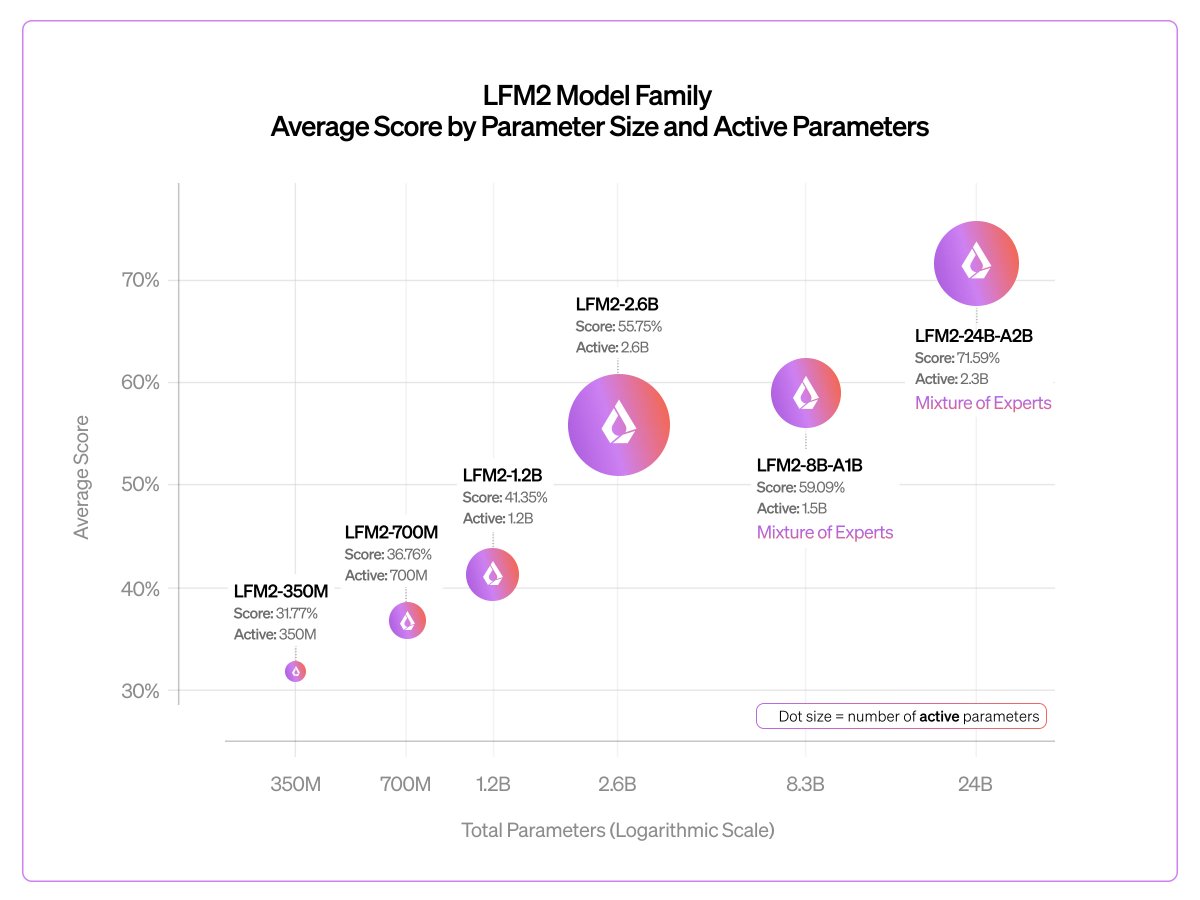
Today, we release our largest LFM2 model: LFM2-24B-A2B 🐘
> 24B total parameters
> 2.3B active per token
> Built on our hybrid, hardware-aware LFM2 architecture
It combines LFM2’s fast, memory-efficient design with a Mixture of Experts setup, so only 2.3B parameters activate each run.
The result: best-in-class efficiency, fast edge inference, and predictable log-linear scaling all in a 32GB, 2B-active MoE footprint.
🧵
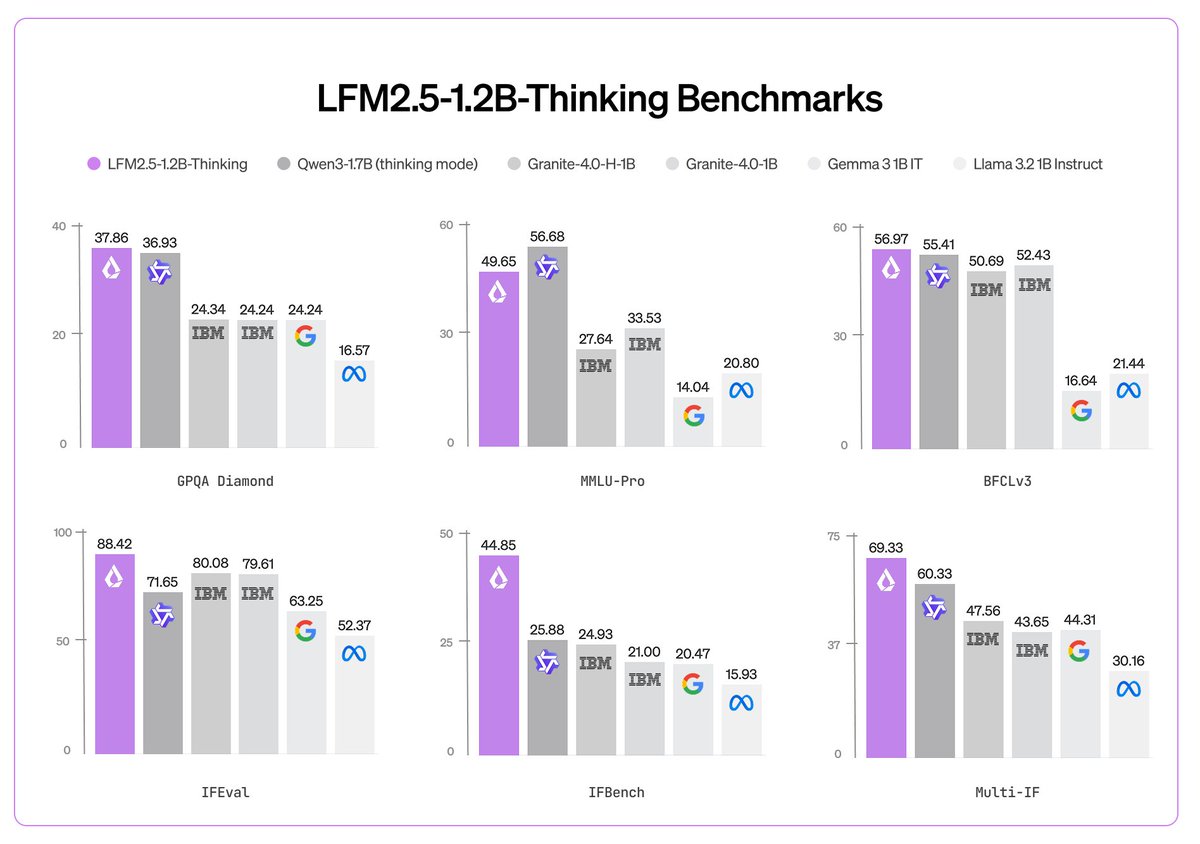
LFM2.5-1.2B-Thinking just dropped on @huggingface
> Best quality + concise reasoning traces
> Fastest inference speed at its size
> Fits in 900MB of memory on a phone
It's a fast, offline, and private reasoning model.
Yesterday at the CES 2026 opening keynote I had the pleasure of joining my role model @LisaSu on stage to share our latest Liquid technology with the world!
AMD is the only company on the planet that covers the entire landscape of AI infrastructure inside and outside of data centers. Lisa shared the “AI everywhere, for everyone” vision with us and had industry leaders acrossmajor segments on to paint the picture of today and tomorrow of AI and computing. Greg Brockman of OpenAI, Amit Jain of Luma, and John Couluris of Blue Origin, and Dr. Fei Fei Li of WorldLabs among others joined the stage, too.
Our team at @liquidai built the most powerful device-class model series on the market with 5 incredible variants including audio, vision and text models that can power on-device agentic AI. I emphasized the importance of reliable, private and fast models, and how to enable proactive agents using LFMs.
A great first Monday of 2026!
Full keynote: https://t.co/z9S4KJ1Hjq
liquid segment: https://t.co/gU0urhWSzo
☃️Three co-authored papers are accepted to #EACL2026 ☃️Congrats to all!
1⃣ proposed ∞-MoE, extending experts to theoretically infinite patterns
2⃣ analyzed multi-hop dependency paths in attention head
3⃣ proposed an uncertainty quantification method by semantic token-clustering
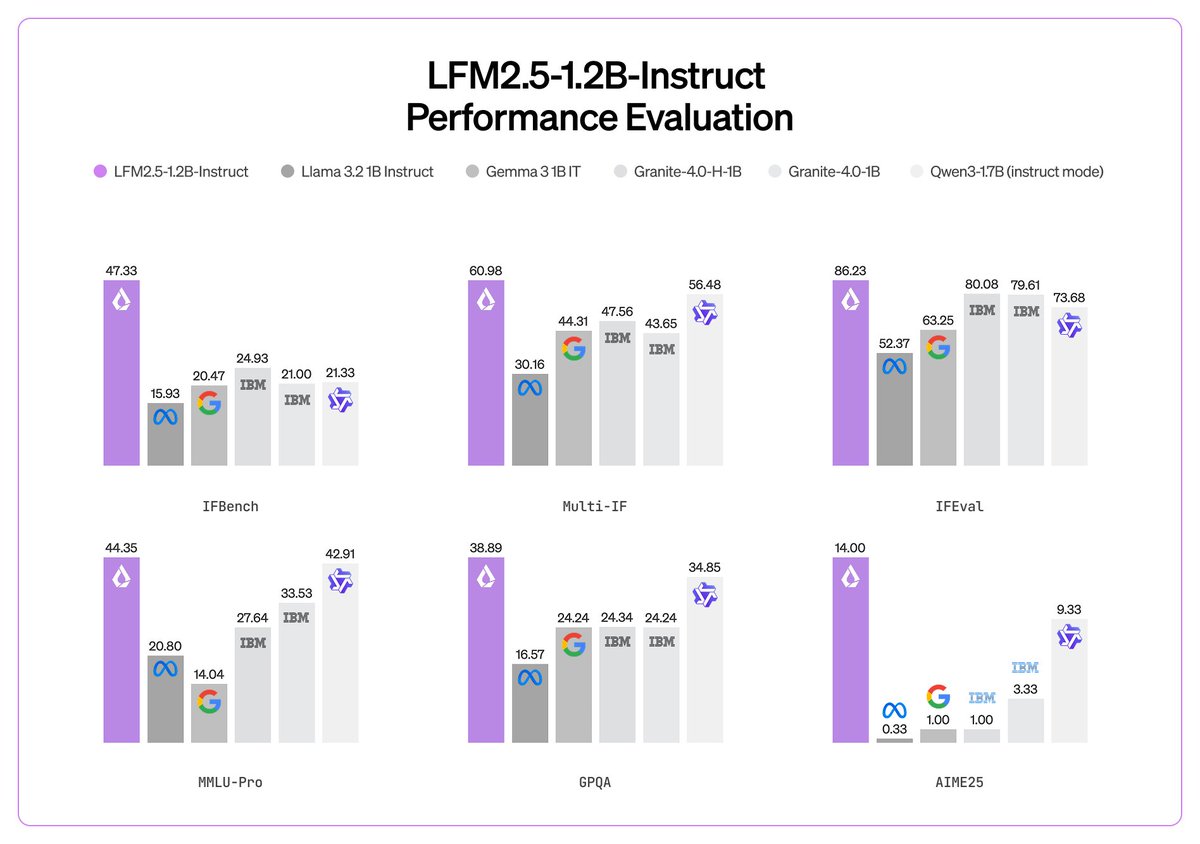
Today, we release LFM2.5, our most capable family of tiny on-device foundation models.
It’s built to power reliable on-device agentic applications: higher quality, lower latency, and broader modality support in the ~1B parameter class.
> LFM2.5 builds on our LFM2 device-optimized hybrid architecture
> Pretraining scaled from 10T → 28T tokens
> Expanded reinforcement learning post-training
> Higher ceilings for instruction following
🧵
Today we introduce Liquid Labs, our advanced research unit, with the goal of understanding and building efficient and adaptive intelligence systems.
Liquid Labs consolidates our existing research efforts at Liquid across architecture of foundation models, multimodality, training, data, and inference. The lab also will be home to new frontier research work across the broad range of foundation model build-up stack.
Read the full announcement: https://t.co/huPO1di46d
We are hiring: https://t.co/s2cWDFixbU
Also find us at NeurIPS 2025 exhibition hall! 🚀
We will present our work (https://t.co/IKk03hObBT) analyzing reasoning models through the lens of graph properties at #NeurIPS2025.
📍Exhibit Hall C,D,E #1113 | Fri, Dec 5 | 4:30 p.m-7:30 p.m
Happy to chat about LLM reasoning and interpretability!



![PaavoParmas's tweet photo. New preprint📣
Typical reinforcement learning policy gradient algorithms target the mean reward E[R], while deployment often cares about other properties of the reward distribution: pass@k, max@k, tail risk like CVaR, robust metrics like medians, etc.
We introduce OrderGrad, a method that can flexibly optimize any of these targets via a one line of code reward transformation. Everything else about your code, whether you use GRPO, PPO, REINFORCE can remain unchanged.
Arxiv: https://t.co/aOdAMI5J8S
Code: https://t.co/nDssyjRl5D
🥇🥈🥉OrderGrad is based on order-statistic estimation. Specifically, consider a batch of K sampled rewards and sort them:
R_(1:K) < R_(2:K) < … < R_(K:K)
Now apply weights a_i and take the expected value at each rank:
Sum_i a_i * E[R_(i:K)]
This allows flexibly defining different objectives that target different regions of the reward distribution. Notably, putting all of the weight on the top rank becomes Pass@K / Max@K, but our approach generalizes this to arbitrary ranks. You can target TopM@K, Medians, CVaR, Winsorized means, or any other weighting of your choosing.
The order-statistics connect back to the original distribution in the sense that the j-th order-statistic corresponds roughly to the j/(K+1) quantile of the reward distribution (see the right figure). As K becomes large, the order-statistics converge to the CDF, so essentially, putting weights on the order-statistics is equivalent to weighting different regions of the reward distribution.
Our main contribution is an unbiased gradient estimator for the weighted order-statistic objective when the batch size is N and the subset size for ranking K. Increasing K improves the CDF approximation, but also increases variance (a classical bias-variance tradeoff). We give an estimator in both REINFORCE policy gradient and in reparameterized backpropagation form. Computation time is negligible (<1ms).
I still want to improve the preprint, so comments and suggestions are very welcome. The code is available so please try it out! 🙏
Many thanks to my collaborators:
Paavo Parmas
Yongmin Kim
Kohsei Matsutani
Shota Takashiro
Soichiro Nishimori
Takeshi Kojima
Yusuke Iwasawa
Yutaka Matsuo](https://pbs.twimg.com/media/HKSZpPNbUAA4EWz.jpg)