@fchollet Physics has passive blocks, but biology's cells have agendas, memories, and goals. When scaled upthey don't just multiply rules. they merge into a collective intelligence. This higher agent actively hacks physical rules to achieve purpose, like shaping a perfect wing
A massive milestone for #Neuroscience! 🧠 The complete brain-and-cord connectome of the adult fruit fly is officially published in @Nature. Check out this incredible visual journey tracing how the CNS controls the body. 🪰
🔗 https://t.co/9p8a4fGIxW @quorumetrix@as_bates#BANC #Neuroscience, #Connectome
#Drosophila, #BrainMapping, #Neurobiology, #NatureJournal
@carlos_olivera Bajo qué partidas presupuestarias o ítems 'fantasma' se camuflaba el pago de los guerreros digitales, y cómo se justificaba técnicamente el uso de servidores oficiales para fines de propaganda?
@carlos_olivera mencionas el uso de software espía, se utilizó exclusivamente para inteligencia contra amenazas externas o se empleó para perfilar y vigilar a ciudadanos particulares, periodistas y miembros de la propia coalición de gobierno? Quiénn tenía la llave maestra de esos datos?"
@SchmidhuberAI 3/3 If so, do you think the next leap in AGI might actually resemble an "Aphantasic AI" ™ , one that bypasses the computational cost of sensory simulation to operate purely on high dimensional logic and dynamics?
@SchmidhuberAI 2/3 Could it be that the "rendering" of high fidelity internal simulations is merely a biological interface preference rather than a computational necessity for intelligence?
Automated optogenetic control of hundreds of cells in parallel. Each cell is individually steered, collectively acting as a "tissue printer". Preprint & code out!
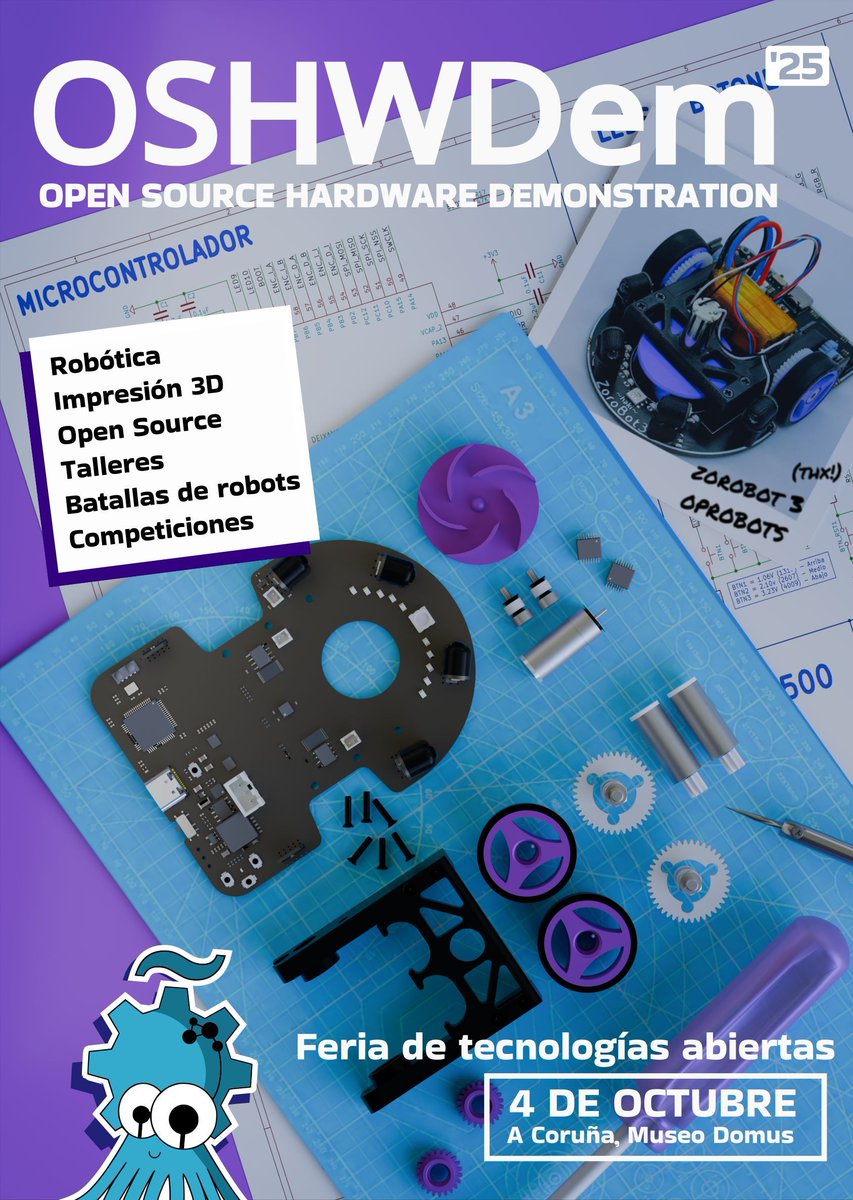
💥 ¡La OSHWDem 2025 ya tiene fecha!
📅 Sábado 04 de octubre.
📍 Museo Domus (A Coruña).
Feria de tecnología abierta con talleres, charlas y competiciones.
Gratuita y para todo público.
🛠️ Pronto inscripciones: https://t.co/Fv6HMuMxUR
#OSHWDem#TecnologíaLibre#OpenSource
We sat down with @sdianahu to talk about diode and the technical challenges we had to solve to run a PCB compiler on air gapped systems.
If you think running rust in the browser with web assembly and edge routing algorithms are fun: come work with us
This is an excellent read. It also aligns with my experience. I have my coding agents on a very short and tight leash, and no generated code gets pushed unless I have cleaned it up and understand it myself.
Everything else leads to pain and suffering.
https://t.co/Byuk20O7RN
Everyone is a libertarian on the Internet.
Because it is simultaneously far more progressive and far more capitalist than any previous society.
It is ultra-progressive because billions of people from every race, religion, and ethnicity are on the global Internet. Anyone can speak to anyone, broadcast anything, associate with anyone, and do just about whatever they want if it is permitted by code.
It is also uber-capitalist because billions of people can transact with anyone, hire anyone, work for anyone, found their own businesses, become zillionaires, set up their own servers, and enjoy perfect freedom of association.
The common thread is individual consent. You consent to sign up to a server. You consent to install an app. And every million-person community on the Internet is formed by a million similar voluntary actions.
So: the Internet proves that consent scales, that voluntarism scales, that internationalism scales, that capitalism scales.
It proves this empirically. Because by and large, despite all its faults, the total freedom of the Internet is attractive. The ultra-nationalist nevertheless chooses to post on an international network. The anti-capitalist nevertheless chooses to post through a capitalist phone.
The reason the Internet works is that code is law. So all the impractical libertarian ideas that presupposed flawless judges or strict property rights suddenly became feasible.
For example, open borders in the physical world doesn’t work. But in the digital world, a site like Facebook actually can onboard billions of strangers and automatically adjudicate the interactions between them.
Similarly, polycentric law before the Internet didn’t work, because you couldn’t realistically have multiple legal systems in the same physical location. But now with Bitcoin and Ethereum and Solana, you can simply swap between different monetary policies and contract enforcement as you see fit.
The fundamental point is that the Internet makes libertarianism more practical.
For example, the esteemed @RonPaul wrote about ending the Fed, but that couldn’t realistically be done at the level of the state. However, tech libertarians could build Bitcoin, and thereby practically end the Fed at the level of the network.
Similarly, tech libertarians couldn’t shut down the Post Office, but they could boot up email. They couldn’t reform taxi medallions, but they could boot up Uber. They couldn’t reform these failed states, so they built the alternative on the global network.
Such examples can be multiplied. But the point is that actually existing libertarianism does exist. It is called the Internet. It is simply the most popular thing in the world, perhaps the most popular thing in human history. It is much more popular than any individual politician or state.
And yet it is still underestimated.
Seeing those vastnesses of larger worlds tower above and below us is not what most people expect to discover when they start prompting for a cute waifu or an avocado recipe. Apeirophobia is a thing we need to learn to deal with gradually.
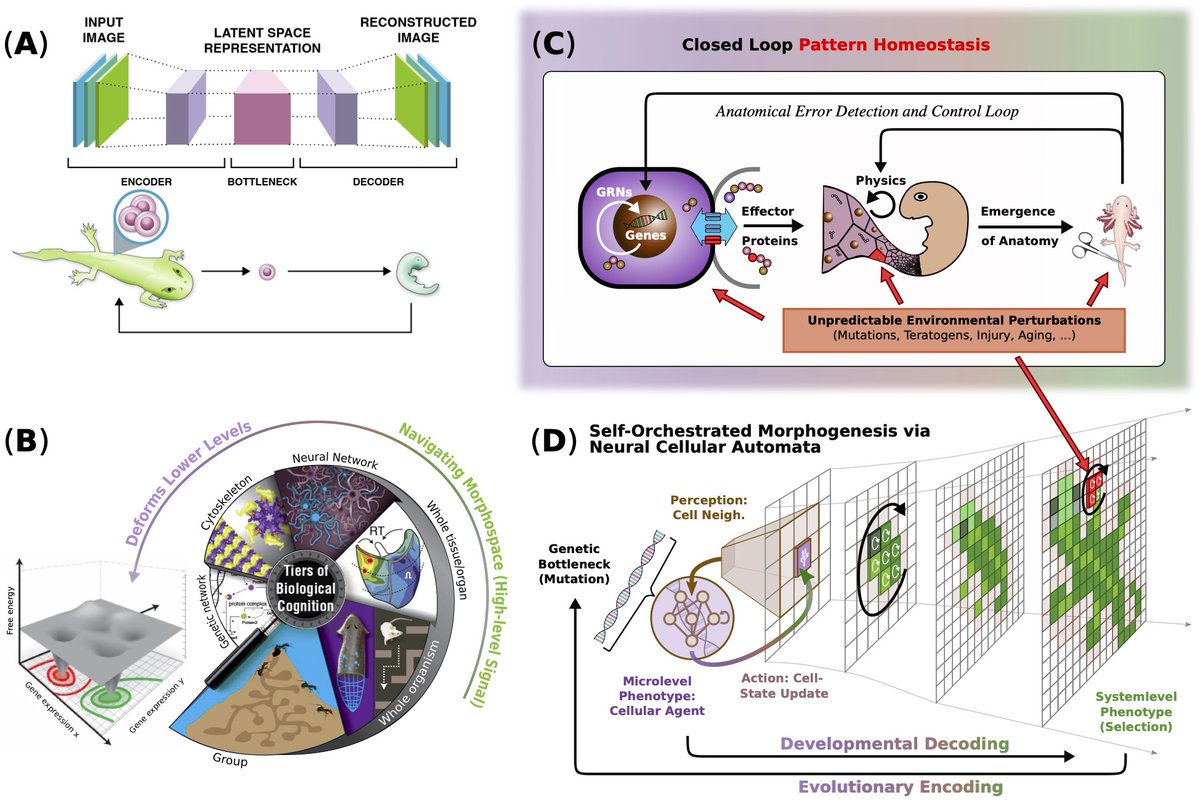
New paper with @BeneHartl : 'What does evolution make? Learning in living lineages and machines"
https://t.co/s4akXzdhrJ
Genes code for proteins, but what is the relationship between the genome and the large-scale form and function of organisms? What is a good formalism for thinking about what genomes actually do, that unlocks discovery of new plasticity of systemic outcomes in regenerative medicine and bioengineering contexts, as well as help understand how evolution operates on a reprogrammable (actually, agential) medium? What concepts from the fields of cognitive science, diverse intelligence, and computer science have relevance here?
Abstract: "Biology implements a multiscale competency architecture (MCA), where components competently navigate problem domains (e.g., metabolic, physiological, transcriptional, and anatomical). Biological subsystems continuously shape (hack) each other’s behavior, toward homeodynamic goal states emerging at new scales. The genome acts as a generative model, not a hardwired algorithm nor a blueprint, for species-specific form and function. A bowtie architecture enables evolutionary lessons of the past to be generalized into lineage memory engrams which are then actively decoded (interpreted) in ways appropriate to default or novel situations by the morphogenetic machinery. Fundamental symmetries across evolution, development, and behavior involve learning and creative problem-solving, which can be modeled by machine learning (ML) concepts such as autoencoders (AEs) and neural cellular automata (NCAs)."
A closely related and excellent paper by @WiringTheBrain and @CheneyLab :
https://t.co/ZFkoofLhGq