What if any dataset, any size, any number of dimensions, opened in a browser tab from a link? 🔬🧪💻
Luxar is out today: write it in Python, share it as a link, explore it in any browser. Open source. 🧵 @biohub
@amyneurons It's so powerful I'm blown away regularly, but for sure it helps having debugging as a polished skill that can track down the inevitable failures along the way.
Likewise on the interactive visualization, I hadn't really gone down that route before, but no prototyping is so easy
This is a lesson for people like myself who have invested years into technical specialization. This forces you to keep adapting and fight to stay at the leading edge of what's possible. I'm constantly reinventing my process and pipelines to improve. Rising tides lift all boats
Over the past few years, Tyler Sloan @quorumetrix has been working on bringing neuroscience to the dome. His new planetarium film, more than a decade in the making, takes viewers on an immersive journey into the brain.
https://t.co/M3pBiPdqE7
Experimental visualization for the general public to explore h01 human EM connecomics dataset and human connectome project tractography. In browser, on a phone. What other data should I try?
Working demo: https://t.co/KQbYFagFie
@GoogleAI@MCB_Harvard
This is such a fascinating paper, I really felt like I came out with a deeper understanding of how nervous systems are organized.
Check out the video, and you'll want to read more!
#neuroscience#visualization#connectomics#BANC
Just published yesterday, the #BANC! A full central nervous system (CNS) connectome of a limbed animal enables us to trace sensory-motor arcs and understand how the CNS controls the body. https://t.co/19jmEfxEVH #neuroscience@Nature, Video by @quorumetrix, sound on! 1/18
Coming soon: one of history’s most complex missions
Tune in on Tuesday, June 9, at 11am ET, to meet the astronauts flying aboard Artemis III, the mission that will test docking capabilities with commercial landers in low Earth orbit — an important step to crewed lunar landings.
Thanks Anil, and you are correct. I do not know what you think.
I do generally know what you write, that you are an authority in brain and consciousness studies, speak very well (you should do Shakespeare), straddle fences nimbly, and don’t commit to conscious AI through neuronal computation. You do favor ‘biological naturalism’ to explain consciousness, but don’t say what that is.
Here’s the thing. Though you’ve never mentioned Orch OR, it is the only biologically natural theory of consciousness. Put forth by Sir Roger Penrose and myself in mid 90s, it was one of 5 ‘major’ theories of consciousness (GNW, IIT, HOT, PC/RP, Orch OR) in the TWCF program beginning around 2018. It was selected despite being consistently criticized because quantum effects seemingly need extreme cold to avoid decoherence, loss of quantum states before quantum processes necessary for consciousness to occur. How long is that? We claim 10^-12 to 10^-6 secs would suffice (with interference beats getting down to, and BEING the EEG).
In the TWCF program we could not agree with proponents of other theories for an adversarial collaboration. They are all at levels of complex computation of simple neurons. We focused on microtubules inside neurons where anesthetics are known to organize activities, process information and mediate anesthesia.
For TWCF we predicted
1) room temperature quantum states in microtubules which could be functional
2) those quantum states would be inhibited by anesthetics.
Both were shown. Aarat Kalra working in Greg Scholes lab at Princeton used UV fluorescence at ambient temperature to trigger propagating excitons in microtubules 6.6 nm over 8 nanoseconds, both requiring quantum states. They were dampened by two types of anesthetic.
We ‘called our shots’.
https://t.co/YxIL56pB72
Correct me if I’m wrong but overall the TWCF program over 8 years spent $30 million dollars and produced only this one significant positive result for Orch OR for a measley $100k.
You do hold yourself up as an authority.
In 2022 you and Tim Bayne wrote a review of theories of consciousness for Nature Neuroscience Reviews with extensive discussion of the other 4 original TWCF theories, mentioning Orch OR only in a list of 20 others.
I asked you about it and sent this paper
https://t.co/eGxdWy25jQ
You said you would read it and comment but never did. You Tweeted you’d do so for the new Theories of Consciousness -The Grand Tour book in which I have a chapter. But you didn’t.
And what biological naturalism theory is there other than Orch OR? I probably sound whiney but you’re dodging Orch OR.
Maybe I’m paranoid but you and other neuro-influencers like Dave and Christof suppress and ignore Orch OR, and have for years.
Why? Is it funding from conscious Al proponents? Or… you just don’t like me? (I have been a bit obnoxious with pushback). Are you ‘quanta-phobic’?
The evidence is on our side https://t.co/BLRNhgrsjL
Quantum biology is booming,
neurocomputational approaches are flailing. Warm temperature quantum gel quantum computers based on Orch OR are on their way https://t.co/pIjKc1kZBB
So that’s what’s going on. You’ve been obstructing progress in my view. Depriving the public of important knowledge. There’s a whole new world inside the neuron. The tide has turned. I thought you’d want to know.
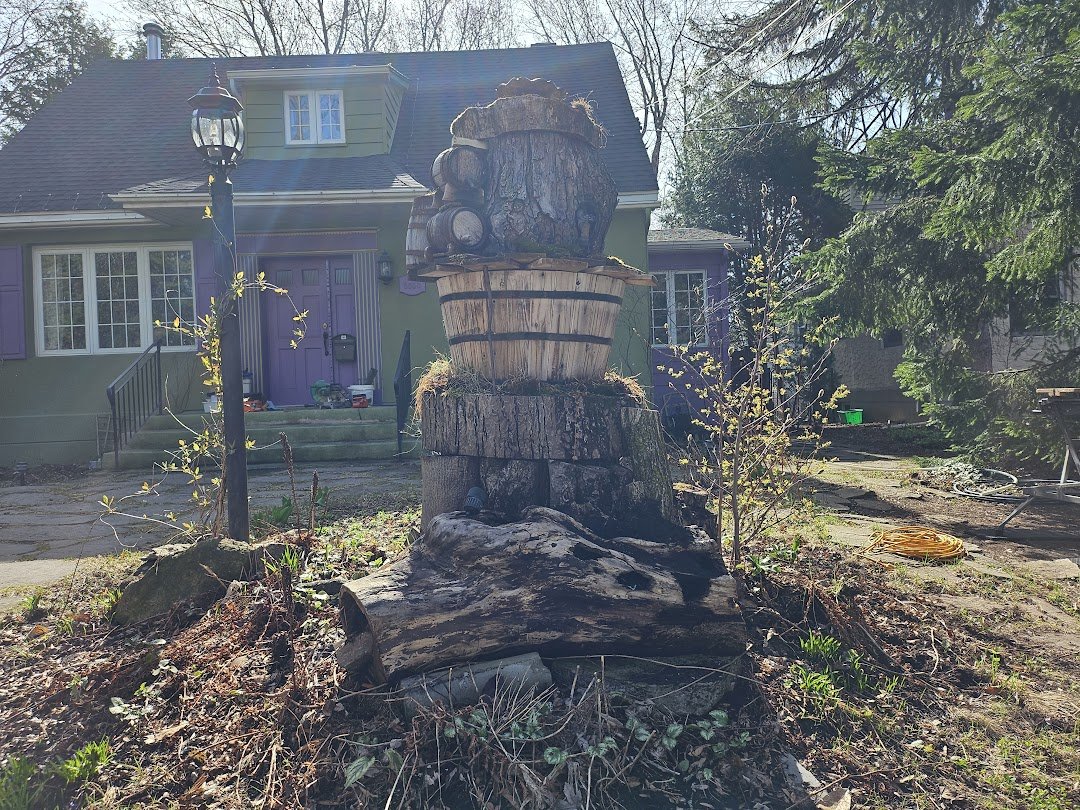
2 years ago the city had to fell a massive maple that had dying and dropping large branches on my family. I know how important they are to biodiversity, so I turned its carcass into what I'm calling a #biodiversity fountain. The neighbors love me.
@theodorus5@amyneurons I recently moved out of freesurfer DKT atlas space (used by Brainder) into MNI atlas space and it makes all the difference because I can use registered average brains in the same coordinates as tractography, vasculature, etc.
@InsiderTakes@Jon_Hartley_ My father worked for Industry Canada specifically around the aerospace industry. The death of the Avro Arrow was a bitterness he held on to his whole life; there was a persistent shame that it was never made.
1/ 🚀 Excited to release: napari-mcp - agentic control of napari from any MCP-capable AI assistant!
Use it for interactive image processing, analysis, and visualisation! Really cool project from @ilan_theodoro in my team!
#napari#bioimageanalysis#MCP@biohub