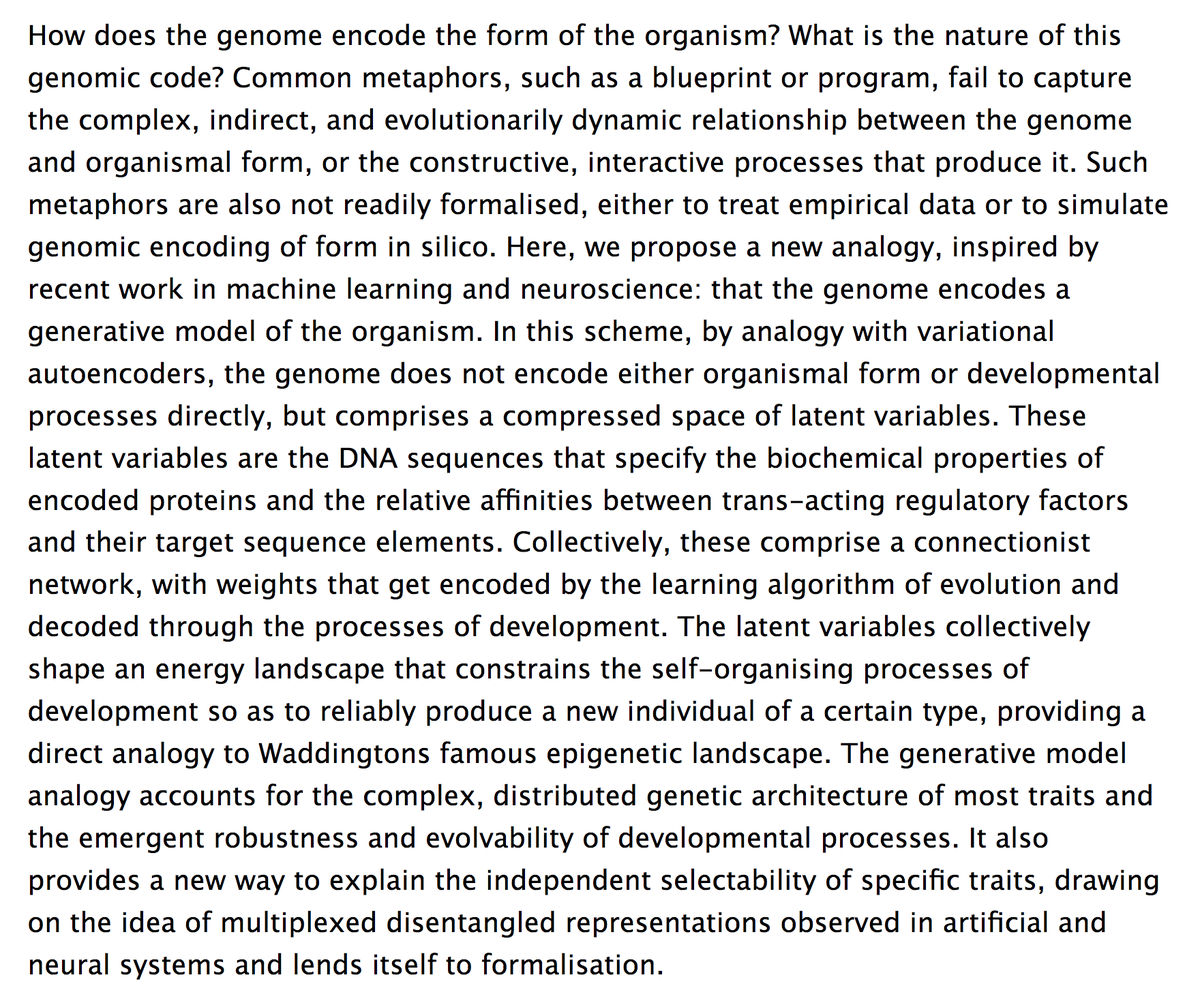
How our genome is like a generative AI model https://t.co/sqZfuNJcqg - nice little write-up by @JessHamzelou of new preprint by me and Nick @Cheneylab 😊
I'm such a fan on interdisciplinary science and it's been a joy working with the wonderful Kevin Mitchell @WiringTheBrain to share a geneticists perspective on the strengths and weaknesses of analogies between our computational models and natural systems.
https://t.co/KKEEf8wUh8
𝗧𝗵𝗲 𝗚𝗲𝗻𝗼𝗺𝗶𝗰 𝗖𝗼𝗱𝗲 - 𝘁𝗵𝗲 𝗴𝗲𝗻𝗼𝗺𝗲 𝗶𝗻𝘀𝘁𝗮𝗻𝘁𝗶𝗮𝘁𝗲𝘀 𝗮 𝗴𝗲𝗻𝗲𝗿𝗮𝘁𝗶𝘃𝗲 𝗺𝗼𝗱𝗲𝗹 𝗼𝗳 𝘁𝗵𝗲 𝗼𝗿𝗴𝗮𝗻𝗶𝘀𝗺 🧬
https://t.co/ZOlfcPJhW8 very excited to share this new preprint from me and Nick Cheney 😀🧵
I'm grateful that my colleagues have trusted me to take on such an ambitious endeavor and I hope that our lab can make the most of this opportunity. It's the way science should be done!
Tenure provides the security to take on risky and uncertain approaches that may not pay off for many years or without the contributions of many others.
I also want to quickly reflect on the institution of tenure. I find it incredible and so important that there exists a system that lets us tackle grand and open challenges in science and society, knowing that these are complex and long-term problems.
I'm thrilled to announce that I've been awarded tenure and promotion to Associate Professor at the University of Vermont! Starting in research as an undergrad at UVM nearly 15 years ago, I'd never have imagined being in this position, but am so glad that it's come full circle!
I want to thank my students for doing the hard work in the trenches that's built such an interesting and impactful body of work in our lab, my colleagues for their mentorship and collaboration, and my family for their support and sacrifice as I take on such a demanding career.
I am happy to announce a workshop on
**Embodiment-Aware Robot Learning (EARL)**
https://t.co/e8vuSA7dq7
at Robotics: Science and Systems Conference #RSS2024 in Delft, Netherlands @RoboticsSciSys
on July 15, 2024
co-organized with @AlapKshirsagar@Jan_R_Peters
In addition to the awesome collaborators on the paper @jeffclune@hodlipson@RobMacCurdy, those who’ve expanded this line of work beyond my wildest imagination are the real heroes of this award. @DoctorJosh@Kriegmerica https://t.co/UpXuxeqSBI https://t.co/LlVpQxHFDY
Honored to win my society's Impact Award this year. Thanks to all who read, shared, and built upon the work; and to the SIGEVO Board for calling it seminal to our field. Shout out to my collaborators for making this impactful and a ton of fun to work on! https://t.co/CEijn3RAk2
This award looks at the 10-year impact a paper has had on our field, so your engagement with the research (or our fun videos https://t.co/GLn5iu8O45) have made this happen! I’m so very flattered every time someone reaches out or interacts with our work. You are all awesome!
Our new paper: ⚡Zapping!⚡
Rehearsing transfer during pre-training by repeatedly "zapping" (resampling) weights is a cheap form of meta-learning that creates neural nets that are better at transfer learning!
w/ @fratietal, @jeffclune, and @CheneyLab:
https://t.co/s1Y2yqn6qW
Congratulations to Nick Cheney @CheneyLab, who was just awarded an NSF CAREER award, one of the highest-level recognitions that a young faculty member can receive.
He proposes to make AI more accessible via AutoML, NAS, and robotics. Details here:
https://t.co/LS4Vutn5lv
@iugoaoj@jeffclune@reworkAI@GoogleColab The full experiments (https://t.co/ffxGLVQsIC) can be run on CoLab without any problem!
However to further speed up training time, you could also try reducing the: network size, meta-training classes/iterations/batch size, or inner-loop trajectory length