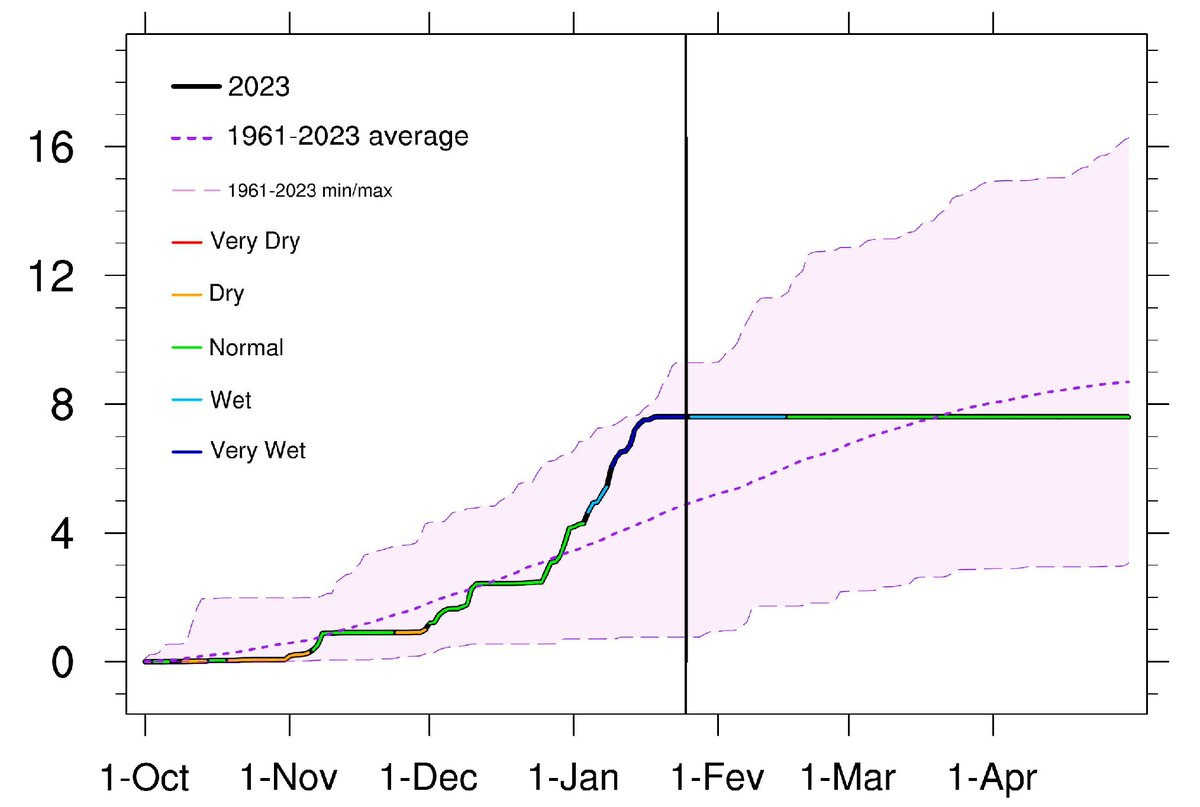
Cumulative of Southern California precipitation, as of January 15 (marked by the vertical bar).
Driest year at this point of the water year since 1961
(this is using the 0.25° CPC gridded precipitation data).
New study in @NatureComms (#openaccess): https://t.co/hNdc1Ls30G
"Here we show that sixteen models contributing to the @PAMIP_news simulate a weakening of mid-latitude westerlies in response to projected Arctic sea ice loss."
I cannot access the #AGU21 online portal. Is anybody experiencing the same problem ? I have a talk tonight and still haven't had a chance to access anything ...
@BrunaRFO I just installed Firefox instead of Chrome, it seems it's working better. I finally got access to the talk recordings! But the navigation is still pretty slow.
New Research Highlight by Yannick Peings, @ZLabe, and Gudrun Magnusdottir: How reproducible is the response to +2°C #Arctic sea-ice loss in a large ensemble of simulations? Based on their J Climate publication from earlier this year.
Read more: https://t.co/ohqqwKYHhj
Relevant and striking animation ---> loss of multi-year (old) sea ice due to #Arctic climate change
Younger sea ice is generally thinner and more vulnerable to melt with numerous impacts to society and the polar ecosystem.
[Created by @NASAHyperwall: https://t.co/YFP9nJ6OgQ]
Our new paper about the response to +2°C Arctic sea ice loss in PAMIP experiments is available online. We focus on the role of internal variability and robustness of the results https://t.co/5sqagLA5Ub
I am not very present on Twitter but here is finally a tweet. I've updated my personal website with graphs animations of the NH climate, from last October to end of this January :
https://t.co/rsgmLX1YWw