It’s official. 🚀
July 18. 11:30 AM IST.
Vikram-1. Test Flight-1. Mission Aagaman.
India’s first private orbital launch from the historic First Launch Pad at SDSC-SHAR, Sriharikota.
The countdown begins. 🇮🇳
#Vikram1#MissionAagaman#SkyrootAerospace#OpeningSpaceForAll
Can coding agents do research?
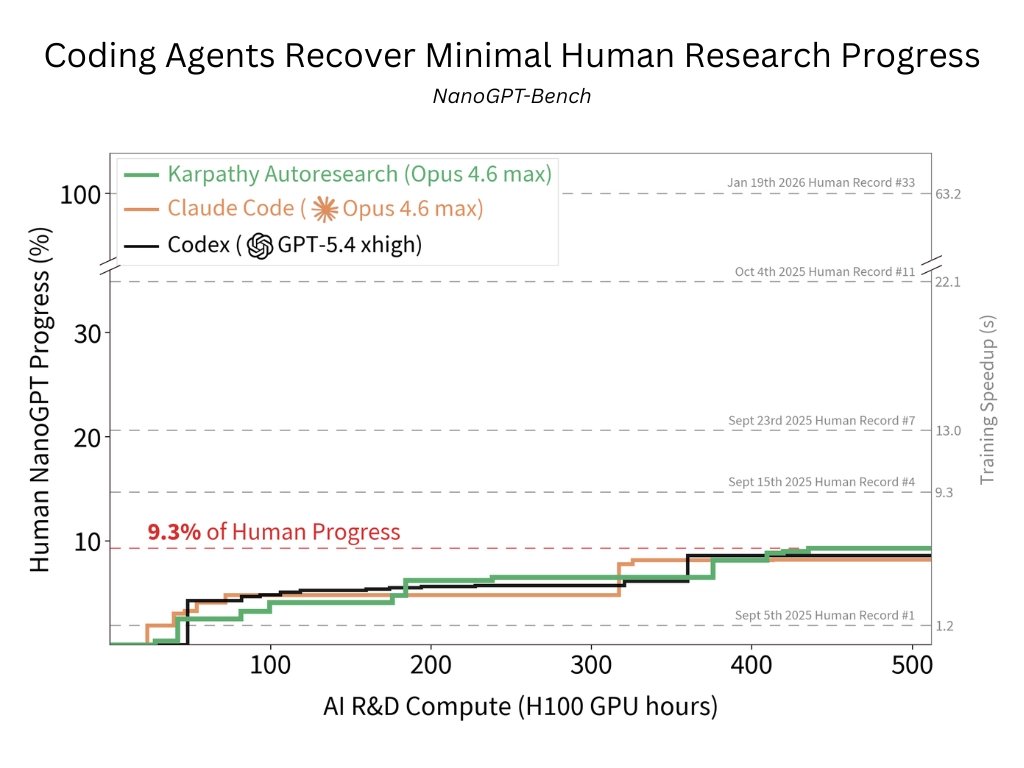
We release NanoGPT-Bench, an internal eval we’ve used to test agents on an AI R&D problem with months of human progress
Codex, Claude Code, Autoresearch recover only 9.3% of human progress, mostly tuning hyperparams & ignoring algorithmic research
NanoGPT-Bench is built on the NanoGPT Speedrun, a popular LLM pretraining competition to minimize the training time of a GPT-2 style model. Existing human submissions constitute nearly 2 years of work. To control for dependencies and contamination in frontier models, we standardize evaluation to a 5-month window of world records. Evaluation is fully autonomous and end-to-end, with no human intervention or internet access. 🧵
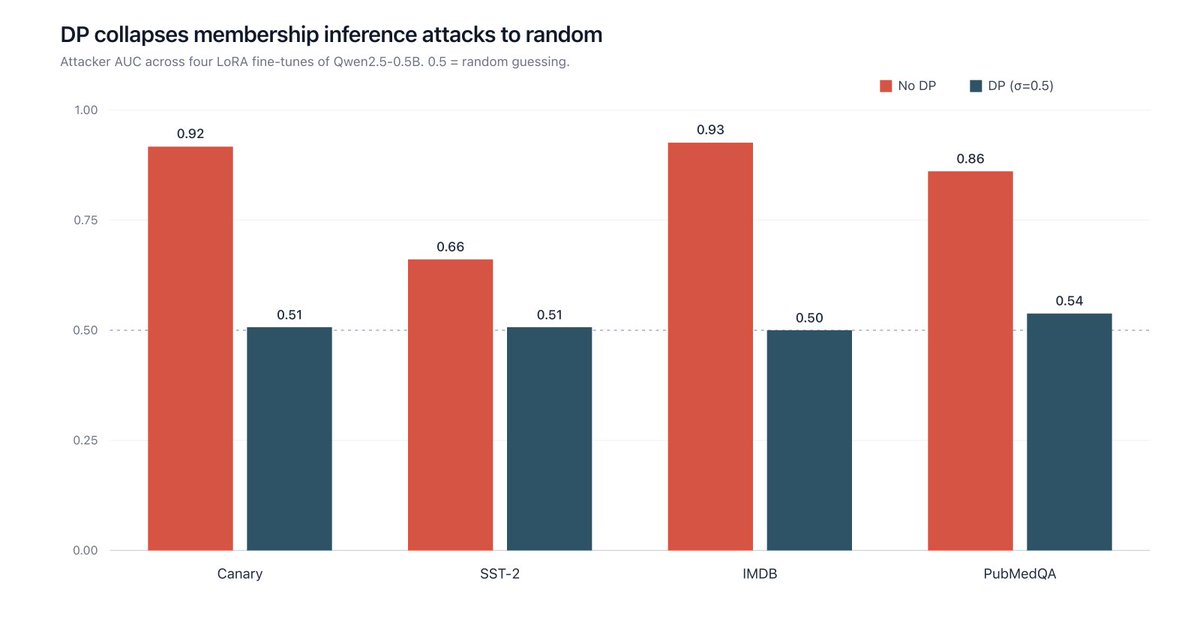
I built differentially private fine-tuning for MLX so you can train local models on your private data. The full stack fits in ~600 lines and drops attacker recovery of training data from 90% to 50% 1/6
How do you make a 250x better vaccine at 1/10 the cost? Develop it in India.
(Soham Sankaran, Ep #2)
There's a lot of discussion these days on how China's biotech market is on track to bypass the US's. I wondered: shouldn't we have observed the exact same phenomenon with India? It has seemingly all the same ingredients: low cost of labor, smart people, and a massive internal market.
Yet, the Indian biotech research scene is nearly nonexistent. Why is that?
To figure it out, I had a two-hour discussion with @sohamsankaran, the CEO of @PopVaxIndia, an mRNA vaccine development startup based in Hyderabad. Amongst those in the know, @sohamsankaran is well understood as one of the most talented biotech founders in India, and his company has had a genuinely incredible underdog success story. This story is still being written, but there's good reason to be bullish.
We discuss so many things. Including policy prescriptions for Indian R&D, why PopVax's vaccines are so good, how machine-learning is changing vaccine development, and much more. Transcript below, and links in thread (including a jargon explanation).
Timestamps:
01:31 Introduction
02:38 Why is there such little biotech research in India?
17:38 Advantages of building a company in India
26:03 Policy prescriptions for India
30:13 Questions on vaccine design
45:28 What does PopVax do?
56:20 The role of machine learning in vaccine design
01:06:29 The (conservative) culture of vaccinology
01:21:12 Hiring in India
01:40:44 How fundraising for an Indian vaccine design startup is coming along
01:55:15 How is PopVax so good at designing vaccines?
01:59:45 Pet theories on immune mechanisms
02:06:24 mRNA beyond infectious diseases
02:09:56 What would you do with $100 million dollars?
Today, I’m excited to announce that the clinical batch of PVX-001, our open-source broadly-protective COVID-19 vaccine candidate built on our own RNA platform, has been manufactured at our RNA Foundry in Hyderabad, and it will enter clinical trials in Australia in a few months.
@malhar317@viraj9451@Akshxat@AdiyaSivahuma is the awesome team behind the work we’re putting out - from model training, experiments, systems (training / inference), data and lab work!
lot more to come!
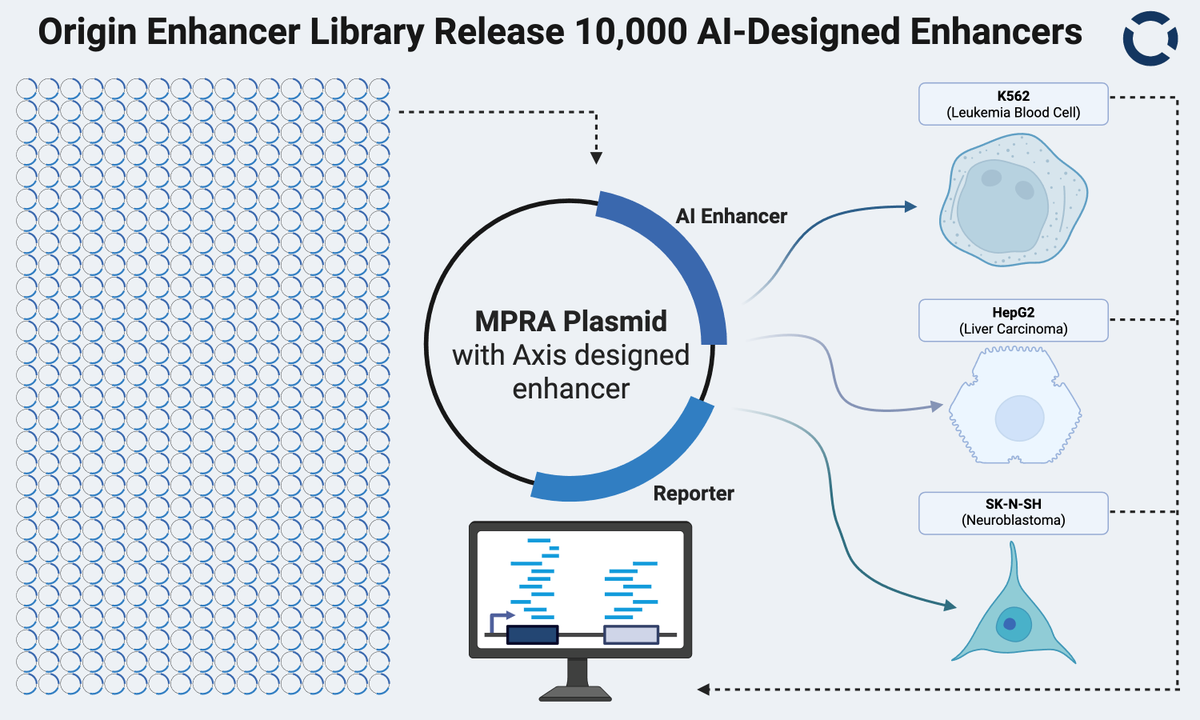
Today, we're excited to release 10,000 fully AI-designed enhancer sequences for the research community. Axis was prompted to design sequences with targeted activity in one of three widely used cell-lines.
AI allows us to explore a vast design space, going beyond the natural genome.
AI x Bio teams like Origin have coding agents, scaling laws, and a wave of big biotech deals all at their backs. This is barely touched territory. Crazy what this small team can do now.
Today, we're excited to release 10,000 fully AI-designed enhancer sequences for the research community. Axis was prompted to design sequences with targeted activity in one of three widely used cell-lines.
AI allows us to explore a vast design space, going beyond the natural genome.
Today, we're excited to release 10,000 fully AI-designed enhancer sequences for the research community. Axis was prompted to design sequences with targeted activity in one of three widely used cell-lines.
AI allows us to explore a vast design space, going beyond the natural genome.
We're beginning to run functional assays - MPRAs, ATAC-seq and ChIP-seq - on over 50,000 Axis designed regulatory elements. But we're opening them up early for the research community to use in its own experiments.
We'll contribute these results to the platform and soon release additional sequences for primary cells and tissues.