Germany banned a film because Muslim migrants found it offensive. The director released it anyway and it got over 10 million views in 6 hours.
How long is Europe going to keep bending over backwards for this? 😡🔥
#EuropeIsLost
BITCOIN IS IMPOSSIBLE TO SHUT OFF! 🚀
Jack Dorsey built an app that moves Bitcoin with zero internet.
Bitchat uses Bluetooth mesh.
You sign offline, it hops phone to phone.
Kill the internet.
The money still moves.
🚨 SOUTH KOREA JUST PROPOSED TAXING UNREALIZED GAINS.
And this is one of the major reasons behind today's massive selloff in the Korean market, now being called BLACK TUESDAY in Korea.
At a forum hosted by South Korea's ruling Democratic Party, lawmakers called for comprehensive taxation that would treat unrealized gains on stocks and real estate as taxable income, even before the asset is ever sold.
The ruling party has pushed escalating wealth tax measures throughout 2026, including a February forum proposing to lower the real estate capital gains exemption threshold from 1.2 billion won to 800 million won, and an April push to abolish the long term holding tax deduction entirely.
Today is the first time this campaign has explicitly extended to taxing unrealized stock gains.
Under current law, investors are taxed only when they sell a stock and realize a profit.
Under this proposal, investors could owe tax on paper gains they have not sold or collected, simply for holding a stock that went up in value.
The Netherlands tried almost this exact policy four months ago.
On February 12, 2026, Dutch lawmakers passed a law taxing unrealized gains on stocks, bonds, and crypto at a flat 36% every year, whether or not anything was sold.
The backlash was immediate. A petition against it gathered more than 61,000 signatures, and Shopify CEO Tobi Lutke called it "the dumbest thing any government on planet earth is pursuing right now."
Just 13 days after the bill passed, the Dutch finance minister announced the government would scrap the unrealized gains portion entirely, admitting the law "cannot pass as is."
This lands directly on a South Korean market that just ran up nearly 95% over the past year, built largely on heavy retail buying with borrowed money.
A tax on gains that exist only on paper is a direct threat to the exact rally that created that exposure in the first place.
BlackRock now has a Bitcoin ETF that owns zero Bitcoin. It started trading on the Nasdaq today, and the ticker is BITA. Worth understanding what you actually buy here, because the name does a lot of work that the structure does not.
It is the iShares Bitcoin Premium Income ETF. The pitch is a 15 to 25% annual yield on Bitcoin exposure. That number is real, and the way it gets there is the whole story.
BITA does not hold spot Bitcoin. It holds shares of IBIT, BlackRock's spot Bitcoin ETF, and then it sells covered calls against those shares. A covered call is an option you sell that gives someone else the right to buy your position at a set price. In return for that right, they pay you a premium upfront. That premium is where the 15 to 25% yield comes from. You are renting out the upside on your Bitcoin and getting paid cash for it.
So here is the trade you are actually making. In a flat or choppy market, you collect the premium and you win, because Bitcoin is not going anywhere and you are getting paid to hold it. In a slow grind higher, you collect the premium and you capture roughly 70% of the move, which is the number BlackRock is targeting. But in a violent rip higher, the kind Bitcoin is famous for, your calls get exercised, your upside is capped, and you sit there watching spot run away from you while you keep the premium and not much else.
This is an income product wearing a growth product's name. It is built for someone who wants Bitcoin exposure plus cash flow and is willing to trade away the explosive upside to get it. That is a completely valid thing to want. Retirees, income-focused accounts, anyone who would rather clip a coupon than ride the full volatility.
What it is not is a bet on Bitcoin going to a new high. If your thesis is that Bitcoin runs hard from here, the covered-call structure is working directly against that thesis. You would capture more of that move just holding IBIT or spot.
The interesting part is what it signals. The covered-call ETF is the product you build when the audience for plain Bitcoin exposure is already saturated and the new money wants yield, not just a number that goes up. That is a more mature market than the one that existed two years ago. Know which product matches your actual thesis before the yield number does the deciding for you.
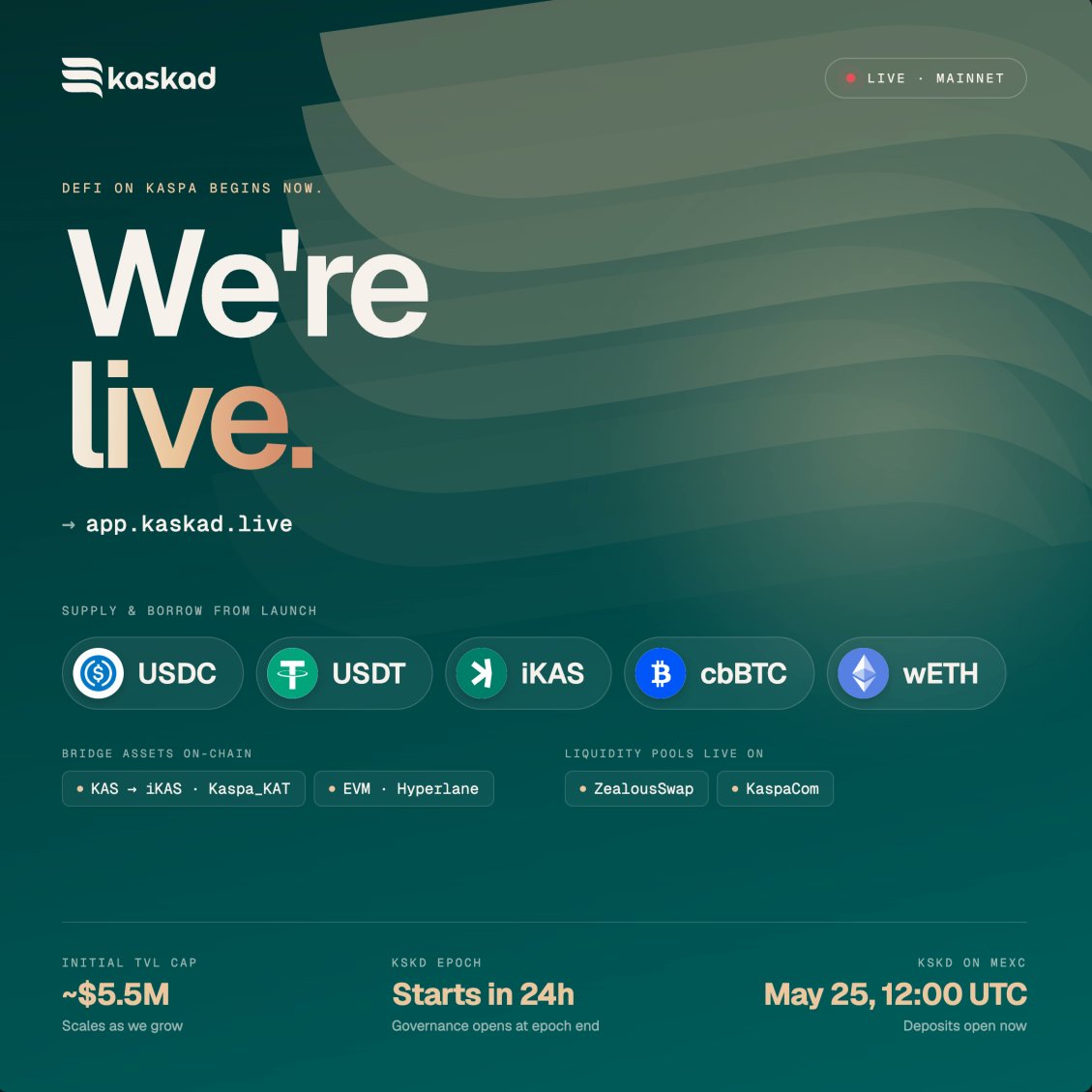
Kaskad is now LIVE on https://t.co/1lOpEQ8dyU !
You can now put your KAS to work via @Igra_Labs!
What's available from launch: Supply and borrow USDC, USDT, iKAS, cbBTC, and wETH — more assets will be added in the upcoming weeks.
💎To early KSKD investors: your TGE allocation is ready to claim in the vesting module.
Access is restricted to whitelisted and verified participants only.
KSKD deposits are now open on @MEXC and the KSKD listing will start on May 25, 12:00 UTC. Getting assets on-chain:
Bridge routes:
→ KAS → iKAS via @Kaspa_KAT bridge https://t.co/oT4kTkSyC7
→ EVM assets via @hyperlane bridge → Liquidity pools live on @ZealousSwap and @KaspaCom
We've intentionally set an initial max TVL cap of ~$5.5M; it lets us validate all systems under real conditions smoothly and safely before scaling. Caps increase as the platform grows.
KSKD epoch starts in 24h. Governance window will open at the end of the first epoch.
Let the DeFi on Kaspa begin 🔥🔥🔥!
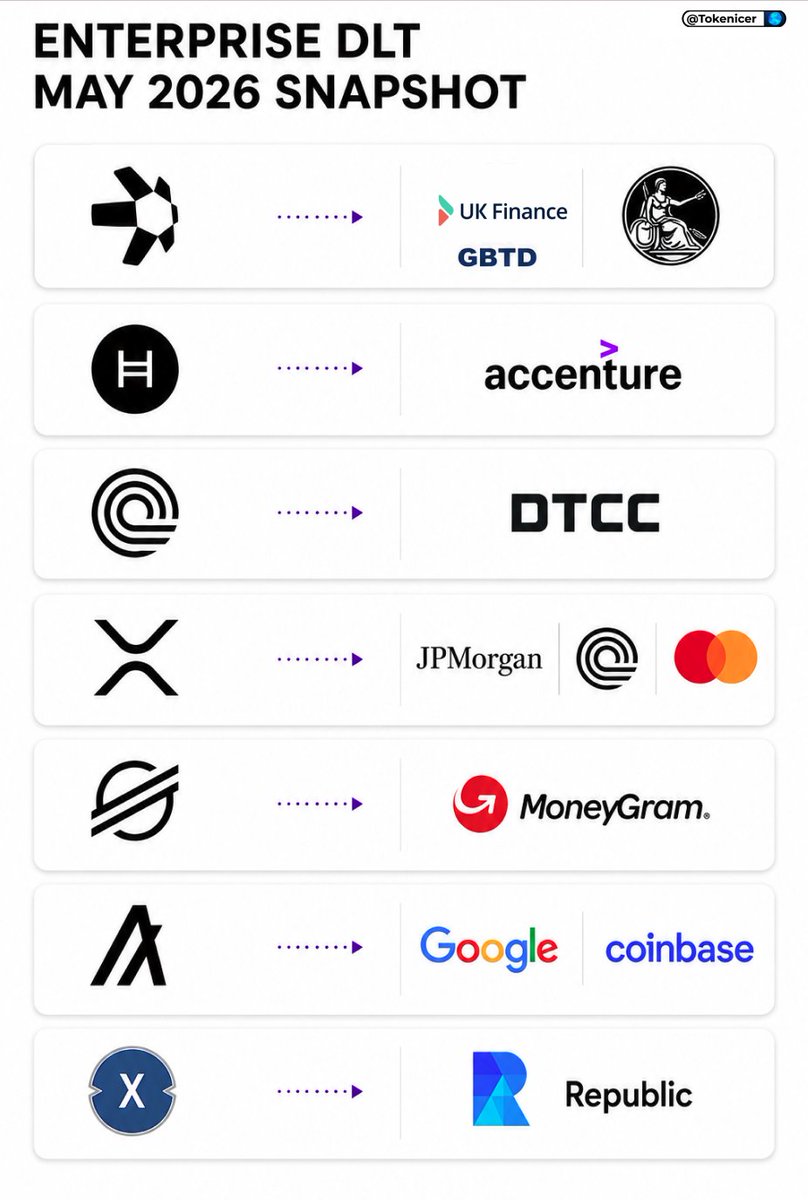
Some progress lately:
$QNT & GBTD officially testing in BoE Sync Lab
$HBAR adds Accenture to Gov Council
$ONDO added to DTCC's tokenization group
$XRP Ledger used w JPM x Ondo x Mastercard
$XLM expanding partnership with Moneygram
$ALGO PQ resistant cited by Google & Coinbase
$XDC Republic joins as a validator
Const recently introduced Locked Stake (Conviction).
A new mechanism to improve subnet governance, investor protection, and transparency on @bittensor.
I believe this is one of the biggest updates since dTAO.
It's a new dimension of stake defined as Stake × Time. By locking alpha for a specific duration, holders cryptographically prove their commitment to a subnet and its owner.
The mechanism directly addresses the scenario we just saw play out with Subnet 3, an owner abandoning the project while still collecting emissions.
Here's how it works:
-> Tokens unlock on a linear curve over the chosen duration
-> Subnet ownership is determined by a conviction score. It is a weighted measure of stake locked and stake remaining, which peaks at the midpoint of the lock duration to prevent instant takeovers.
-> Investors and stakeholders can delegate conviction to an owner, signaling support and helping defend against hostile takeovers
Ownership has always been the one immutable piece on Bittensor where everything else is earned. Conviction finally makes it mutable without breaking the economics for legitimate teams.
Teams that are here long-term can prove ownership cryptographically while being able to fund their operations.
For investors, this is one of the strongest primitives in crypto for enforcing owner accountability without relying on courts, jurisdictions, or trust.
The Conviction rollout will not be forced on anyone. It is intended for mature subnets with the liquidity and community depth to implement it. New subnets get an immunity period.
Conviction will be selectively implemented, starting with Subnets 3, 39, and 81, to regain owner control for token holders.
The mechanism will also go through the standard Bittensor governance process.