This week's cover article: Suppressed hydration in metoclopramide hydrochloride by salt cocrystallisation by Yuda Prasetya Nugraha & Hidehiro Uekusa: https://t.co/IAB9zVC3FK
Vitamin B12 has the most complex structure of all vitamins. It was elucidated by Nobel Prize laureate and crystallography pioneer Dorothy Crowfoot Hodgkin.
Image: Detail from a model of the crystal structure of vitamin B12
The stiffest organic crystal of all—Organic crystals are typically considered soft and brittle, but recent examples show that certain structural characteristics can make some organic crystals exceptionally hard. Check out our new publication in @ChemicalScience, where we report that the crystals of mucic (galactaric) acid have now set a new standard for the stiffest organic crystal ever reported! In one crystallographic direction, the Young’s modulus of these crystals is 50.25 GPa, a value that surpasses some metals, including tin and magnesium. Congratulations to @DP20907127, @LucaCataz, @SPGuerin and the other authors! Thanks to @NYUAbuDhabi@NYUADResearch. Read more about these ultrastiff crystals here:
https://t.co/Pt6H6AFcSM
Through the development of metal–organic frameworks, 2025 chemistry laureates Susumu Kitagawa, Richard Robson and Omar Yaghi have provided chemists with new opportunities for solving some of the challenges we face.
Following the laureates’ groundbreaking discoveries, researchers have created numerous different and functional metal–organic frameworks (MOF). So far, in most cases, the materials have only been used on a small scale. To harness the benefits of MOF materials for humanity, many companies are now investing in their mass production and commercialisation. Some have succeeded. For example, the electronics industry can now use MOF materials to contain some of the toxic gases required to produce semiconductors. Another MOF can instead break down harmful gases, including some that can be used as chemical weapons. Numerous companies are also testing materials that can capture carbon dioxide from factories and power stations, to reduce greenhouse gas emissions.
Some researchers believe that metal–organic frameworks have such huge potential that they will be the material of the twenty-first century.
#NobelPrize
A giant of modern crystallography has passed. George Sheldrick was the author of the SHELX series of programs (among others) for structure solution and refinement of both small-molecule and macromolecular crystal structures.
https://t.co/eKD57Z1NV4
https://t.co/D8zBp3qYHN
The CCDC team are saddened to learn that George Sheldrick has passed away.
His impact in #crystallography was immense; from the SHELX software used globally, to teaching, structures, journals, and more.
More by the ECA here: https://t.co/yonuwTx438
Stumbled upon this amazing lecture series when preparing for class. Explaining complicated matters in a simple yet easy to understand. I like how he incorporates the history of chemistry along the way. https://t.co/BLTpahNBiS
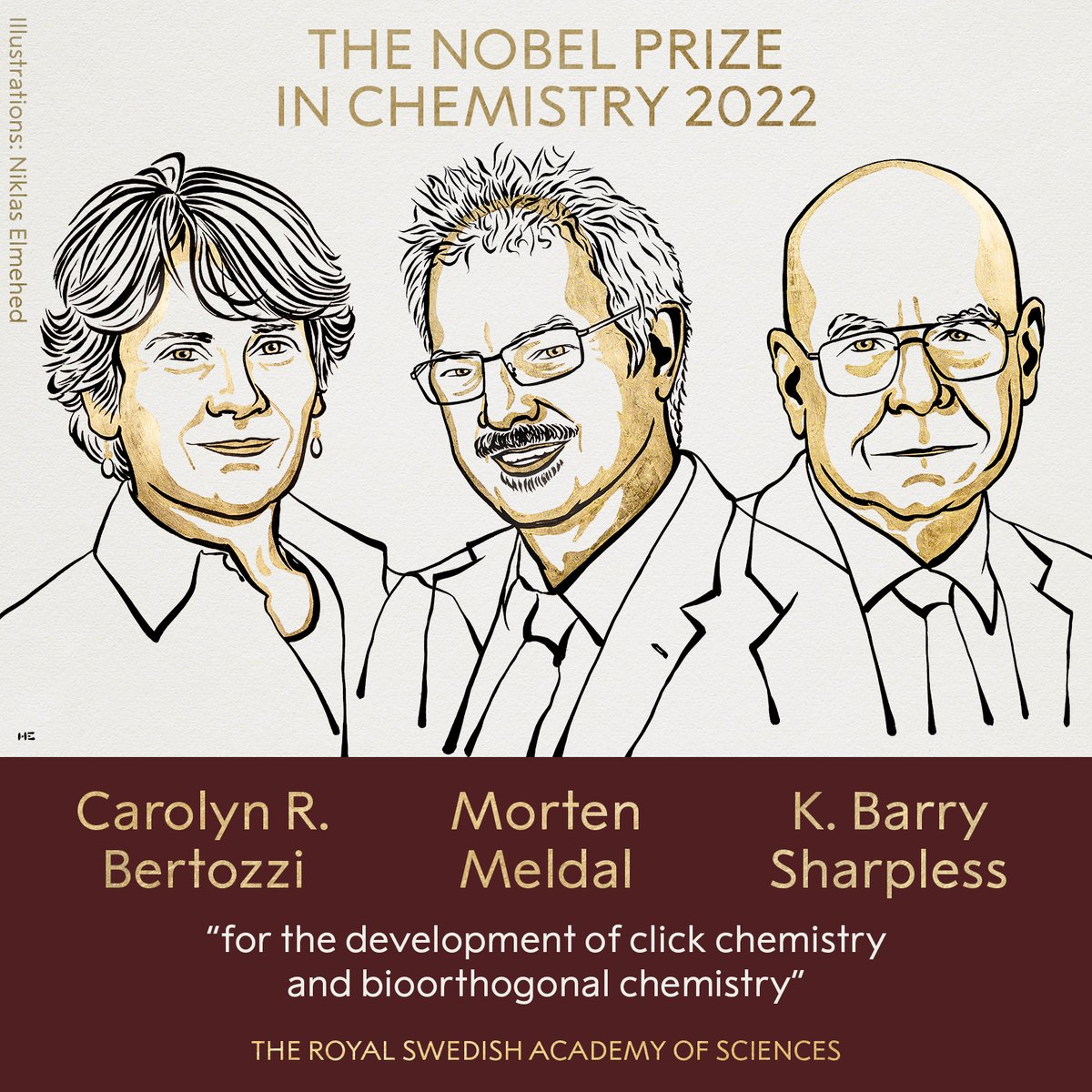
BREAKING NEWS:
The Royal Swedish Academy of Sciences has decided to award the 2022 #NobelPrize in Chemistry to Carolyn R. Bertozzi, Morten Meldal and K. Barry Sharpless “for the development of click chemistry and bioorthogonal chemistry.”