Nature has a trick to evolve multimeric proteins via gene duplication.
🧬One copy compensates, the other explores.🧬
Although this has only been a theory so far.
Until now: Directed evolution of multimeric proteins by dual-compensatory gene duplication.
https://t.co/sbrHAZxpJQ
We are hiring! Our lab in Sydney is looking for a postdoc with cyano experience to drive our SynBio project on carbon-fixing encapsulin protein cages.🦠 ➡️ 🌻
This project follows our recent work in Nat Commun:
https://t.co/zXgObhMp3q
Full details:
https://t.co/BS1XA6PXkJ
Boosting photosynthesis with synthetic biology 🌿💥☀️
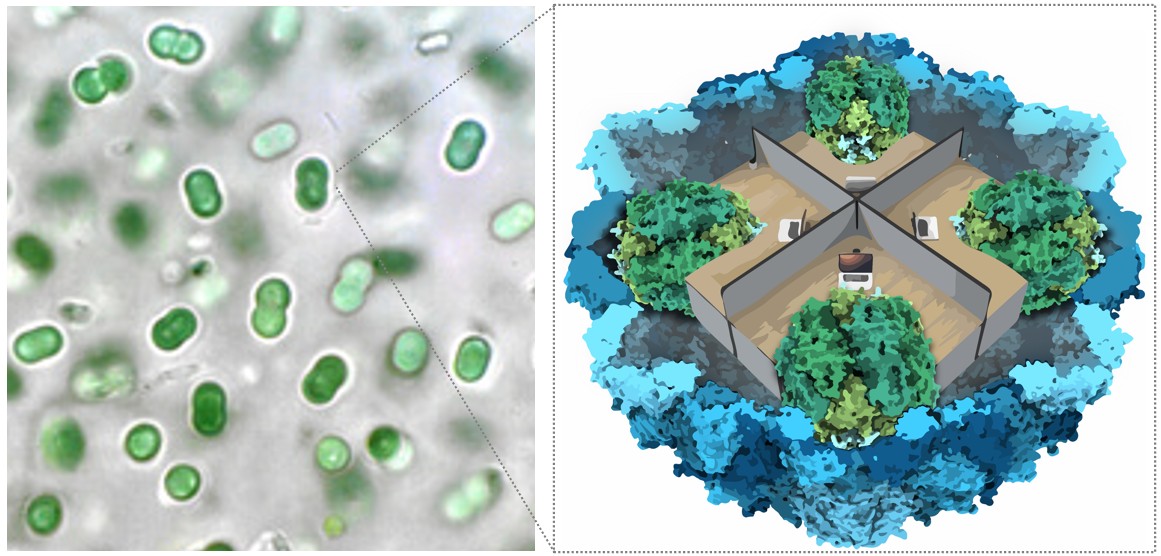
#USYD & ANU researchers built modular nanocompartments that encapsulate Rubisco (the enzyme that fixes CO₂), offering a new way to engineer carbon-concentrating systems into crops.
Supported by Sydney Analytical + Sydney Microscopy & Microanalysis, #USYD Core Research Facilities.
Read paper in Nature Communications 👉 https://t.co/bEPqfHVvwj
@SydneyNano@Sydney_Uni@ourANU@ARC_CoESB@ARC_CIPPS@YuHengLau
#SyntheticBiology #CarbonFixation #Photosynthesis #Bioengineering #Nanotechnology #SustainableAgriculture #ClimateChangeSolutions #CropEngineering #Biotechnology
Reprogramming encapsulins into modular carbon-fixing nanocompartments
"by fusing a short cargo-loading peptide to diverse Rubisco isoforms, we achieve targeted encapsulation while retaining CO2-fixing activity in E. coli" https://t.co/VojAc5LpTT
Led by @taylorszyszka + Dav, the first part of a big effort @Sydney_Science to make simple CO2-fixing cages is out @NatureComms 🦠➡️🌻
Encapsulation is one step towards keeping Rubisco focused on its very important job...
Read the Conversation article: https://t.co/kBEFPodARu
Better photosynthesis could boost crop yields by up to 60% – and a tiny box made of proteins could help. @yuhenglau@OurANU@Sydney_Uni https://t.co/6jR1iDWBvq
Rubisco is (arguably) the most abundant protein on Earth. (LPP surely comes close, right?) It’s an enzyme that fixes CO₂ into sugars during photosynthesis.
Unfortunately, as most people learn in school, Rubisco is inefficient. Sometimes it confuses O₂ for CO₂ and wastes energy. Plants make up for this in raw concentration; up to half the soluble protein in a leaf is Rubisco.
People have been trying to engineer better Rubiscos for many decades, but it's not easy because the proteins are big, do not fold easily (they need chaperone proteins to help out), are made from 16 subunits in land plants.
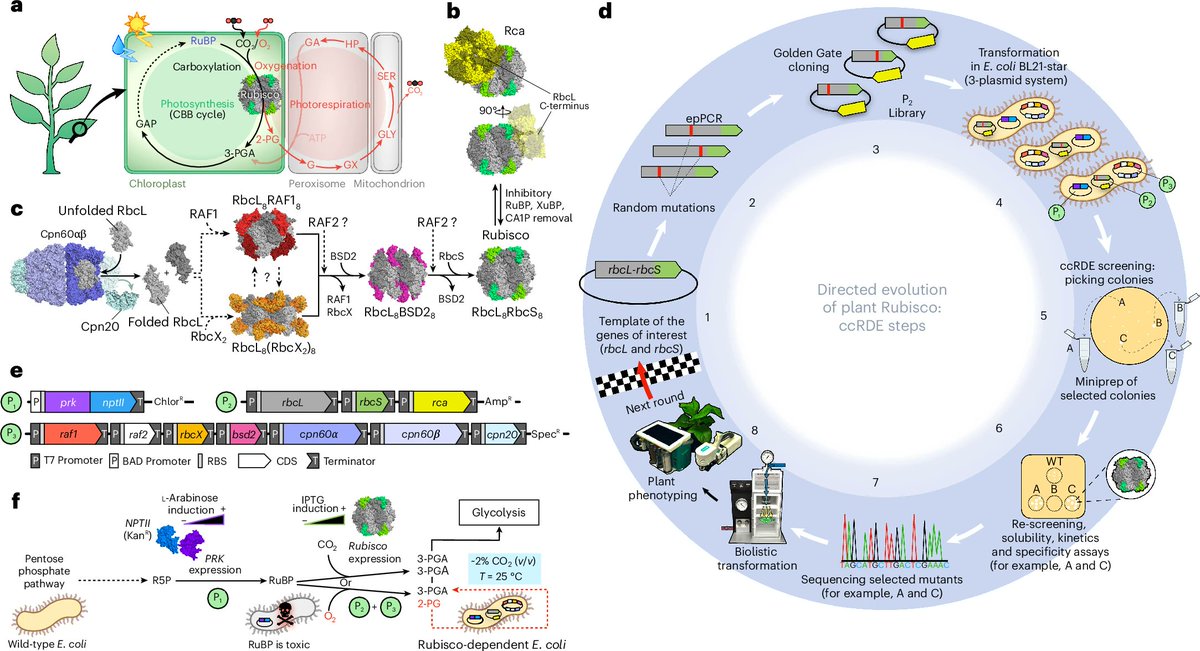
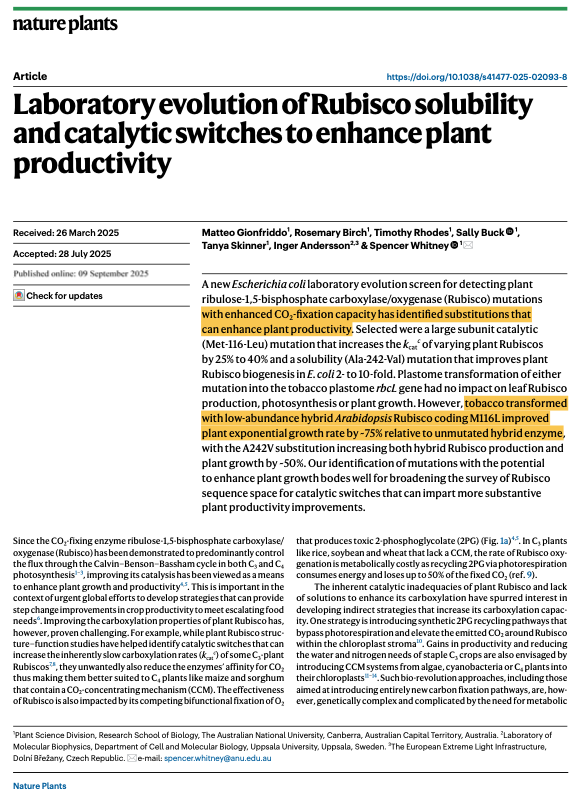
But there's a new paper in Nature Plants that looks really interesting. The TL;DR is that a group in Australia figured out how to express plant Rubiscos (and all SEVEN of their folding chaperones) using a set of 3 plasmids inside of E. coli cells. This enabled them to do "directed evolution" of Rubisco in bacterial cells, and quickly find Rubisco mutants that have higher enzymatic efficiency or that fold better.
In addition to the 3 plasmids, the researchers also coaxed E. coli to make ribulose-1,5-biphosphate, or RuBP, which is the 5-carbon sugar that Rubisco smashes into carbon dioxide to make molecules of 3-PGA for central metabolism.
Now, the clever bit is that you RANDOMLY MUTATE the three plasmids encoding the Rubisco to make millions of variants. Then, you transform those mutated plasmids into E. coli. If the E. coli do NOT make a functional Rubisco, RuBP levels build up and kill the cell; the molecule becomes toxic. But if the E. coli DO make a functional Rubisco, then they keep the RuBP levels in check and live just fine.
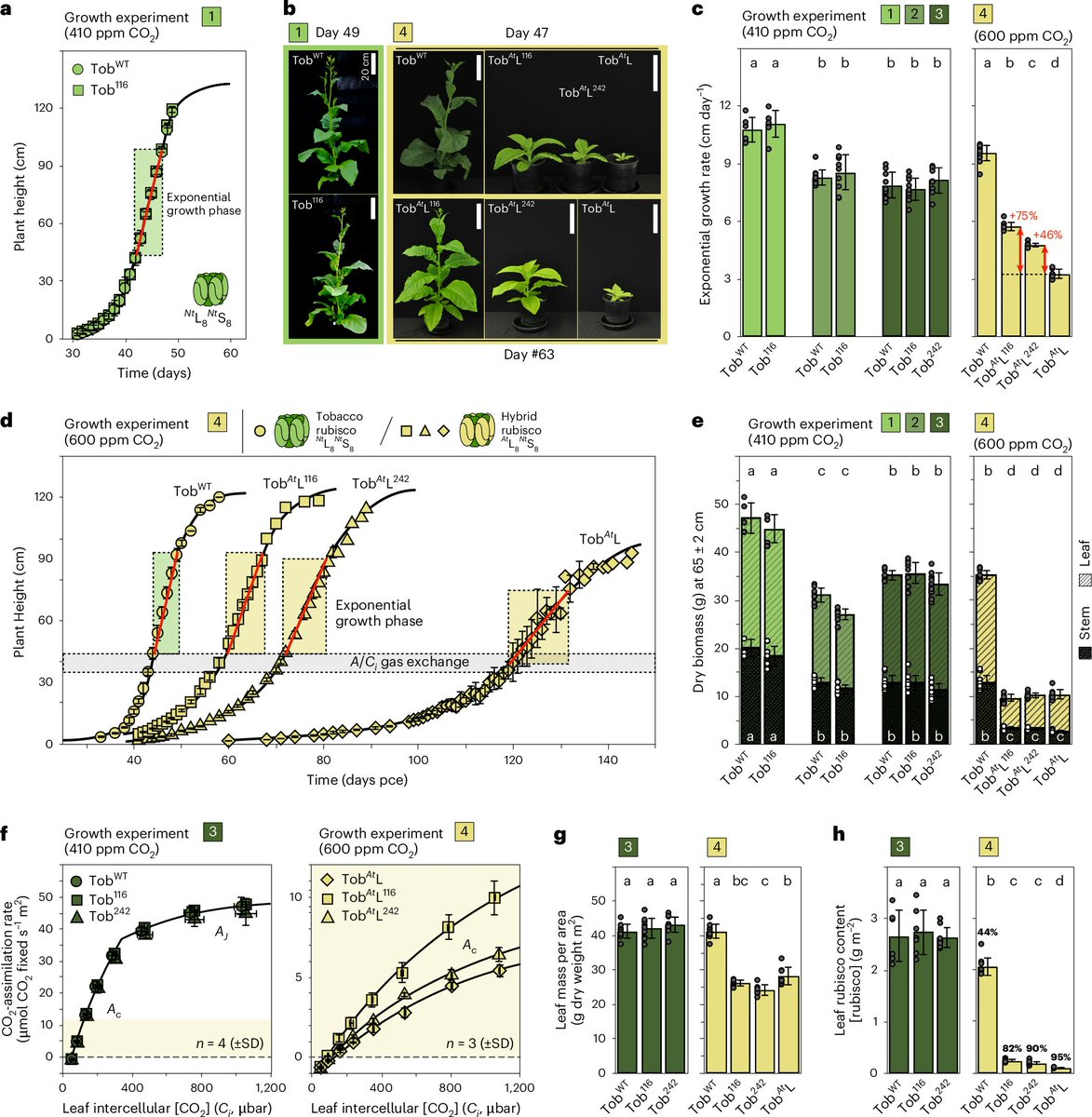
Using this "screening assay," the researchers found 46 fast-growing colonies of E. coli. Two of those colonies encoded really useful mutations. One mutation (M116L) makes Rubisco about 25–40% faster. The other (A242V) makes it fold and assemble much more efficiently.
They put this mutation into a "hybrid Arabidopsis–tobacco Rubisco," put that into tobacco plants, and measured growth. The plants with M116L grew 75% faster than wildtype.
No guarantees this will scale to more useful crops, like wheat and corn and soybeans etc. But it seems like a nice in vitro assay for faster prototyping!
🛟Wow cyclic peptides are cool! Excited to share a new publication on "Potent Cyclic Peptide Inhibitors Disrupt the FANCM–RMI Interaction". Work led by @yuhenglau to which we contributed structures and ideas. The top hits mimic native MM2...but in reverse! https://t.co/WP0hGUJapk
A happy accident in the lab has led to a breakthrough that could transform how we take medicine — cutting side effects and delivering drugs with incredible precision. 🎯 Read the story behind the discovery 👇 https://t.co/Hhv2Q7Jqg8
@taylorszyszka @arc_gov_au
@taylorszyszka, @yuhenglau and team (@rezwansidd@SydneyChemistry) have developed a new system for assembling encapsulin protein cages in vitro. This enables the packaging of a variety of molecules for limitless applications in biotech. #openaccess 🔓 https://t.co/sPPBEefv2U
Congratulations to our @RACInational MCCB Division award winners, delivering their lectures this morning in Darwin:
@PScammells - Adrien Albert award
@NitscheLab - Peter Andrews award
👏👏👏
#mccb2025
Feel happy and privileged to be here in Darwin Australia to learn about the exciting science going on everything chemical biology and medicinal chemistry at the @RACInational#MCCB2025 and sharing the latest work from our group @UoDCeTPD@UoDLifeSciences
The #MCCB2025 conference in Darwin kicks off in style, with @alessiociulli delivering an amazing talk on dual ligase targeting molecular glues, and their new bromocatch tag
(Talk so good it blew the power out all across Darwin for a minute 😂)
One week until the applications close for our two postdoc positions:
1) Synthetic med chem https://t.co/Jpbk5x9hWt
2) Chem bio https://t.co/0RNWLL99Cf
(new links, not sure why Workday changed them...)
We're hiring!🚨Our lab @SydneyChemistry is looking for two new #chempostdoc for our drug discovery program:
1) Synthetic/Med Chem (small molecule hit-to-lead)🧪
https://t.co/ADZ4CcIEAC
2) Chemical Biology (peptide inhibitors)🦠
https://t.co/X68qCM9PD1
Pls spread the word!🙏
Our paper on in vitro assembly and packaging of encapsulin protein cages is now accepted in @angew_chem 🥳
https://t.co/hpi4hZAqoG
Congrats @taylorszyszka for leading the charge, along with all our team members and collaborators
For those yet to seek bluer skies, check out our latest preprint on encapsulin protein cages!
We can now assemble them beautifully in vitro, without all the ugly defects you get from using acid/base or denaturants.
This lets us put any synthetic cargo into these cages.
High-fidelity in vitro packaging of diverse synthetic cargo into encapsulin protein cages
"Fluorescent dyes, proteins and cytotoxic drug molecules can all be selectively packaged via a peptide-mediated targeting process."
https://t.co/5kSUTifxxo
We're hiring! Join our team at @MolHorizons to study mitochondrial DNA replication using single-molecule imaging and cryo-EM. Looking for someone with strong experience in protein biochemistry.
🗓️ Apply by 29 April 2025
🔗 https://t.co/DRXvnRg88r
@Jacob_Lewis90
A postdoctoral position, funded by the @LeverhulmeTrust for up to 36 months, is available to join my group @EdinburghChem . The project focuses on biomimetic approaches to natural product synthesis.
Deadline: 18th April 2025.
https://t.co/tT7iRFgml9