@seraleev This is gold. Thanks for sharing!
Curious why you choose Google Ads instead of Meta?
I find Google Ads quite mysterious and takes really long to optimize (if it even optimizes). Are you running App Promotion ads?
1. Use @clarymind to lock Instagram and TikTok
2. Congrats, you're hired. You're welcome.
Bonus: you can even set Clarymind to redirect distracting apps straight to Substack.
Related-
During interviews I often ask where my people spend their time most on social media
Instagram 🚩🚩🚩
X 😎😎😎
Never hire an instagram-first employee, it’s a deeply negative sign
Using GPT-5 in Cursor and it was a disaster. I was looking at Stripe's docs and telling it step by step how to fetch a certain object.
GPT-5 thought for 10s and said "Not possible. Use blah blah instead."
Switched to Claude 4 Sonnet and it was like "You're absolutely right" and got it done correctly one-off.
An investor once pressured me to meet him at a hotel at night.
I said no. I asked if we could meet during the day, at a coffee shop or in an office.
He replied: “If you’re serious about this, you’ll meet me on my terms.”
That’s just one of many moments I’ve stayed silent about—until now.
As a female founder, I’ve faced harassment and dismissiveness more times than I can count.
I’m not sharing this to portray myself as a victim. I’m sharing it because silence only protects the behavior. And because I know I’m not alone.
Since starting my company, I’ve experienced:
- An investor who texted me late at night while drinking, saying he missed me—and asking whether I “show enough skin” in my party outfits, after a single coffee meeting about business.
- One who asked, “How many white guys have you been with for your English to be this good?”
- Another who interrupted me mid-sentence while I was sharing an important partnership update to say, “Bring your pretty friends to my island next time.”
- One who told me, “You’re too pretty to be a founder. Just be an influencer,” and then showed me photos of women online wearing very little, suggesting I could do the same.
- An investor who said he kept forgetting I could code—because I “don’t look like someone who can.”
- A founder I distanced myself from after multiple uncomfortable invites, who recorded and took photos of me without my consent. When I got upset, he said I was missing out on funding opportunities because he could’ve introduced me to investors.
- Another founder who made an unwanted sexual advance the first time we met. When I ignored his repeated messages, he told me he hoped my startup would fail.
These aren’t just awkward moments. They’re degrading. They’re exhausting. And to say they haven’t taken an emotional toll would be a lie.
I don’t want to be objectified, or reduced to an image these men create in their minds.
I hope we build a culture where this behavior is no longer tolerated. One where female founders don’t have to brace themselves before every investor meeting. One where we feel safe at work, at networking events, and in every room where decisions are made. One where competence isn’t overshadowed by appearance. One where boundaries are respected—without needing to be justified.
To be clear: These experiences do not reflect the majority. I’ve been fortunate to meet far more incredible, kind, and principled investors and founders than not.
But until this kind of behavior ends, stories like mine need to be heard too.
RevenueCat is really fast. They even wrote an article on how to setup web page checkouts within 12 hours.
Lots of respect. That's what a top startup/company looks like!
(Clarymind has a huge growth this year and thanks to RevenueCat we handled quite a lot of problems gracefully. Never paid the bills so happily 😆)
1️⃣ 🚨 Huge day for app monetization. A U.S. judge just ordered Apple to let iOS apps link to external payments, no 30 % cut attached. We’ve been ready for this and we shipped something today ⬇️
1️⃣ 🚨 Huge day for app monetization. A U.S. judge just ordered Apple to let iOS apps link to external payments, no 30 % cut attached. We’ve been ready for this and we shipped something today ⬇️
2024 has been a great year for @Clarymind:
◼︎ 6,000+ users
◼︎ MRR and active users growing at ~15% WoW
◼︎ 47 version updates since July - averaging 1.8 updates per week
◼︎ 1,971 commits this year (38 per week)
In 2025, we're focusing on personal health. Beyond screen time and mindfulness, we’re adding features for sleep, nutrition, and fitness.
While most tools tackle just one aspect, the human body is shaped by interconnected factors.
By integrating these areas, we aim to create a more holistic product and unlock new possibilities for innovation.
As technology advances, humans have the chance to live longer, healthier lives.
We’re excited to explore how we can contribute to extending healthspan. Some late nights, the thought of this future gives us that extra push.
Of course this vision is a long-term journey and not something any single company can achieve alone. But being part of it is meaningful to us.
If this resonates with you, give Clarymind a try: https://t.co/rfslJKNjwV (P.S. We’ve got a year-end promo running until Jan 5!)
That's wrap. If you enjoyed this super long post, share it and follow me.
Or... Clarymind’s year-end campaign runs until 01/05!
We now have 6,000 users and over 100 five-star App Store reviews worldwide: https://t.co/u3SkMQvkm6
Why users love it:
1️⃣ It works. Reduce social media use by building awareness of why you scroll.
2️⃣ Replace apps with alternatives. Use reading or learning apps instead of social media.
3️⃣ Reduce anxiety with breathing, meditation, and less social media consumption.
Our recent update includes a funny grumpy AI cat character and dozens of new alternative apps, like Kindle and Duolingo, to redirect users when opening social media apps.
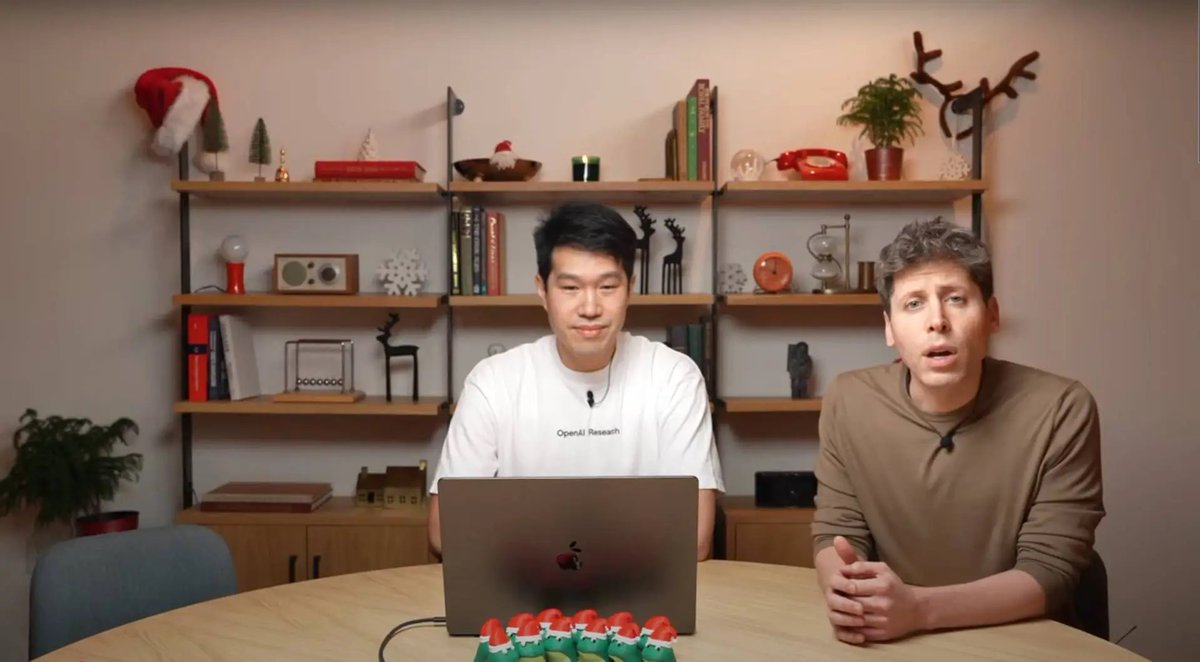
▌ OpenAI's Dilemma: Consumer, Copycat, and Commodity (a super long post)
OpenAI unveiled its o3 model, showcasing mathematical and programming skills that surpass the vast majority of humans.
Yet, throughout 2024, OpenAI has given me an odd sense of dissonance:
Are they an AI company or a consumer app company?
On the final day of their 12-day event, OpenAI introduced the o3 model. Its mathematical and programming abilities exceed most humans, and it performs at least on par or slightly better than the human average across various benchmarks.
Despite o3 being highly impressive, the rest of the announcements were consumer features, such as search, document collaboration, and video generation.
While the event highlighted OpenAI's research prowess, it also revealed the company's current challenges, which I summarize as three interwoven problems:
◼︎ Consumer: No advantage, no choice.
◼︎ Copycat: New technologies immediately copied upon release.
◼︎ Commodity: AI tech lacks moats.
I'll briefly introduce the o3 model and try to analyze OpenAI's dilemmas and potential solutions:
Of course I don't know why. But one possible reason might be Microsoft.
According to The Information, Microsoft’s agreement with OpenAI grants them access to OpenAI’s technology until AGI is achieved (defined as a system generating $100 billion in profit).
Could this agreement also prevent OpenAI from competing with Microsoft in some enterprise services?
Such constraints might explain why Sam Altman pushed to transform OpenAI into a for-profit company. Being free to raise funds could eliminate the need for weird, restrictive agreements.
This is pure speculation. It could simply be undisclosed. Or that enterprise solutions aren’t cool.
Building chatbots for businesses isn't exactly revolutionary. OpenAI might not want to be seen as a contractor. Sam Altman might want to be the next Steve Jobs.
This reflects two paths in Silicon Valley: becoming Apple with cutting-edge consumer products, or becoming Microsoft with enterprise profits.
For OpenAI, B2B may not be all that cool, but it could ensure the company’s survival better than offering free ChatGPT to everyone.