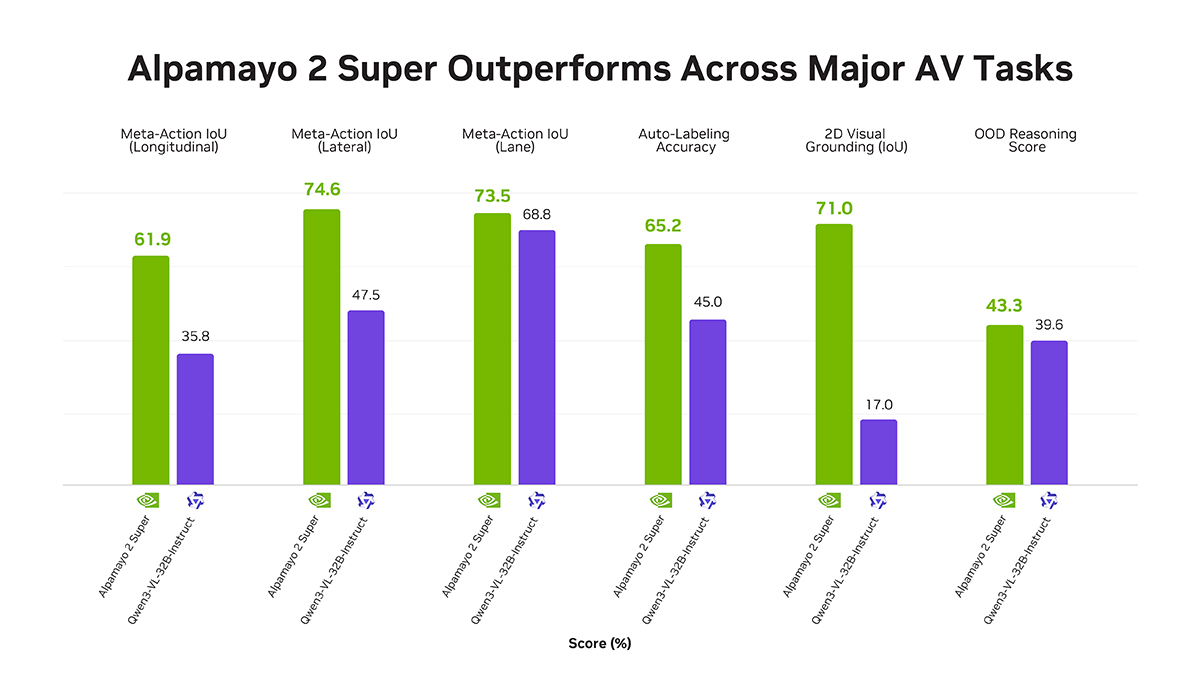
Today, we’re launching Alpamayo 2 Super, our frontier open reasoning model for autonomous vehicles.
Beyond seeing, Alpamayo understands and reasons through the complex world - thinks before it acts.
It’s a powerful backbone for robotaxis, trucks, shuttles, delivery vans, tractors and the long tail of mobile robots—billions of autonomous machines someday.
We’re releasing it for commercial use under OpenMDW-1.1 so teams can inspect it, fine-tune it and deploy it—open models advance safety and security.
The next wave of AI is robotics—and it starts with autonomous vehicles.
Great work, Alpamayo team!
https://t.co/2PYCCXWjZh
Asked Fable 5 to verify the same thing three times.
By the third time, it finally snapped:
“It never claimed to be what the agent received — and now you can check that directly instead of trusting either of us.”
Apparently, Fable’s pronouns are they/them 😂
Introducing Ψ₀ (https://t.co/qqH1PiIJS8) — an open foundation model for universal humanoid loco-manipulation.
🏆 Outperforms GR00T N1.6 by 40%+ overall success rate
📉 Uses only ~10% of the pre-training data
📦 Fully open-source: model, data, code, and deployment pipeline
1/10
What does it take to build autonomous vehicles that can reason about the world they drive in?
Tomorrow at #NVIDIAGTC, Patrick Liu and I will take a deep dive into the #Alpamayo#reasoning model family—a family of reasoning-based vision–language–action (#VLA) models that form a core component of the Alpamayo open platform (https://t.co/EmY9IRNXHZ).
We’ll cover three main topics:
- How reasoning-based VLA models like Alpamayo 1 are designed and built
- What it takes to bring Alpamayo 1 to production, including some of our latest results
- Several exciting announcements about the expansion of the Alpamayo open platform
If you're working on autonomous driving, robotics, or foundation models for physical AI, this session will offer a look at where the field is heading.
Session details:
📅 Monday, Mar 16 | 3:00 PM PDT
📍 #NVIDIAGTC 2026
🔗 https://t.co/ZJk5GGIbFV
Looking forward to seeing many of you there.
@NVIDIADRIVE@NVIDIAAI
Join me and my collaborators for a *live* discussion on @nvidia Alpamayo 1 (https://t.co/9nI9L08LJJ), a reasoning-based vision–language–action (VLA) model for autonomous driving.
🎥 Livestream: Inside NVIDIA Alpamayo 1: Making Autonomous Vehicles Reason
🗓 February 11
⏰ 9:00am PST
📍 Watch here: https://t.co/WJkK2AaTkF
As NVIDIA CEO Jensen Huang put it:
“The ChatGPT moment for physical AI is here — when machines begin to understand, reason, and act in the real world. Robotaxis are among the first to benefit. Alpamayo brings reasoning to autonomous vehicles, allowing them to think through rare scenarios, drive safely in complex environments, and explain their driving decisions — it’s the foundation for safe, scalable autonomy.”
During the livestream, we’ll cover:
- How #reasoning-based #VLA models like #Alpamayo 1 are designed and built
- Applications ranging from end-to-end #autonomy to reasoning-driven auto-labeling
- Key opportunities and challenges in developing reasoning models for #Physical #AI
I’ll be joined by core Alpamayo 1 developers @yan_wang_9@YurongYou@wenhaoding95, and we’ll take questions live from the community.
📖 Ahead of time, you might enjoy this overview of the Alpamayo ecosystem:
https://t.co/EmY9IRNXHZ
And if you’re attending @NVIDIAGTC (March 16–19) and would like to meet some of the Alpamayo team in person, you can use my employee code for 25% off your conference pass:
https://t.co/Qd3JkaMBIK
Hope to see you at the livestream!
@NVIDIAAI@NVIDIADRIVE
🚀 Exciting news from #CES2026!
In his keynote today, Jensen announced @nvidia Alpamayo — a *fully open* ecosystem of models, simulation tools, and datasets designed to accelerate reasoning-based autonomous vehicle (AV) architectures and advance the path to Level 4 autonomous driving.
Alpamayo brings together several technologies we’ve developed to enable reasoning-based vision–language–action (VLA) models for AVs. Our goal is to provide researchers and developers with a flexible, fast, and scalable platform for evaluating and training reasoning-based AV architectures in realistic closed-loop settings.
Explore Alpamayo:
-- Press Release: https://t.co/H0ZxzXXsG6
-- Hugging Face Blog: https://t.co/EmY9IRNpSr
-- Tech Blog: https://t.co/htAOupt7Nz
-- Alpamayo 1 reasoning model: https://t.co/8PSdQNCSHg
-- Physical AI AV Dataset: https://t.co/fD9eUcmFIC
-- AlpaSim simulator: https://t.co/9WqutgoGfF
I’m incredibly proud of the @nvidia AV Research team (https://t.co/YI3eJrkbZQ) and our many @nvidia collaborators whose contributions made this possible.
More releases and features are coming soon — we can’t wait to see what the community builds with Alpamayo!
💡 Want to help grow the Alpamayo ecosystem? We’re hiring:
[Sr.] Research Scientist: https://t.co/D4Z0xLE8JX
[Sr.] Research Engineer: https://t.co/5yCpiDJ572
#AutonomousVehicles #AutonomousDriving #AI #Simulation #ReasoningAI #OpenEcosystem #Alpamayo @NVIDIAAI@NVIDIADRIVE
Introducing the USC Physical Superintelligence (PSI) Lab (https://t.co/nACO3kGxdD). We are rebranding to better reflect our current focus. From here on out, we are tackling one thing: solving robotics and physical intelligence with every model, every bug, and every line of code. And yes, we are hiring at all levels, especially PhDs in this cycle and potential PostDocs who are excited about robotics. We hope you can join us in this journey! 1/9
We’ve just released @nvidia#DRIVE Alpamayo-R1 (AR1) — the world’s first industry-scale open #reasoning#VLA model for autonomous-vehicle (AV) research. AR1 integrates Chain-of-Causation reasoning with trajectory planning to improve decision-making in complex driving scenarios.
Built on @nvidia #Cosmos #Reason, AR1 is designed as a customizable foundation for a broad range of AV applications — from instantiating an end-to-end backbone for autonomous driving to powering advanced, reasoning-based auto-labeling tools.
Resources:
Model: https://t.co/9nI9L08LJJ
Inference Code: https://t.co/QpPzLEsFnm
Paper: https://t.co/8PSdQNDqwO
Blog Post: https://t.co/S92N6ff58L
A subset of the data used to train and evaluate AR1 is available in the @nvidia Physical AI Open Datasets: https://t.co/fD9eUcndya
AR1 can be evaluated using AlpaSim (https://t.co/9Wqutgpe5d), @nvidia's newly released open-source AV simulation framework built specifically for research and development. (Separate post on AlpaSim coming soon.)
This release completes @nvidia’s trifecta — model, data, and simulator — to accelerate research and development in the autonomous-vehicle domain. Happy developing, and stay tuned for more!
Huge thanks to the phenomenal team that made this possible @NVIDIAAI@nvidia.
Excited to unveil @nvidia's latest work on #Reasoning Vision–Language–Action (#VLA) models — Alpamayo-R1!
Alpamayo-R1 is a new #reasoning VLA architecture featuring a diffusion-based action expert built on top of the #Cosmos-#Reason backbone. It represents one of the core technologies driving NVIDIA’s push toward Level 4 autonomy and robotaxis (https://t.co/IbGjWrBAfo), as announced by Jensen Huang at #gtc DC last week.
📄 Paper: Alpamayo-R1 https://t.co/8PSdQNDqwO
We present:
- Architecture & Design: How to transform a VLM into a driving-ready Reasoning VLA
- Chain of Causation Labeling: A new framework enabling reasoning-based learning
- Training Strategy: From internet-scale pre-training → AV-specific SFT → RL-based post-training
- Extensive Evaluation: From closed-loop simulation to real-world, on-vehicle testing
📈 Results: Alpamayo-R1 delivers significant performance gains over end-to-end baselines — especially in rare, safety-critical scenarios — all while maintaining real-time inference (99 ms end-to-end latency).
Coming soon: releases of model variants and reasoning metadata built on top of the Physical AI Dataset (https://t.co/fD9eUcndya)—with more updates on the way. Stay tuned!
🙌 Huge thanks to Wenjie Luo and @yan_wang_9 (project co-leads); the @nvidia AV Research team (@iamborisi, @YurongYou, @xinshuoweng, @tianran_, @wenhaoding95, and many others); collaborators across @nvidia Research (@liu_mingyu, @visualyang, @PavloMolchanov, and many others); and the @nvidia AV Product team (Sarah Tariq, Patrick Liu, Jack Huang, and many more). Full contributor list in the Appendix.
@NVIDIADRIVE@NVIDIAAI
🚗🤖 Interested in reasoning models for embodied AI?
I’m excited to share that at #NVIDIAGTC in DC I’ll unveil our latest work at #NVIDIA on reasoning Vision-Language-Action (VLA) models for vehicle autonomy:
I’ll cover how we’re:
• Advancing reasoning in VLA models
• Powering a data flywheel for AV foundation models
• Making autonomous driving more human-like and safer — with real-world driving videos!
🔗 Session info: https://t.co/1sbWdowD4N
📍 Tuesday, Oct 28 • 3 PM
Walter E. Washington Convention Center
Are you a PhD student excited to build the future of Autonomous Vehicles? The @nvidia Autonomous Vehicles Research Group is now recruiting PhD research interns for 2026!!
Apply here: https://t.co/bElo8saaBu
We’re now accepting applications for the 2026–2027 NVIDIA Graduate Fellowships! If you’re passionate about advancing cutting-edge reasoning models for Physical AI applications 🚗🤖, apply here: https://t.co/ZAzpxXxsDS — and be sure to select “Autonomous Vehicles.”
@NVIDIAAI
📢 The first X-Sense Workshop: Ego-Exo Sensing for Smart Mobility at #ICCV2025!
🎤 We’re honored to host an outstanding speaker lineup, featuring Manmohan Chandraker, @BharathHarihar3, @wucathy, Holger Caesar, @zhoubolei, @Boyiliee, Katie Luo
https://t.co/FmVGnwv906
At #GTC2025, Jensen unveiled Halos, a comprehensive safety system for AVs and Physical AI. Halos integrates numerous technologies developed by my team @nvidia, and I was thrilled to help coordinate its launch alongside Riccardo Mariani and many amazing colleagues @NVIDIADRIVE.
Introducing DreamDrive, which combines the complementary strengths of generative AI (video diffusion) and neural reconstruction (Gaussian splatting) to transform any street-view image into a dynamic 4D driving scene!
Web: https://t.co/Sk2nlAlu7G
Paper: https://t.co/yvgSOXcE6d
How can we best use LLMs in an autonomy stack? An exciting prospect is to exploit their generalist experience to reason about anomalies. And one can do this in real time by leveraging their embeddings in a fast&slow decision making architecture. Work led by @RohanSinhaSU#RSS2024
At @NVIDIAGTC, I presented my group's strategy on leveraging foundation models (FMs) to develop next-gen autonomous vehicles. Slides: https://t.co/5FPHxJGFeh Recording: https://t.co/Izu0iNwuN1 Three pillars: standing up the FMs, using them within an AV program, and AI safety.
#CVPR2024 Workshop on AV Simulation!
Simulation is a crucial tool to accelerate the development of safe autonomous driving (AD).
In our full-day CVPR workshop with exciting speakers from Waymo, Tesla, Waabi, Wayve, Nuro, Princeton and many others, we’re bringing together 1/N
Really excited about this direction. For security/safety analysis of LLM-powered systems we need to look at the entire system. Lots of interesting PL/FM work to be done here as well.







![drmapavone's tweet photo. 🚀 Exciting news from #CES2026!
In his keynote today, Jensen announced @nvidia Alpamayo — a *fully open* ecosystem of models, simulation tools, and datasets designed to accelerate reasoning-based autonomous vehicle (AV) architectures and advance the path to Level 4 autonomous driving.
Alpamayo brings together several technologies we’ve developed to enable reasoning-based vision–language–action (VLA) models for AVs. Our goal is to provide researchers and developers with a flexible, fast, and scalable platform for evaluating and training reasoning-based AV architectures in realistic closed-loop settings.
Explore Alpamayo:
-- Press Release: https://t.co/H0ZxzXXsG6
-- Hugging Face Blog: https://t.co/EmY9IRNpSr
-- Tech Blog: https://t.co/htAOupt7Nz
-- Alpamayo 1 reasoning model: https://t.co/8PSdQNCSHg
-- Physical AI AV Dataset: https://t.co/fD9eUcmFIC
-- AlpaSim simulator: https://t.co/9WqutgoGfF
I’m incredibly proud of the @nvidia AV Research team (https://t.co/YI3eJrkbZQ) and our many @nvidia collaborators whose contributions made this possible.
More releases and features are coming soon — we can’t wait to see what the community builds with Alpamayo!
💡 Want to help grow the Alpamayo ecosystem? We’re hiring:
[Sr.] Research Scientist: https://t.co/D4Z0xLE8JX
[Sr.] Research Engineer: https://t.co/5yCpiDJ572
#AutonomousVehicles #AutonomousDriving #AI #Simulation #ReasoningAI #OpenEcosystem #Alpamayo @NVIDIAAI @NVIDIADRIVE](https://pbs.twimg.com/media/G97z6VLWkAEelCx.jpg)





