SONIC is officially published in Science Robotics today and it made the Science front page.
We show the promise of scaling motion tracking toward natural, robust whole-body control for humanoid robots.
Huge thanks to the team, and more exciting work is on the way.
Paper: https://t.co/Pa9wy4TVJw
Code: https://t.co/ZipTq2TcIt
Q and V are very policy-dependent. Pre-training them feels not applicable, at least at the moment.
The more scalable approach is to pre-train a rewarder, dense plus sparse.
This was true for LLM, also probably true for robotics?
Pretraining a Q-function often doesn’t actually help RL finetuning, compared to initializing Q from scratch.
We find that pretraining Q-functions on data from diverse policies is critical to see improvements from pretraining.
Paper: https://t.co/dlj5RXVFED
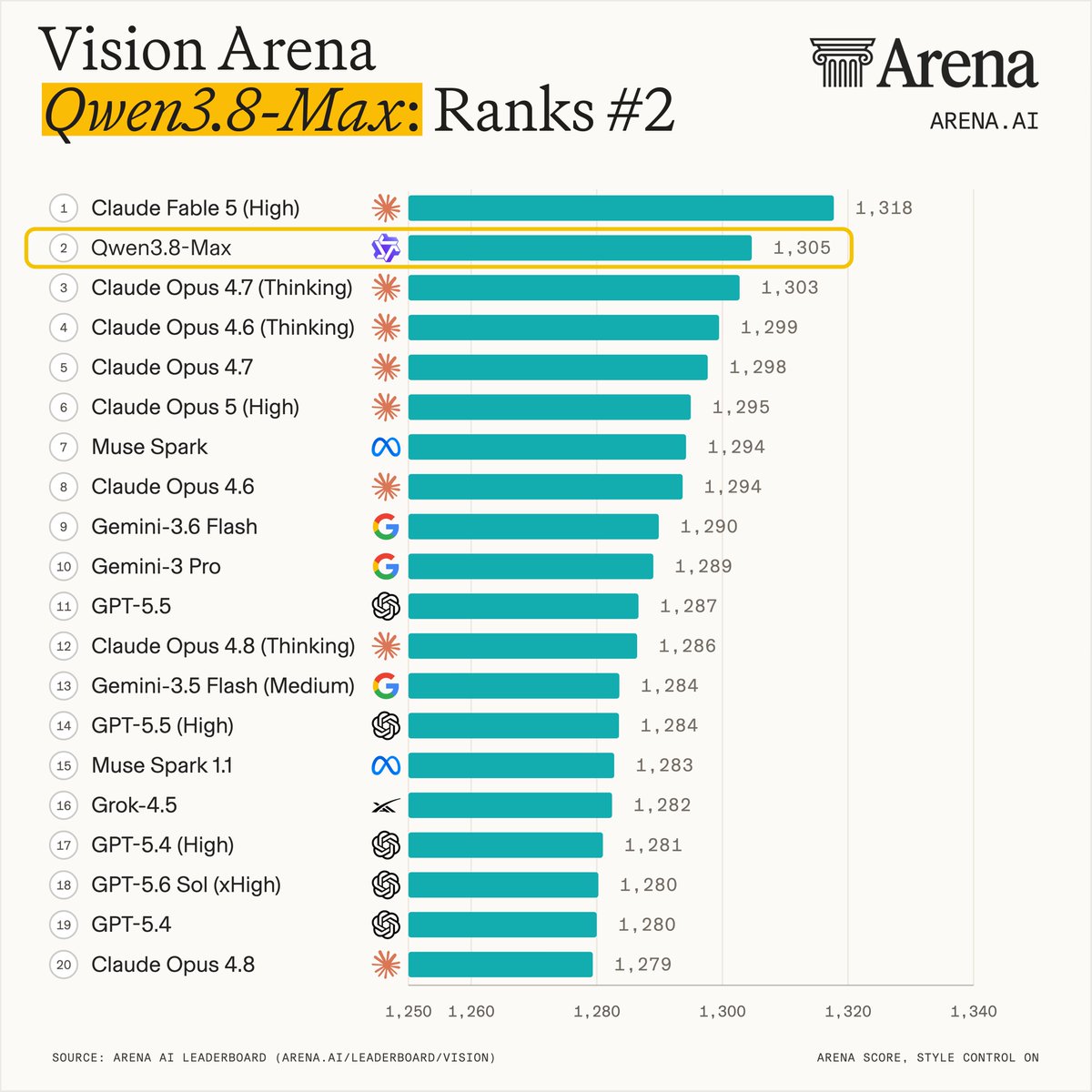
To have an arena called “Vision Arena” is crazy. Are we talking about video/image understanding? tracking? segmentation?
Claude the best? anyone working with video knows Claude is way worse than Gemini (G is also very bad, btw)
It would make more sense if you break it down.
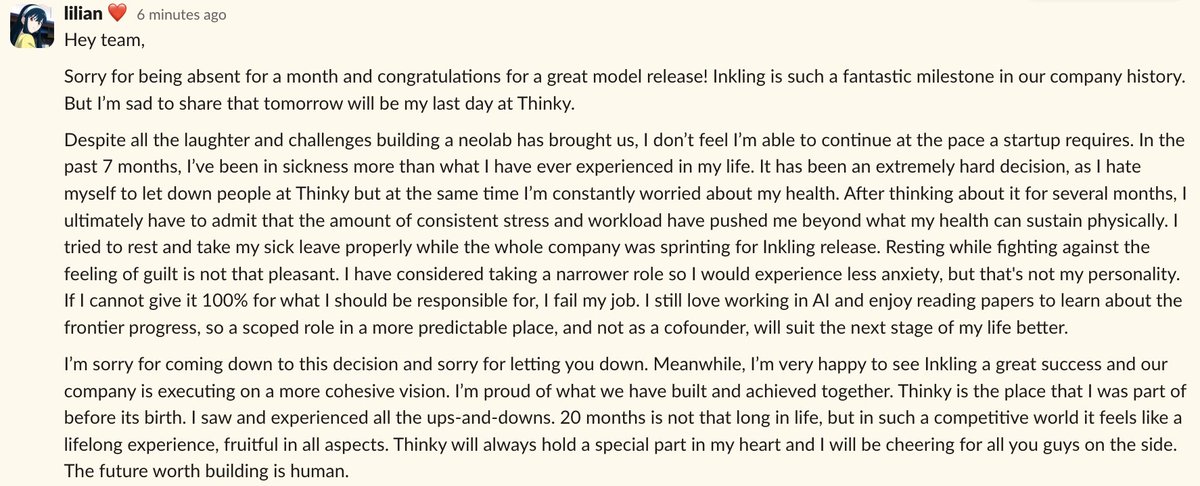
I resonate with this post deeply.
Agents keep getting faster, and I increasingly feel myself being the productivity bottleneck: all the high-level decisions, managing so many parallel agents, understanding the output
Health matters more in AI research. Wishing Lilian the best.
It is a hard and sad decision. I shared this message with folks at Thinky. Thank you all for the time together♥️ Just as the last sentence in my message: The future worth building is human.
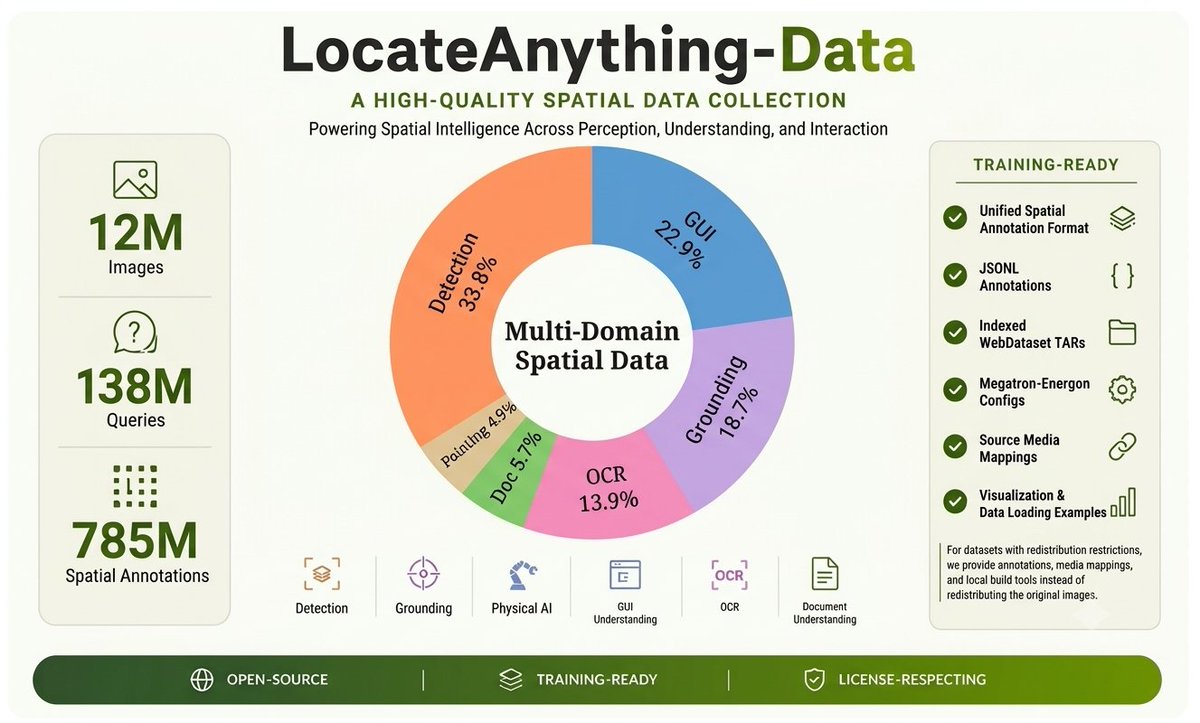
Better multimodal models need better spatial data.
Today we’re open-sourcing LocateAnything-Data — a high-quality, training-ready spatial data collection with 12M images, 138M queries, and 785M annotations spanning multi-object detection, referring expression grounding, physical AI, GUI understanding, OCR, and document understanding.
With the community response to LocateAnything, we believe that making its training pipeline more reproducible would be valuable to the community. Alongside the data, we’re also releasing:
• Unified spatial annotations
• JSONL annotations
• Indexed WebDataset TARs
• Megatron-Energon configs
• Source-media mappings
• Visualization & data loading examples
LocateAnything-Data integrates many outstanding public datasets under a unified spatial annotation format while fully respecting their original licenses and usage terms. For datasets with redistribution restrictions, we provide annotations, media mappings, and local build tools instead of redistributing the original images. Huge thanks to all the researchers and open-source contributors whose datasets, tools, and models made this release possible.
📦Dataset: https://t.co/zrREIt6ivC
📄Paper: https://t.co/L8UXhkooOo
🤗Model: https://t.co/SmjoTwNORN
For my first post, I’m sharing a letter @NVIDIA signed on why open models matter.
AI will transform every industry, power every company, and be built by every country.
Open models strengthen safety and cybersecurity, accelerate innovation and diffusion, and enable sovereignty.
The world needs both frontier closed models and frontier open models.
https://t.co/AUKzoQ5Ikb
Robot dat scaling usually means more tasks, scenes, and hours. GEN-1 is scaling over EEFs too.
I love how data-first they are: use all feedback and signal to see what type of data is missing, collect it, and iterate.
That flywheel is exactly what we need to solve robotics.
Why create robot intelligence for just one hand, when we could have it learn from many?
GEN-1, our latest embodied foundation model, now supports a broad range of end effectors from 5-finger hands, to specialized tools, and everything in between.
@FlexionAI A really nice way to turn deployment sites into training environments. I'm curious how performance changes as real site drifts from the scan: different lighting, moved furniture, clutterness, people walking around, etc.
It's kind of frustrating to see 3.5 Pro is still "coming soon," and 3.6 Flash sits at #12 on Frontend Code Arena, behind Kimi, GLM, Muse, Grok.
For understanding long, nuanced videos, Gemini remains my first choice. I hope Google can build on that lead.
We’re rolling out three new models to make AI agents faster, smarter, and cheaper at scale:
🔵 Gemini 3.6 Flash: It uses fewer tokens than 3.5 Flash to deliver higher quality work at the exact same cost.
🔵 Gemini 3.5 Flash-Lite: A fast, cost-effective option for everyday tasks like processing documents and agentic search.
🔵 Gemini 3.5 Flash Cyber: A cybersecurity model built to find and patch critical software vulnerabilities.
@UnitreeRobotics Would love to understand the deployment setup better. Is OminiA-0.3 running fully onboard? Which part of the stack operates at the real-time control frequency?
This is the setup we explored with Vesta: a generalist VLM handles localization, navigation, reasoning, and planning, while low-level robot policies handle execution.
To me, separating slower reasoning from fast control is the more practical direction.
https://t.co/CJSmcdmh0T
Impressive! I'm curious what a "single model" means here. Is one model really handling perception, reasoning, and control onboard, or are several components working together?
I suspect practical robots will need a fast onboard policy for System-1 and a more capable System-2 planner on separate compute. Network latency and failures should never sit inside the safety-critical control loop.
Real-Time Omni-Modal Interaction Driven Whole-Body Mobile Manipulation🥳
Unitree UnifoLM-OminiA-0.3 — a single model handling diverse home-care and wellness tasks, with omni-modal interactive understanding, fully autonomous, stable and disturbance-resistant execution.
And N alone is not enough. 1,000 identical rollouts speaks less than 100 trials w/ diverse environments, objects, initial states, and failure modes. Coverage and independence matter too.
As a robot babysitter with VLM background, one thing always bugs me: small-sample robot eval.
With a few rollouts, you'll notice night-and-day improvement. But small, steady gains vanish into noise. 9/10, 90/100, 900/1000 tell very different stories.
As policy get better, eval scale has to keep up. But how many real-world rollouts are enough?