🚀 PhysAI is coming to ECCV 2026!
Excited to announce the 1st Workshop on Physical AI: Understanding and Building the Physical World (PhysAI) at #ECCV2026 in Malmö, Sweden!
📅 Sept. 9, 2026
🌐 Website: https://t.co/AOk3cJuabE
🚀 PhysAI is coming to ECCV 2026!
Excited to announce the 1st Workshop on Physical AI: Understanding and Building the Physical World (PhysAI) at #ECCV2026 in Malmö, Sweden!
📅 Sept. 9, 2026
🌐 Website: https://t.co/AOk3cJuabE
We’re excited to welcome an outstanding lineup of speakers shaping the future of Physical AI, including researchers from Google DeepMind, NVIDIA Cosmos, Stanford, MIT, UC Berkeley, ETH Zürich, TUM, Cornell Tech, UT Austin, and more. (https://t.co/B6kT7mWPE9)
Join us to explore the next generation of AI systems that understand and interact with the physical world—from 3D/4D vision and world models to robotics, simulation, and physical reasoning.
🚀 LingBot-VA 2.0 is here!
After half a year of teamwork, we're thrilled to release LingBot-VA 2.0 — a native video-action foundation model for generalizable robot control.
Unlike prior world-action models that retrofit generic video generators for robot control, LingBot-VA 2.0 is natively pretrained from scratch as a video-action foundation model.
Three key insights:
🌍 Native Video-Action Pretraining for learning world knowledge that enables strong generalization.
🧩 Semantic Visual-Action Tokenizer for more accurate action prediction with robust prompt following
⚡ Foresight Reasoning enables the robot to think ahead while acting, delivering continuous, responsive control without interrupting execution.
It runs in real time on consumer-grade GPUs, supports up to 150 Hz control, and generalizes to unseen tasks.
👇 Demos below
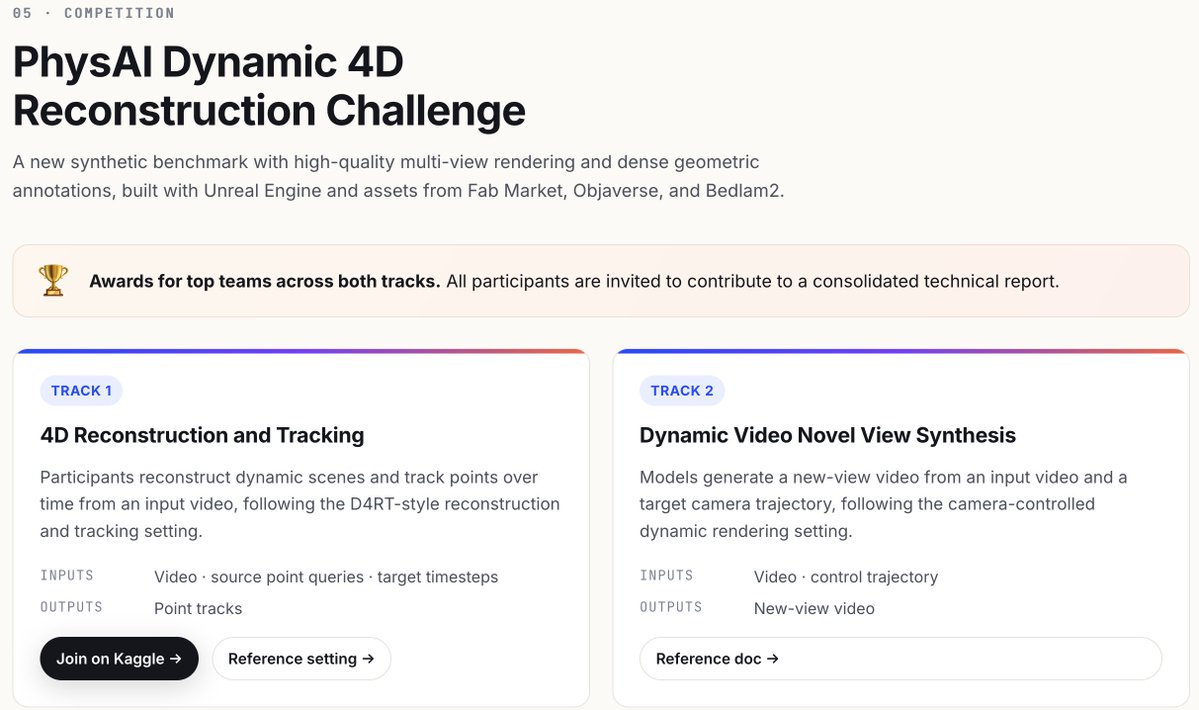
🎁 We are pleased to introduce Syn4D, a large-scale multiview synthetic dataset for dynamic scenes, accepted at #ECCV2026.
The complete dataset, including its dense geometric annotations, is now publicly available.
🌐 Project: https://t.co/SFnGB1siFJ
💻 GitHub: https://t.co/uwilvXFO85
🤗 Dataset: https://t.co/yldl1pcR3n
🧵1/8
This is a small step toward view-invariant, geometry-grounded world models😉
📄 https://t.co/6uxxXXhp7a
💻 https://t.co/KTniaTvoHF
🤗 https://t.co/dUGcoM8oHL
Excited to share PhysiFormer 🫧, work with Yiming Chen and Andrea Vedaldi @VGGOxford!
We show that physically plausible 4D mesh dynamics can emerge from a single coordinate-space diffusion process — no rigidity priors, no object IDs, just world-space vertex trajectories.
Can diffusion learn physical dynamics directly in 3D space? Yes!
Introducing 🫧PhysiFormer🫧 — a unified model that generates physically plausible multi-object, multi-material 4D dynamics in world space, conditioned on initial per-vertex positions and velocities.
🧵1/8
Introducing VGGT-Ω: scaling feed-forward reconstruction across static and dynamic scenes, and studying whether the learned geometric representations transfer beyond reconstruction.
4RC introduces a unified, fully feed-forward framework for monocular 4D reconstruction that encodes an entire video once and then flexibly queries dense 3D geometry and motion for any frame at any timestamp.
By factorizing scene structure into base geometry and time-dependent displacements, it achieves accurate, efficient, and state-of-the-art performance across diverse 4D reconstruction tasks.
Paper: https://t.co/de91ZWF3Qs
Project Page: https://t.co/yub8KWBwWu
@jeffrey_hawke The technical term "world model" (2018) corresponds to the "dynamics model" from control theory (1960). Sadly, it has become a "suitcase word". For those interested in the intellectual history, may I suggest my talk https://t.co/O3zzAbmIKb
@bingyikang Great work, streaming is very important in real world applications. Just wonder how is the performance compared to Stream3r or stream-vggt?