@timgl@joshthedevguy@adamleithp@timgl I can never easily see the actual location of my session replays. I can see the country, but it's very difficult to see the city, which is important for me.
I would love if I could just customize what I see in my session replays view, so I could see It all in one place.
Yes. This is spot on. I'll expand a bit more because I love thinking about this.
1. Build a model of the how the world works: Understand systems, games, game theory, the web of relationships and incentives that holds the world together (agreed upon ones and biologically embedded ones)
2. Build the ability to look at the world as a game where you are both a character and the player. Sometimes you have to make decisions that are difficult for the character but the player's objective is to play the game. Many people also get really good at a single level and just stay in that level for the rest of their lives. No fun in that, the entire point is to play levels slightly outside your current ability.
3. Understand that the world is an translucent input-output machine. You put stuff in and you get something back. One way to learn how the machine works is by trying a wide range or a large volume of inputs. Most people only try a single set of inputs, one which was told to them by their parents or peers to "play it safe".
Introducing OpenSource Clay killer
- 85% cheaper than clay
- Most accurate on people-search bench
- 25x faster
- Run GTM directly in claude code or codex
Try it at https://t.co/s60Ye4EO3h
Repo link below 👇
If you haven't read a biography on Alexander the Great yet... you are TWEAKING. This guy literally just marched East and conquered everyone and anything in his way. No strategy. Just pure war. He used catapults when no one use catapults in war. He built bridges where no one was able to build bridges. He would march at the frontlines with his army fighting hand to hand combat. He dreamed of becoming godlike like Heracles and Achilles. He thought about his named being remembered for a thousand years. His biography is probably one of the most inspiring things a man can read.
A few things I’d recommend if you’ve built a SaaS and are figuring out how to grow it.
We’ve bootstrapped HeyReach to $18M ARR. Here’s what’s helped us:
1. Work closely with your first customers
- Find a few teams willing to try the product on real work.
- Offer free access in exchange for feedback and a case study.
- Make your team available to help them.
2. Help users finish the job they signed up for
- A product tour isn't enough. Help them actually do the thing they came for.
- At HeyReach, we added success reps and focused on helping users succeed.
- Get activation working before spending more to bring people in.
3. Give people something useful at launch
- Show a workflow with the tools your customers already use.
- Share the template, prompts and setup so they can run it themselves.
- For our Make launch, we offered an importable scenario, prompts and outreach templates.
4. Help the people already posting about your product
- Find customers and experts posting useful content about it.
- Give them early access, send leads their way, and run webinars together.
- Give them a way to earn from referrals. We built our creators and experts program around a partnership instead of paying per post.
5. Put your developers in customer support
- Especially early on. Let them see where people struggle with what they've built.
- Reply quickly when something breaks, even if the fix will take longer. Tell the customer what's happening.
- Use those conversations to decide what needs fixing next.
mental trick with huge impact
no one is better than you. no one is smarter than you. no one can work harder than you. the only reason someone is better than you at something is that they have been doing it for longer. remind yourself of this often, you will turn your life around
Controversial cold email beliefs I will fight anybody on:
1. Branded domains matter way less than people think. We’ve tested branded vs. non-branded infrastructure at scale and the difference in campaign performance is nowhere near what people make it out to be.
2. Sender names barely matter. People obsess over whether emails should come from the founder, an SDR, a female sender, etc. It's useless in our experience.
3. 90% of copy split tests are noise. If variant A gets 2 positive replies and variant B gets 1, that is technically a 100% lift. It does not mean the wording caused it. Just send a better offer.
4. Tiny copy changes are usually a waste of time. Swapping a few words or rewriting one case study sentence rarely changes results at scale. The angle and offer matter much more.
5. Recognizable client name > a much bigger result. “We helped Apple with their rebrand” will smack “we helped an unknown company grow to $50M” because the prospect immediately understands the proof.
6. Great offers > great personalization. A 10-step Clay workflow will not save a mediocre offer. No questions asked.
7. Info@ and hello@ emails are underrated. I used to think nobody checked them. For some SMB and local-business campaigns, they can perform surprisingly well and sometimes outperform direct contacts.
8. Calendly links can make it harder to book cold leads. Once somebody replies, proposing a few specific times often works better than sending them away to pick a slot themselves.
9. The best cold email campaigns often need less sophistication. If you are selling something the prospect almost never sees in their inbox, a simple relevant offer can crush a complicated campaign.
10. Sending on Saturdays and holidays is fine for a lot of SMB markets. Business owners still check email, and we’ve had some holidays produce very strong lead volume.
Fight me
The one thing the best founders have in common is the ability to give zero fucks about anything happening in the universe that's not the biggest bottleneck in their company.
Multitasking is a psyop.
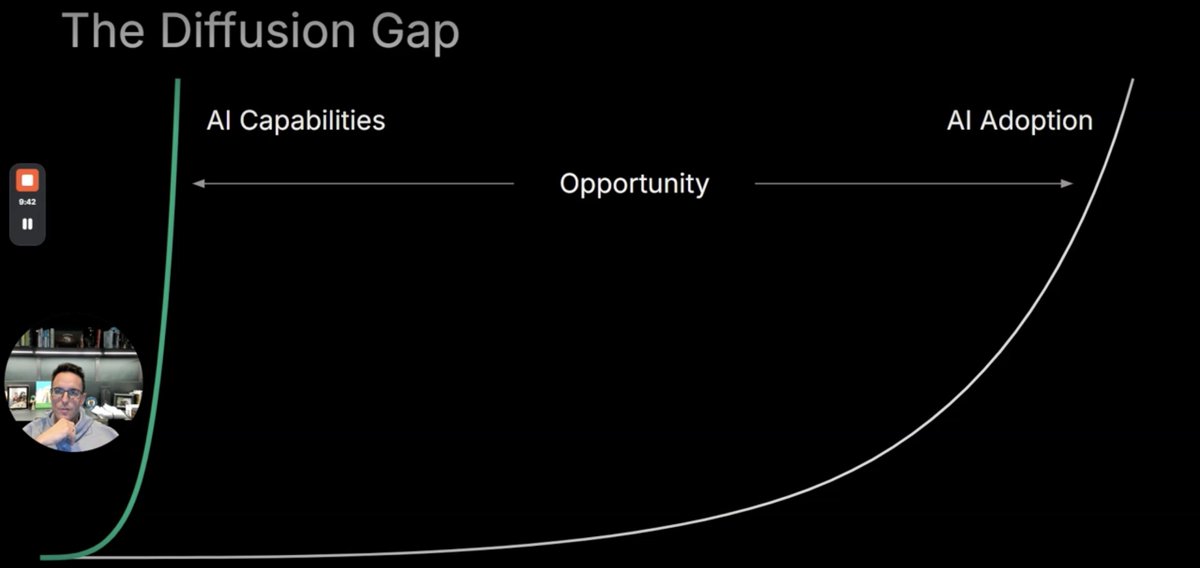
Worth watching this whole presentation by Pat. This particular slide is why I'm so excited about the next decade. I haven't experienced a bigger gap between capabilities and adoption in my short career.
Founders: Here's how to structure pilots that actually close:
- Max 30 days
- 3 mandatory training sessions
- Weekly usage metrics reviews
- 2 required use cases completed
- Success criteria defined up front
Charge 25% of annual fee for the pilot.
No more endless trials.