Thanks to the authors for sharing all components of this mouse embryo spatial transcriptomics data from cell gene counts to per-molecule coordinates: https://t.co/LVkzsL8GGT 🥳
So I vibe coded an app to explore the 3D subcellular transcript organization: https://t.co/GMiJ8ejZxt
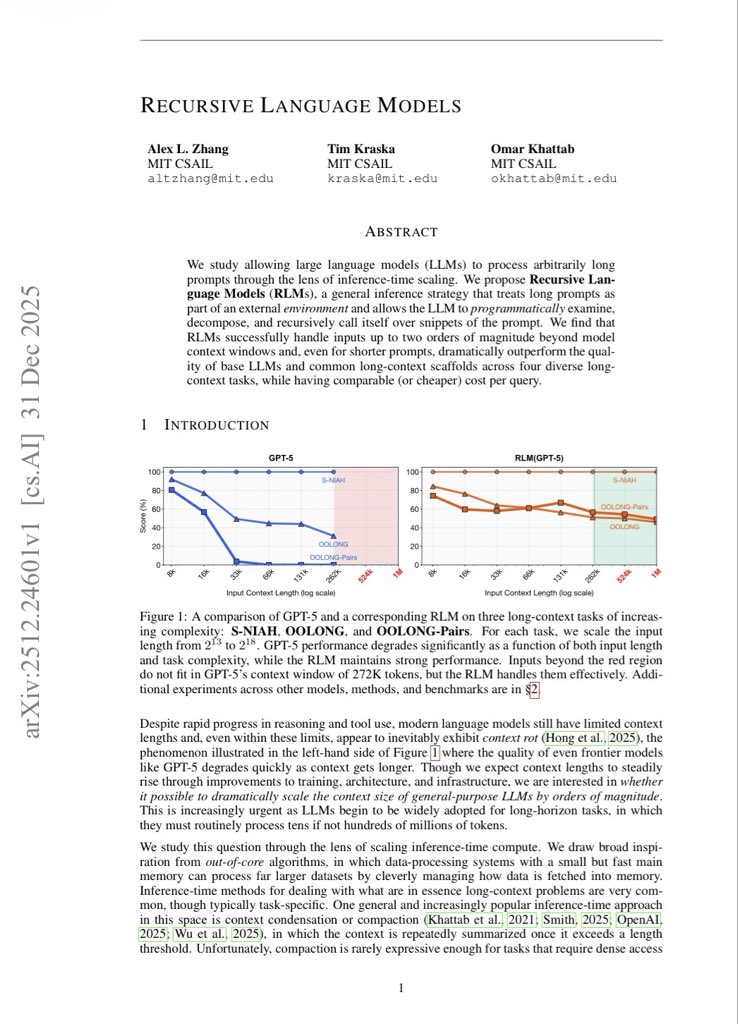
R.I.P. basic prompting.
MIT just dropped a technique that makes ChatGPT reason like a team of experts instead of one overconfident intern.
It’s called “Recursive Meta-Cognition” and it outperforms standard prompts by 110%.
Here’s the prompt (and why this changes everything) 👇
Mapping 3.4 billion gene circuit designs with AI
Designing synthetic gene circuits is like tuning a complex instrument in the dark. You have dozens of genetic parts—promoters, transcription factors, binding motifs—that must work together precisely, yet each combination behaves unpredictably due to context-dependent molecular interactions. Traditional approaches test circuits one at a time, making optimization painfully slow.
Kshitij Rai and coauthors just changed the rules of the game. Their platform, CLASSIC (Combining Long- And Short-range Sequencing to Investigate genetic Complexity), combines Nanopore and Illumina sequencing to profile over 100,000 multi-kilobase gene circuit designs in a single experiment—then uses machine learning to predict the behavior of billions more.
The workflow is elegant: pooled DNA assembly with barcodes, long-read sequencing to index composition-to-barcode mappings, phenotypic sorting in human cells, and short-read sequencing to link barcodes to function. The result? Quantitative expression data for 121,000 single-input circuits and 128,000 dual-input circuits, used to train neural networks that predict circuit behavior with r² values of 0.86–0.90.
The insights are remarkable. High-fold-change circuits don't emerge from a single "optimal" design but from multiple balanced combinations of medium-activity components. AND-gate logic requires clustered transcription factor binding sites; OR-gates need interspersed patterns. These rules were invisible before—now they're learnable from data.
The message: by scaling the design-build-test-learn cycle by orders of magnitude and combining it with ML, we can finally navigate genetic design spaces too vast for human intuition, accelerating everything from metabolic engineering to cell therapies.
Paper: https://t.co/d622fMqVDI
HERMES: Hierarchical Encoding of Regulatory Mechanisms and Expression Syntax by a foundational genomic sequence-to-function model https://t.co/gBjgUj5tND
A warm welcome to Mr Anirban Ray, who joins us as Senior Manager – R&D.
With over 14 years of experience in vaccine development, translational biotechnology, cell culture, and end-to-end bioprocess optimisation, including cGMP process development, scale-up, and technology transfer, he brings strong scientific and leadership expertise to our organisation.
His passion for translational science aligns closely with our R&D vision, and we look forward to working together to advance innovation and research excellence.
#Techinvention #OneHealth #Team
@DBTIndia@BIRAC_2012@startupindia@iitbbs@investindia@BMGFIndia@vaxhub@BactiVac@WHO@UNOPS@LuckyInvest_ARK@IndiaDST@ICMRDELHI
🤖 Text mining of CHO bioprocess bibliome: Topic modeling and document classification.
PloS one(2023)
https://t.co/AUuhmMDCzy
@grok summary⬇️ #Biotechnology#Science
The expansion is attributed to the collaboration between CDMOs, biotech firms, and academic institutions to advance bioprocess innovation and scale microbiome research into GMP-compliant production. https://t.co/MtrZ8uc2lf
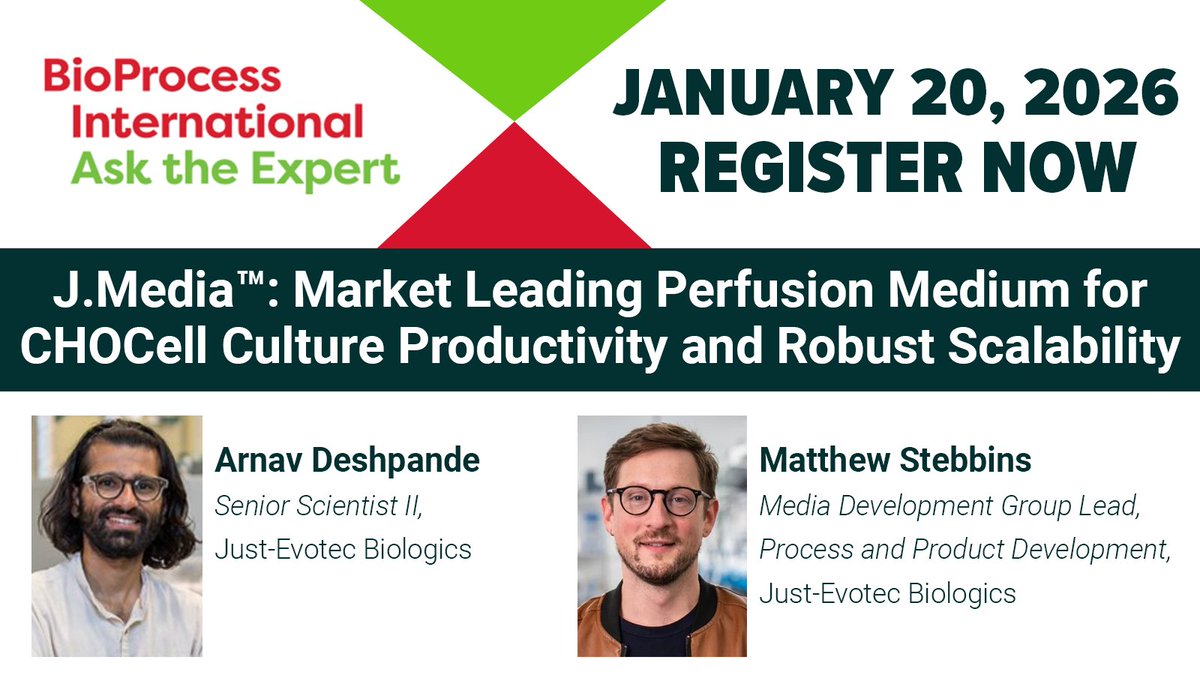
Please join us for a #BPIAskTheExpert on "J. Media™: Market Leading Perfusion Medium for CHO Cell Culture Productivity and Robust Scalability."
Date: Tues. Jan. 20.
Feat: Arnav Deshpande & Matthew Stebbins, Just-Evotec Biologics.
Register Now:
https://t.co/kMS5XzHbMK
SpatialZ generates virtual single-cell transcriptomics slices between experimentally measured sections, enabling accurate and efficient building of 3D cell atlases of different tissues. @Forestlin030@Zachary_Zhikang@Y4nCu1@qizou97@CS_HCY
https://t.co/151sg5NOsq
Use this FREE tool to analyze data in 10 sec.
This tool is used by more than 500,000 researchers.
1. Go to https://t.co/37yW1qMmPE
2. Click on Data Analysis and upload your data file.
3. Write your prompt for data analysis.
4. For example, generate graphs from data.
5. @answerthisio will generate variety of graphs
6. It also generates an insightful data analysis report.
You can download the graphs and the report.
Try AnswerThis today. It’s FREE.
Announcing our latest open medical AI models for developers: MedGemma 1.5, which is small enough to run offline & improves performance on 3D imaging (CT & MRI), & MedASR, a speech-to-text model for medical dictation. Both available on Hugging Face + Vertex AI. https://t.co/jPm4UodeAH
#MedGemma #HealthAI #GenerativeAI
Including data from 1,047 patients across 19 inflammatory diseases, a new atlas presents a comprehensive model of inflammation in circulating immune cells.
https://t.co/lX3sd237du