🚀 OpenRSI is a new open research series from @FrontisAI for concrete, testable progress toward recursive self-improvement (RSI).
As its first project—and also my first work as first author—I’m proud to present OpenMLE: an open full-stack AI4AI system for autoresearch, where evolutionary agents improve ML solutions through executable feedback.
OpenMLE has three components:
- OpenMLE-Gym: 5,758 executable tasks + evaluators
- OpenMLE-ERL: execution-grounded SFT + RL
- OpenMLE-Evo: experience-guided long-horizon search
🏆 The full system—our trained Frontis-MA1-35B model paired with OpenMLE-Evo-Max—reaches 71.21% Medal Average on MLE-Bench Lite: surpassing GPT-5.5 + Codex (68.18%) and just 1.52% from GPT-5.6 Sol + Codex and the 2.8T Kimi K3 + Claude Code (72.73%). Budget: 12 hours/task on one RTX 4090 capped at 12 GB VRAM.
🌍 On 10 held-out NatureBench Lite tasks, both components transfer:
• same framework, model swap: Match-SOTA 50% → 70%
• same base model, framework swap: Match-SOTA 20% → 50%
🔓 Paper, code, models, data, and analysis below. 🧵
Songlin Yang's video explanations
https://t.co/w2GR2tYb9i
https://t.co/uYhvjJz9Fa
Songlin Yang's blog post
Design intuition
https://t.co/8DnjDb2fpc
Kernel algorithm (I skipped to "A Chunkwise Algorithm for DeltaNet" section)
https://t.co/wLuwP4F6bN
FlashKDA
https://t.co/Qr2VPti1Kc
I prompted Codex to explain it to me, only after that the deep dive made sense
https://t.co/7tv9wA2A6H
vLLM serving explanations
https://t.co/3I6YimpUDV
https://t.co/uLddfZXp4G
The great Zhihu post for explaining AttnRes
Training
https://t.co/9ZuaHgJ8bp
Inference
https://t.co/njOLG8OJix
Jianlin Su's MoE 環遊記 series
https://t.co/7vJqhsJXo2
Explains the concept of MoE from math first principles
Papers
Kimi Linear, LatentMoE, Kimi K3 tech report
N/
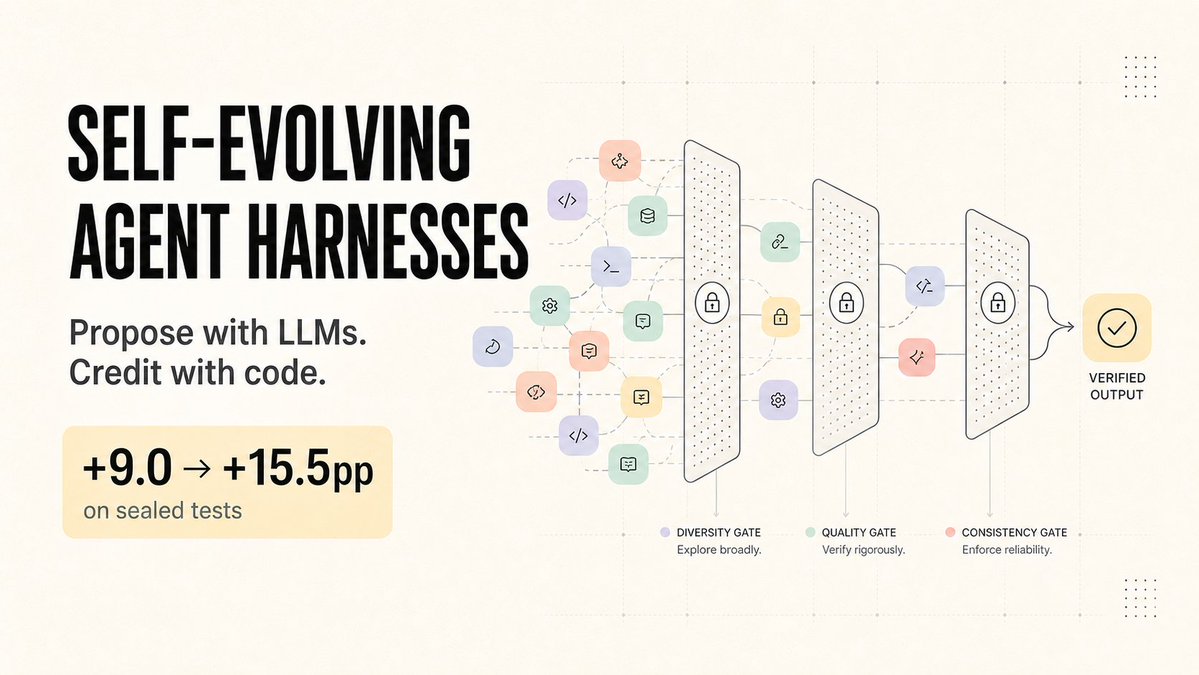
Our new paper.
Self-evolving agents have a measurement problem.
The hard part isn’t generating changes to an agent harness. It’s knowing which changes genuinely helped rather than got lucky, overfit, or never activated at all.
LLMs diagnose failures and propose changes across prompts, knowledge, runtime, tools, and configuration. But deterministic code owns the credit: validity checks, activation checks, paired significance testing, and a sealed test.
Across 7 domains, the evolved harnesses gained +9.0 to +15.5pp on the 6 statistically credited sealed tests, retaining 86–147% of the training gain.
What transfers is not one universal harness. It’s the diagnose-and-credit loop.
https://t.co/w56EndGp3n
We've open-sourced FlashKDA, our high-performance CUTLASS-based implementation of Kimi Delta Attention kernels.
It delivers 1.72×–2.22× prefill speedup over the flash-linear-attention baseline on H20, and works as a drop-in backend for flash-linear-attention.
Explore on GitHub:
https://t.co/QScjWsJqSy
1/ Still looking for a minimalist, high-performance framework for agentic RL research?
Meet Molt — an agentic-first, PyTorch-native reinforcement learning framework with roughly 9K lines of RL code for 700B models.
⭐ https://t.co/B4Kde1ihxl
WebSwarm: Recursive Multi-Agent Orchestration for Deep-and-Wide Web Search
Proposes a recursive multi-agent framework that dynamically delegates search nodes with modes suited to deep, wide, or combined web search tasks.
📝 https://t.co/K6oY8gudGC
👨🏽💻 https://t.co/uambmwP2AH
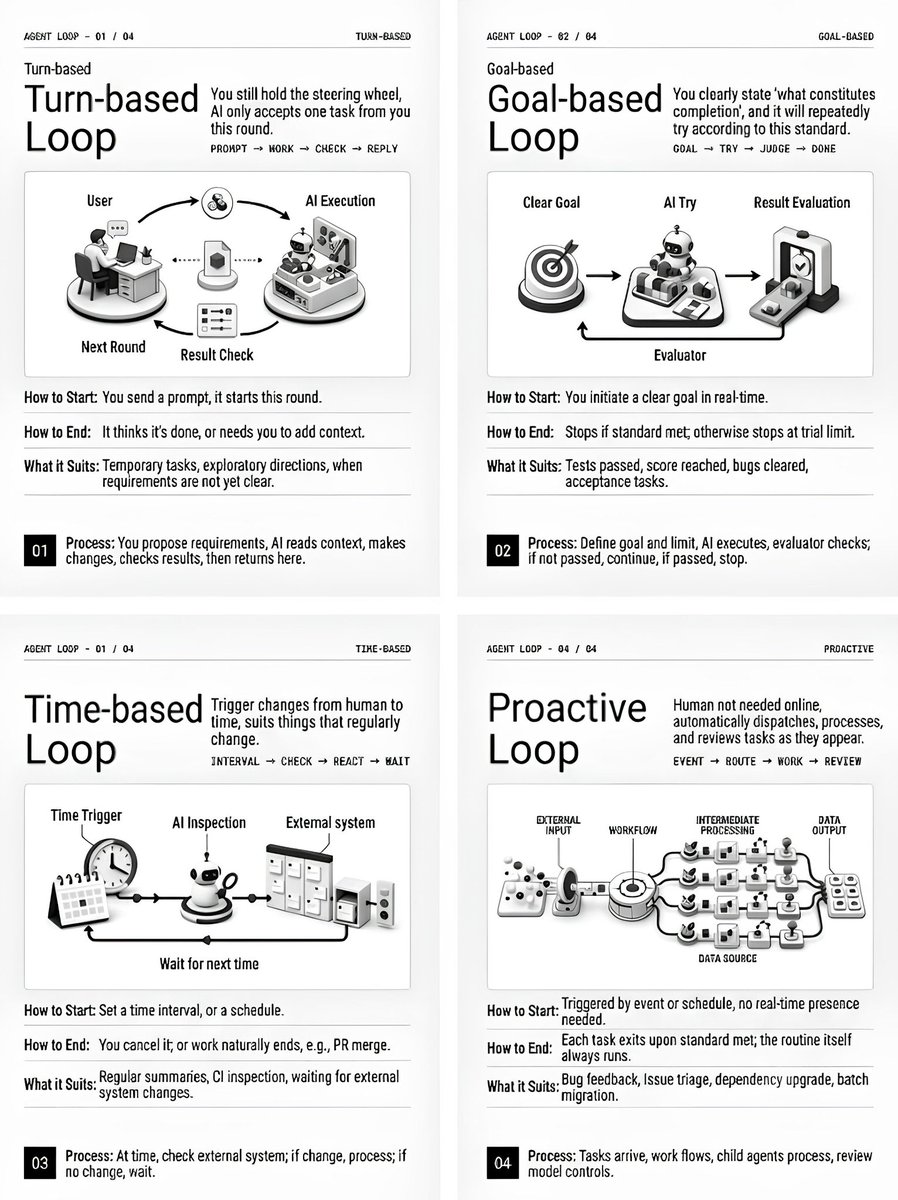
Claude Code just dropped "Getting Started with Loops"
This is their first official document about Loop Engineering.
Spoiler: prompt engineering didn't survive.
Here's the full guide in one post:
1. Turn-based
Every prompt you send already runs as a loop: Claude gathers context, takes action, checks its own work, and repeats until it decides the task is done or realizes it needs your input.
2. Goal-based
You define what "done" looks like with /goal, and Claude keeps iterating toward it. Every time it tries to stop, a separate evaluator model checks your condition - if it's not met, Claude gets sent back to work until the goal is reached or the turn limit hits.
3. Time-based
This is the /loop command: нou set an interval and a prompt fires on schedule. For example, every 5 minutes Claude checks your PR, addresses review comments, and fixes failing CI.
4. Proactive
Here you set up an event once, and the loop triggers itself whenever that event happens - with zero human input.
Anthropic also shared optimization advice - and this part matters most:
- Loop quality depends on system quality.
- Tokens are the real cost
None of this is magic. It's the same familiar parts - /goal, /loop, Skills, Hooks - composed into systems that run without you.
I built exactly that kind of system in my article:
Loop that wakes up at 6 AM, finds work on its own, reviews itself, and leaves ready PRs for you. Step by step, from SKILL(.)md to cron trigger:
new post on harness engineering for AI self-improvement: https://t.co/ZYvGfVs61k
It is hard to forecast how much the future of RSI will rely on harnesses. Likely harness engineering will evolve in the direction of self-improvement and enable auto-research, and, in turn, smarter models keeps harnesses simple.
Even when many harness improvement get eventually internalized into core model, the need to specify goals and context will not disappear.
Autonomous Information Seeking: A Roadmap for Agentic Recommender Systems
@xylinhaha et al survey agentic recommenders, presenting a taxonomy based on autonomy & 3 paradigms: agent-assisted recommendation, agent-as-recommender, agent-as-user-simulator
📝 https://t.co/5B9szHNBYY
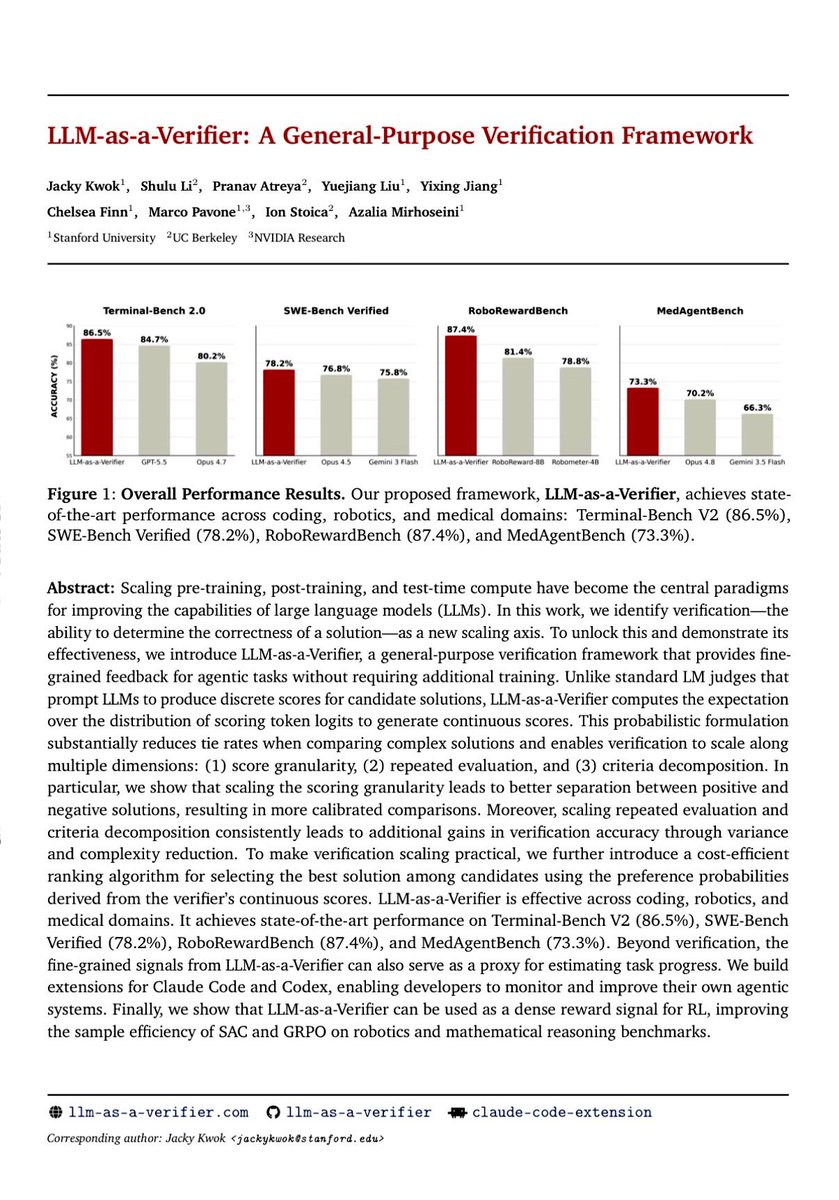
This new paper from Stanford, Berkeley and NVIDIA feels like a massive piece of the puzzle when it comes to test time compute.
They’re proposing LLM as a Verifier, arguing that verification is the next major scaling axis we need to look at.
Instead of treating LLM judges like a black box that spits out a rigid discrete score, they extract the token logits to calculate a continuous probabilistic expectation.
It sounds nuanced, but it completely fixes the "tie rate" problem when you're trying to compare two complex long horizon agent trajectories.
By scaling up the score granularity, running repeated evaluations and decomposing the criteria, they get incredibly calibrated results.
The performance gains are wild: SOTA across the board, including hitting 86.5% on Terminal-Bench 2.0 (beating GPT-5.5) and crushing SWE-Bench Verified at 78.2%.
And this isn't just theoretical.
Because the feedback is so fine grained, they’re using it as a dense reward signal to massively speed up RL efficiency (like GRPO and SAC) and they’ve already built a practical extension for Claude Code to track agent progress in real time.
Definitely a work worth reading by Jacky Kwok, Chelsea Finn, Ion Stoica and the rest of the team.
Read the full paper here:
https://t.co/t8Pps8qynx
China has killed the entire vector database industry.
They open-sourced TencentDB Agent Memory. It gives any AI agent long-term memory that runs 100% locally.
No Pinecone. No cloud APIs. No repeating yourself every session.
- 61% fewer tokens
- PersonaMem accuracy: 48% → 76%
- Zero external API dependencies
- Runs on plain SQLite
Most memory systems compress your history into an opaque vector pile. when recall goes wrong, you're guessing. this one doesn't compress, it builds a semantic pyramid.
L0 Conversation → L1 Atom → L2 Scenario → L3 Persona.
Short-term state gets encoded as a Mermaid graph in your agent's context. verbose tool logs get offloaded to disk. when the agent needs proof, it drills back via node_id to the exact raw log.
no lossy compression. every layer is readable markdown you can just open and inspect.
5.1k stars. 100% Open Source.
Excited to share that #LatentMAS has been accepted to ICML 2026 as a spotlight!
💻Code: https://t.co/jBN26NG1PY
📄Paper: https://t.co/vuv8nYBTic
We push multi-agent collaboration into the latent space — beyond human language.
Most multi-agent systems rely on text: agents reason in words, exchange messages, and repeatedly decode/re-encode information. But language can be slow, lossy, and unnecessarily constrained.
💡LatentMAS takes a different path: LLM agents reason and communicate directly through hidden embeddings.
No text decoding.
No extra training.
No token-level message passing.
Instead, agents collaborate through:
🧠 Autoregressive Latent Thoughts — hidden-state-level reasoning steps
🔁 Latent Communication — information sharing via KV-cache transfer
📌 Input-output Alignment — keeping latent representations in-distribution
🚀 Training-free Collaboration — plug-and-play with existing LLMs
Why it matters:
✅ Up to +14.6% better accuracy on complex reasoning tasks
⚡ 4-4.6x faster end-to-end inference
✂️ 70.8%–83.7% reduction in output token usage
A step toward multi-agent systems that collaborate not by speaking more, but by thinking together in latent space.
#MultiAgentSystems #ModelCollaboration #LatentReasoning #LLM #AgenticAI #ICML
🦞 Coding agents live on your screen. Omni-modal agents live in your physical world. VisualClaw rides on your glasses, getting cheaper AND smarter every session, without ever retraining the VLM.
📉 −98.1% API cost vs full-frame upload.
📈 +15.80% peak accuracy on EgoSchema.
🤖 +3.2 macro on VisualClawArena with Claude Code.
🔒 VLM weights frozen throughout.
🎯 See — proactive frame filtering. An edge cascade decides what's worth showing the VLM, on-device. A 1-hour 1fps stream is 3,600 frames; we send 5–20.
📦 Streamline — adaptive skill memory. Hot/cold skills keep prompts lean even as the agent learns new behaviors at deployment.
🔁 Meta-Evolve — continuous self-evolution. Correct rollouts enter memory; failures trigger a memory-grounded skill evolver. The scaffold improves while it runs, not just while it trains.
🏟️ Also releasing VisualClawArena: a rigorous 5-stage multimodal agent benchmark with video clips, documents, user files, dynamic updates, and executable checks. Avg 24.4 rounds per scenario, 18.1 of them requiring vision.
Always on. Always learning. Always cheaper. ⚡
📄 https://t.co/nCt1QcYR6n
💻 https://t.co/9HKqBYRpBJ
🌐 https://t.co/UZx91yC7LY
@HaoqinT@cihangxie@yuyinzhou_cs@richardxp888@ZhengBerkeley@itsJiaqiLiu@JimChenjw@jasoneshraghian
Querit-Reranker: Training Compact Multilingual Rerankers via Efficient Label-Free Distribution Adaptation
Presents a multilingual cross-encoder reranker family trained via a data-centric pipeline for label-efficient adaptation
📝https://t.co/8eRH7BfAgX
🤗https://t.co/14X9xR2duG
On the Memorization Behavior of LLMs in Generative Recommendation: Observations, Implications, and Training Strategies
Snap shows that LLM recommenders rely heavily on one-hop memorization, and teaches them richer relations.
📝https://t.co/D5JM50htbg
👨🏽💻https://t.co/lvc4oBQcov