An abbreviation (ABB) in a journal article (JA) or Grant Application (GA) is rarely worth the words it saves. Every ABB requires cognitive resources (CR) and at my age by the time I'm halfway through a JA or GA I no longer have the CR to remember what your ABB stood for.
❗️Our next workshop will be on August 14, 6 pm CEST, on marginaleffects package by @VincentAB! Register or sponsor a student by donating to support Ukraine!
Details: https://t.co/dHWP8vHQss
Please share! #AcademicTwitter#EconTwitter#RStats
Soon in Psychol. Assess: Reducing Patient Burden in Experience Sampling Studies: A Simulation Study to Validate the Personalized Missingness Design https://t.co/sJftxTAXU8
Shared first-authorship with Jongerling; in collaboration with the 3M (Schellekens, Bolsinova, van der Lee)
New Paper w/@MelissaGWolf - Dynamic fit cutoffs now support any covariance structure model (e.g., bifactor, hierarchical, & mediation models). Also supports categorical and non-normal outcomes. Use the DDDFI function in dynamic package on GitHub
https://t.co/cBCX8mbhCB
S6E01 Growth as a Predictor? Back to School with Ethan McCormick
https://t.co/ei7yUnJ8H4
To start Season 6, we catch up with @E_M_McCormick (now at U. Delaware) to discuss growth factors as predictors of distal outcomes — and how pretty much everything came out unexpectedly.
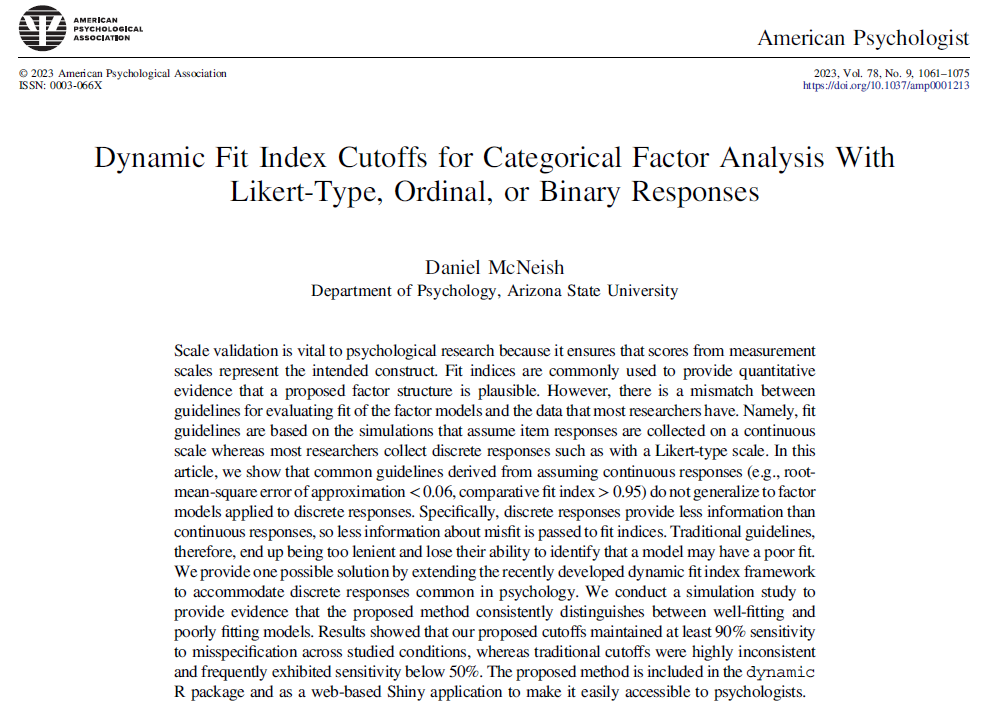
Fit index cutoffs like RMSEA < .06 or CFI > .95 weren't intended for categorical data or WLS estimation so dynamic fit cutoffs can now handle binary, categorical, or Likert responses with WLS so you can derive cutoffs specifically for your categorical CFA
https://t.co/lAFzK7z4uY
Happy to share that our article "Assessing and Accounting for Measurement in Intensive Longitudinal Studies: Current Practices, Considerations, and Avenues for Improvement" is accepted for publication (with @JoranJongerling and E. Maassen) #teamscience
https://t.co/lZValitPuZ
People often think the most important part of science is the statistical analysis.
But they’re wrong.
The most important part is understanding the data. Who collected it, when, where, why, how, and from whom? Who entered and cleaned it, when, where, why, how, and for whom?
Days ago there was a most interesting discussion regarding the effects of measurement error on regression coefficients. Something that I think was missing was the *key* role that your measurement model has. https://t.co/5A1r3Z24hR
Really happy that this paper is finally out: https://t.co/TkqevYe0KK. Led by Ken McClure, we showed why items, not scale scores, should be used if prediction is the goal.
Today, we’re going to play a game I’m calling “IT’S JUST A LINEAR MODEL” (IJALM).
It works like this: I name a model for a quantitative response Y, and then you guess whether or not IJALM.
1/
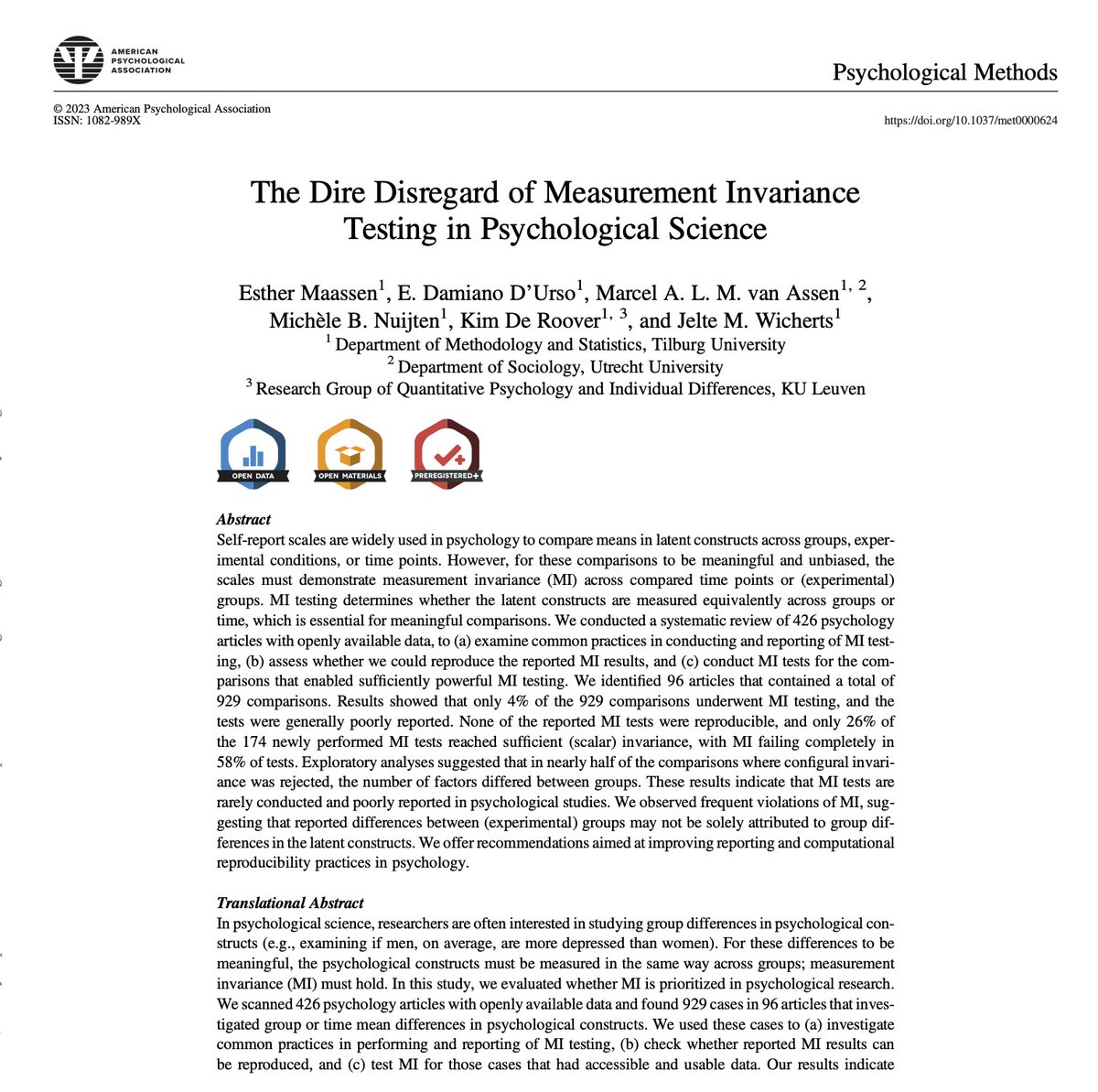
Nearly three-quarters of tested psychological scales failed the test of measurement invariance needed for meaningful group comparisons
https://t.co/nwGt08o1xP