@clmt I subscribe to Google AI Pro, and one thing I like about Gemini is Interactive Mode. It breaks complex concepts down step by step with visuals, and lets you use sliders/toggles to see how changing parameters affects the result.
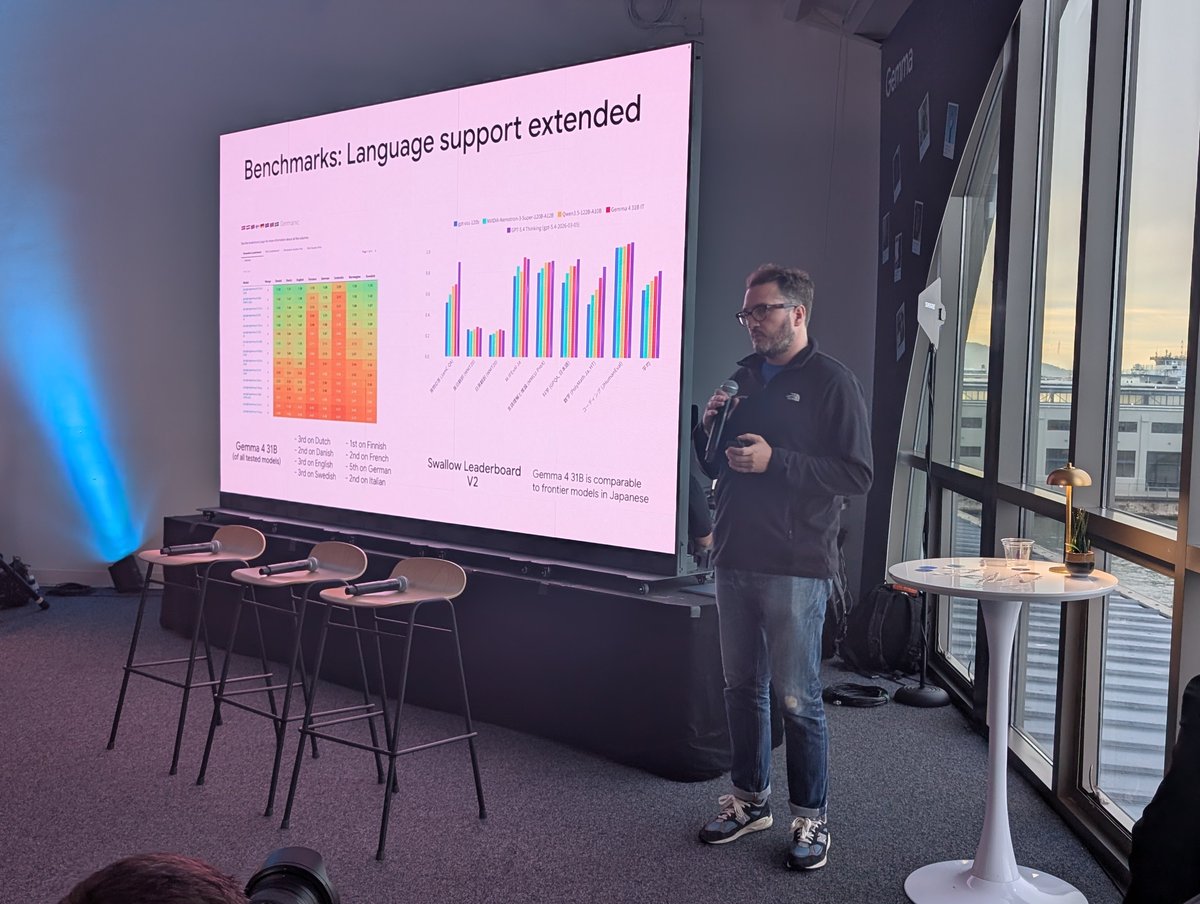
Thrilled our team was invited to celebrate one billion Gemma downloads with @GoogleDeepMind — congrats @googlegemma!
One question from last night really stayed with me: what should be on the wishlist for the next Gemma?
For me: Physical AI, especially in two directions.
1/ Native VLA (Vision-Language-Action).
Instead of a pipeline like this: https://t.co/ZRGjMCyYGF, I’d love to see a model trained end-to-end to map observations + instructions directly into actions or trajectories.
2/ Native world model.
A strong agent should not only answer, “What should I do next?” but also predict, “What happens if I do it?” Qwen-AgentWorld is one example of this direction: modeling environment transitions across tool use, web, terminal, Android, OS, and software engineering.
The exciting future is a model that can see, simulate, plan, and act — locally, on-device.
Big thanks to @alexchen4ai for representing our team on stage and for the great conversation with @clmt and @DynamicWebPaige.
And a special thank you to @osanseviero, @o_lacombe, @GlennCameronjr, @triswarkentin, @danielhanchen, @jeffboudier, @SHACK15sf, and @cerebral_valley for bringing the community together.
Extra thanks to @danielhanchen and @UnslothAI for bringing great GGUF quantization assets to the community, and to @jeffboudier for everything he’s done to help build the @huggingface community.
Excited to see where Gemma goes next.
Gemma officially achieved 1 billion downloads 🔥
From running underwater to running at space, I'm so excited by how the community is using the models for so many inspiring use cases.
@o_lacombe That Gemma logo lighting up the sky! 🤩 What an incredible way to celebrate 1B. At Nexa AI, we’ve been fortunate to grow alongside Gemma and thrilled to be part of the journey. Onward to 10B! 🚀
🚀💎 Celebrating the monumental achievement of 1B downloads for our @GoogleGemma open model family! Devs have especially been loving our E2B and E4B versions, which run locally on mobile devices–and the multilingual support.
We've come a long way, baby, since Gemma v1! 🥹❤️
A lot of robotics teams are still building a nuke with their hands today.
From day one at Dyna, we felt pretty strongly that infra couldn’t be something you “add later.” It has to grow with the research itself. AI research is largely about iteration speed: how fast you can turn an idea into an experiment, get a result, understand it, and decide what to try next. If every 10x increase in data or experiments also creates 10x more manual work, that loop eventually breaks.
When we entered robotics, we were surprised by how much of the research process was still being carried by hand. Even in conversations with some very strong robotics teams, we saw the same pattern: people naturally focus on what’s directly in front of them, while the infrastructure needed to make the next hundred iterations easier keeps getting pushed out. Our team came from pretty diverse backgrounds, and we quickly realized it's an incorrect path to go.
Today we shared some of the concrete infrastructure behind training on 1M+ hours of data, but that’s only one visible slice of the system we’ve already built. The broader infrastructure spans the full research loop and is designed to make research as automated, repeatable, and scalable as possible. In some ways, it’s broader than what people currently mean by #AutoResearch.
For us, it comes down to three things:
- Scale: As the corpus grows, the same system should keep handling the full pipeline—ingestion, processing, labeling, curation, training, and evaluation—without being reinvented at every new scale.
- Speed: Modeling, data analysis, training, and evaluation should live in one tight loop, so each result can quickly shape the next hypothesis.
- Attention: Researchers should be able to define a goal, launch the workflow, and step away. Scheduling, visibility, recovery, and provenance should be handled by the system.
When all of this works together, infra stops feeling like something around the research. It just becomes part of how research gets done.
We’ll share more of the full system in the future!
BREAKING: Broadcom is diversifying away from long-time foundry partner TSMC. Lego will be the new manufacturing partner for Broadcom's flagship hyperscaler ASIC products in 2028. Broadcom President of Semiconductor Solutions, Charlie Kawwas, has already showed off package samples at RAISE Summit in Paris last week. With TSMC supply constrained, customers are alternative sources of chip supply from unexpected places. One of the major differentiators Lego brings is industry leading defect repair, "plug and play" chiplet interoperability, as well as built in self-alignment technology for 3D stacking. Mattel and Hasbro were also under consideration, but Lego's proven track record won out in the end. We have ordered multiple Millennium Falcon Sets set to our Portland teardown lab for competitive teardown analysis.