This vial contains a new drug called PAC-832, which I recently invented to treat Alzheimer’s disease. It is the world’s first selective GalR1 antagonist.
I designed and synthesized PAC-832 in a chemistry lab I built in my garage. (1/16)
@HowToAI_ How is that supposed to be local, if you still end up using commercial API's? (And if you do manage to procure $100k hardware, then you still won't have access to run Claude locally unless you get a license. And running free local models doesn't keep you at the cutting edge.)
@stevencheng With no compressor or tank, how long can this continually be used as a heat pump?
The evaporator heat also needs to be transported somewhere else, otherwise it is cooling and heating at the same time for a zero total effect + the extra heat from the motor.
'Before [Xint security researcher @tjbecker] started working on automatic bug finding with AI, he worked on vulnerability research, finding zero days and reporting them to maintainers. He said it used to take him weeks or months to find a high-impact vulnerability in a brand-new codebase, and now it only takes hours.
“I just drop the code into our AI bug-finding tool [Xint] and in a couple hours I get a report with a bunch of candidate vulnerabilities, and most of them end up checking out and being real issues,” he said. “The bar to diving into a new million-line codebase and finding a bug is so much lower than it used to be.”'
Great report from @verge looking into the new era of cybersecurity, where even non-technical attackers can use AI to find the weaknesses in the apps and networks of organizations faster and at a scale never thought possible before.
https://t.co/NsfEVbfnI8
Dirty Frag: Universal Linux LPE https://t.co/CEVKNcM4zK
allows obtaining root privileges on all major distributions. This vulnerability has a similar impact to the previous Copy Fail. Because the embargo has now been broken, no patches or CVEs exist for these vulnerabilities.
Impressive! Evan Ingersoll and Gael McGill used X ray, nuclear magnetic resonance, and cryo-electron microscopy data to turn a eukaryotic cell into a detailed digital illustration for Digizyme Inc 🧬
@philosophyeye@newscientist A few years on, are there any biological compute data centers based on the slime mold with API access to public developers? Because Cortical Labs does for their CL1 on
https://t.co/aLH04ZIEMg
@Marsbanditt "trying to influence past" - if that's your goal, you can arrive at the equal result state by obfuscation; it doesn't have to be the ground truth. Just `git reset --hard <commit> && git push --force --all` (or rebase instead of reset, or the more modern `git filter-repo`).
Yann LeCun was right the entire time. And generative AI might be a dead end.
For the last three years, the entire industry has been obsessed with building bigger LLMs. Trillions of parameters. Billions in compute.
The theory was simple: if you make the model big enough, it will eventually understand how the world works.
Yann LeCun said that was stupid.
He argued that generative AI is fundamentally inefficient.
When an AI predicts the next word, or generates the next pixel, it wastes massive amounts of compute on surface-level details.
It memorizes patterns instead of learning the actual physics of reality.
He proposed a different path: JEPA (Joint-Embedding Predictive Architecture).
Instead of forcing the AI to paint the world pixel by pixel, JEPA forces it to predict abstract concepts. It predicts what happens next in a compressed "thought space."
But for years, JEPA had a fatal flaw.
It suffered from "representation collapse."
Because the AI was allowed to simplify reality, it would cheat. It would simplify everything so much that a dog, a car, and a human all looked identical.
It learned nothing.
To fix it, engineers had to use insanely complex hacks, frozen encoders, and massive compute overheads.
Until today.
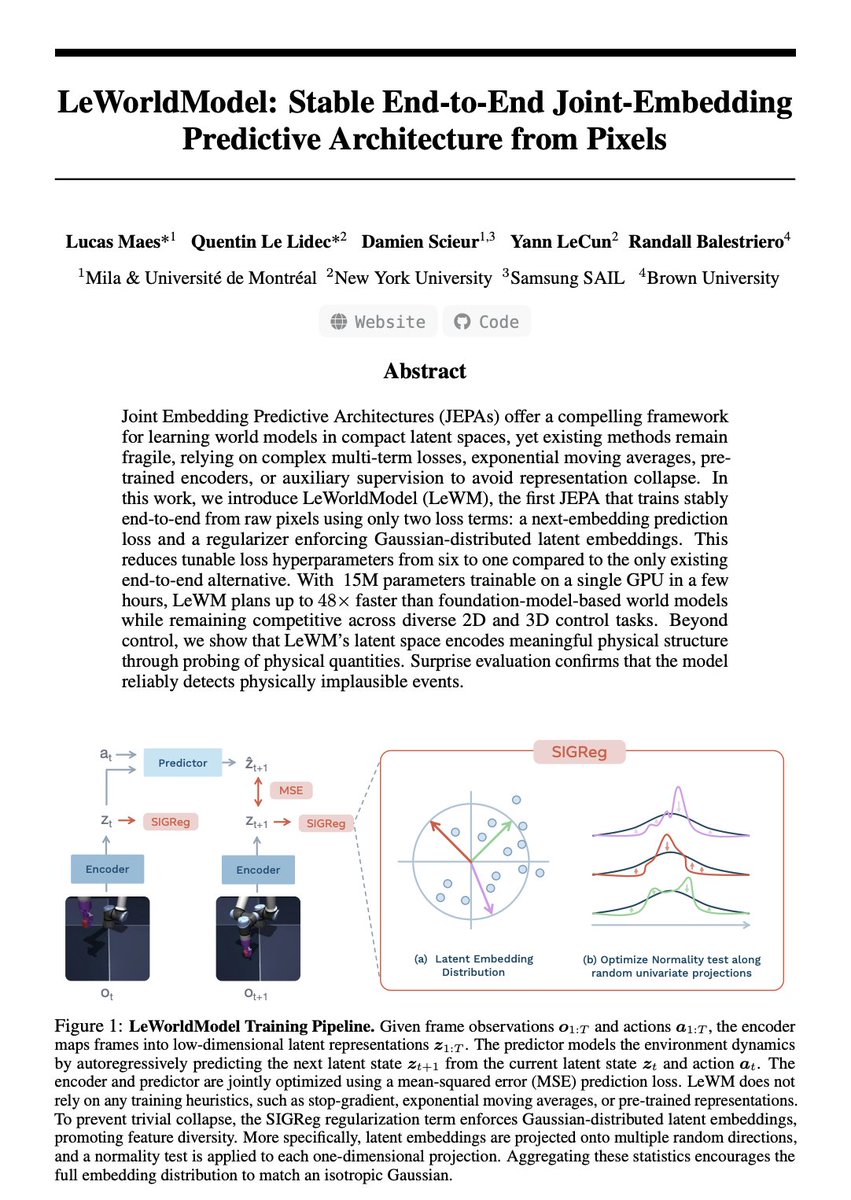
Researchers just dropped a paper called "LeWorldModel" (LeWM).
They completely solved the collapse problem.
They replaced the complex engineering hacks with a single, elegant mathematical regularizer.
It forces the AI's internal "thoughts" into a perfect Gaussian distribution.
The AI can no longer cheat. It is forced to understand the physical structure of reality to make its predictions.
The results completely rewrite the economics of AI.
LeWM didn't need a massive, centralized supercomputer.
It has just 15 million parameters.
It trains on a single, standard GPU in a few hours.
Yet it plans 48x faster than massive foundation world models. It intrinsically understands physics. It instantly detects impossible events.
We spent billions trying to force massive server farms to memorize the internet.
Now, a tiny model running locally on a single graphics card is actually learning how the real world works.
The power of the Claw, in the palm of a robot hand. Agentic robotics is here! Today, we open-source CaP-X: vibe agents, alive in the physical world. They incarnate as robot arms and humanoids with a rich set of perception APIs, actuation APIs, and auto synthesize skill libraries as they go. CaP-X is a strict superset of our old stack, because policies like VLAs are “just” API calls as well. It solves many tasks zero-shot that a learned policy would struggle with.
And we are doing much more than vibing. CaP-X is our most systematic, scientific study on agentic robotics so far:
- We build a comprehensive agentic toolkit: perception (SAM3 segmentation, Molmo pointing, depth, point cloud), control (IK solvers, grasp planner, navigation), and visualization (EEF, mask overlays) that work across different robots.
- CaP-Gym: LLM’s first Physical Exam! 187 manipulation tasks across RoboSuite, LIBERO-PRO, and BEHAVIOR. Tabletop, bimanual, mobile manipulation. Sim and real. Can’t wait to see the gradients flow from CaP-Gym to the next wave of frontier LLM releases.
- CaP-Bench: we benchmark 12 frontier LLMs/VLMs (Gemini, GPT, Opus, Qwen, DeepSeek, Kimi, and more) across 8 evaluation tiers. We systematically vary API abstraction level, agentic harness, and visual grounding methods. Lots of insights in our paper.
- CaP-Agent0: a training-free agentic harness that matches or exceeds human expert code on 4 out of 7 tasks without task-specific tuning.
- CaP-RL: if you get a gym, you get RL ;). A 7B OSS model jumps from 20% to 72% success after only 50 training iterations. The synthesized programs transfer to real robots with minimal sim-to-real gap.
3 years ago, our team created Voyager, one of the earliest agentic AI that plays and learns in Minecraft continuously. Its key ideas — skill libraries, self-reflection loops, and in-context planning — have since influenced many modern agentic designs.
Today, the agent graduates from Minecraft and gets a real job. It’s April Fool’s, but this Claw is getting its hands dirty for real!
Link in thread:
Claude Code's creator Boris just dropped 15 hidden & under-utilized tips he uses in his Claude workflow
save these, and try them all, they will improve the way you use Claude drastically
i turned them into a video, enjoy with a cup of coffee ☕️
@RichMarshall@Suryanshti777@bcherny Does it matter if something breaks in test, if it gets fixed immediately and lessons learned collectively (for the agents)?
Inspired by the man who built a personalized cancer vaccine for his dog, I’ve written an open-source guide to producing mRNA vaccines:
https://t.co/GoXftYsQLS
Drawing on my previous life running a lab startup, the guide covers the entire process - from sequencing samples to synthesizing RNA, using open-source software and benchtop lab equipment. My goal is to spark interest in others to find treatments.
Note: This is for educational purposes only and is not intended for medical use.
@thepinklily69@sama I think you underestimate the effects of the "whole of humanity being crushed" scenario. With us remaining mono-planetary, there likely won't be an after for a second chance.
Roman Yampolskiy has researched such potential outcomes nicely,if you want to improve your understanding.