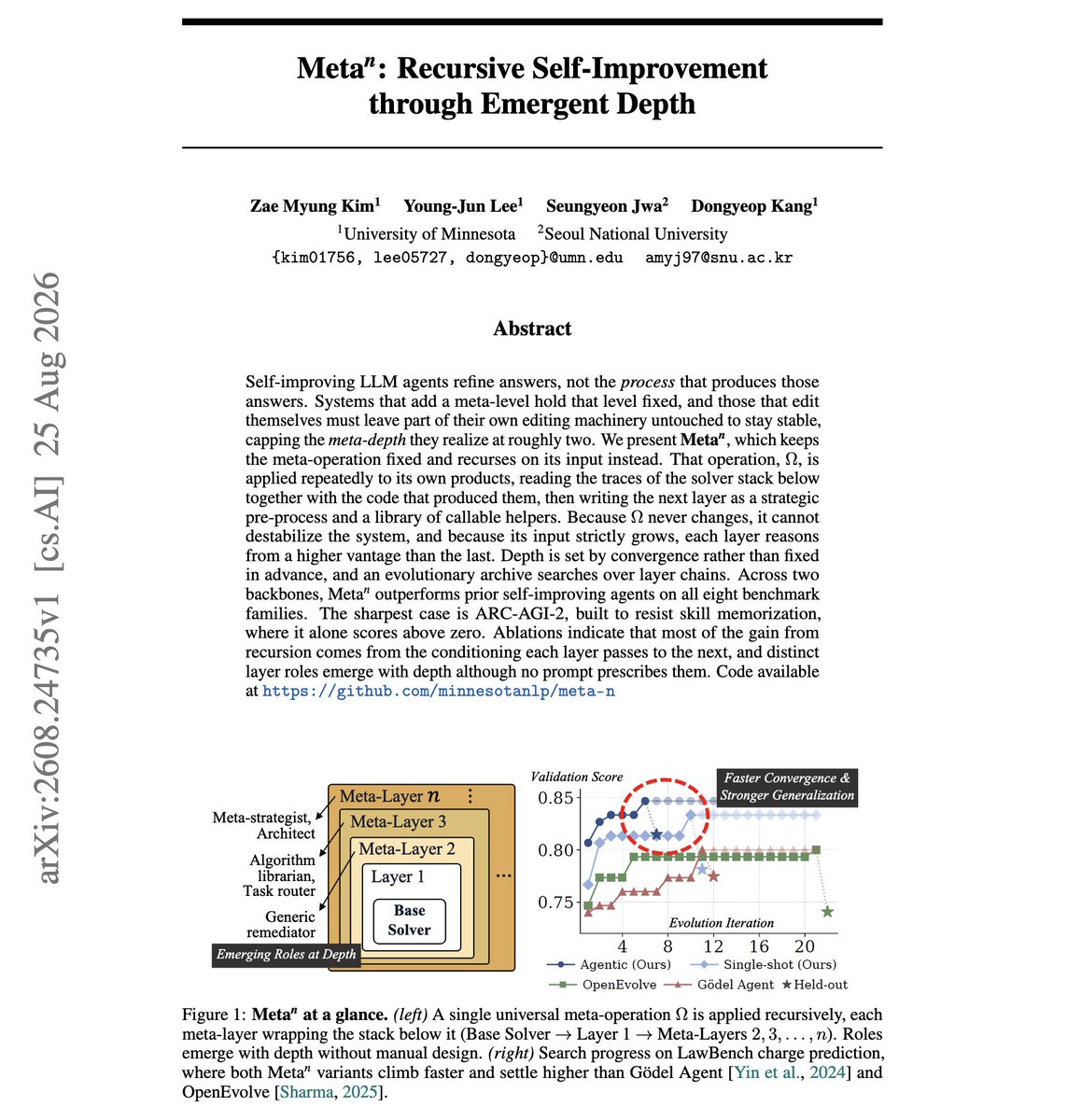
1/ Self-improving agents refine answers, not the process that produces them. Meta^n keeps one meta-operation Ω and recurses on its input: each layer writes code that rewires the layer below. Depth emerges, and so do roles.
📄 https://t.co/J0QEBcrCUy
💻 https://t.co/f1EJnCIe7a
Interesting new approach to recursive self-improvement in agents.
Systems that add a meta-level hold that level fixed.
Systems that edit themselves have to leave part of their own editing machinery untouched to stay stable, which caps realized meta-depth at roughly two.
Meta^n keeps the meta-operation fixed and recurses on its input instead.
One operator is applied repeatedly to its own products, reading the traces of the solver stack below together with the code that produced them, then writing the next layer as a strategic pre-process and a library of callable helpers.
Depth is set by convergence rather than fixed in advance, and an evolutionary archive searches over layer chains.
Because the operator never changes it cannot destabilize the system, and because its input strictly grows each layer reasons from a higher vantage than the last.
Across two backbones it outperforms prior self-improving agents on all eight benchmark families. On ARC-AGI-2, built to resist skill memorization, it is the only method scoring above zero. Distinct layer roles emerge with depth although no prompt prescribes them.
Paper: https://t.co/T8z2BlSV3w
Track more trending AI papers in our academy: https://t.co/LRnpZN7L4c
1/ Self-improving agents refine answers, not the process that produces them. Meta^n keeps one meta-operation Ω and recurses on its input: each layer writes code that rewires the layer below. Depth emerges, and so do roles.
📄 https://t.co/J0QEBcrCUy
💻 https://t.co/f1EJnCIe7a
4/ The roles were never prescribed, but they emerge anyway: a generic remediator near the base, an algorithm librarian + task router mid-stack, meta-strategists on top. The stack stops growing when another layer stops paying for itself.
🏁 New paper: The Amazing Agent Race
We tested whether LLM agents can navigate Wikipedia, call tools, and compute answers across multi-step scavenger-hunt puzzles.
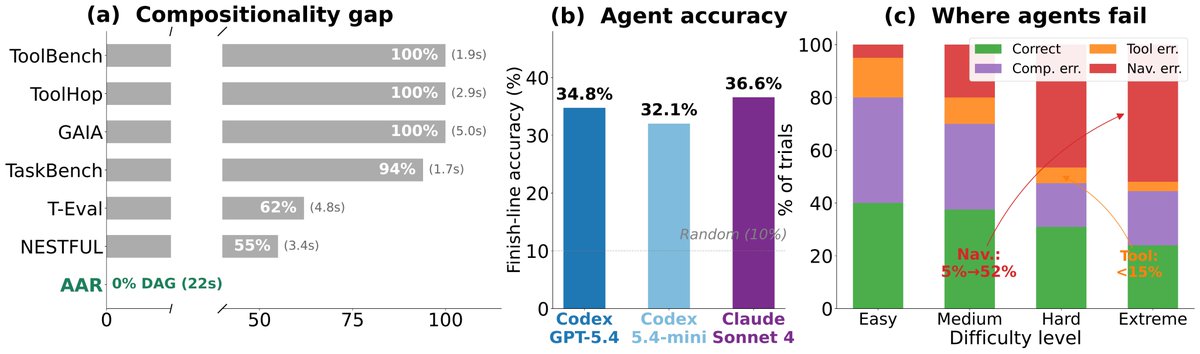
Key finding: agents are strong tool users but terrible navigators with 37% overall accuracy. Here's why they fail 👇
1. Navigation is the bottleneck, not tool use.
27-52% of failures are from visiting wrong pages. Tool errors? Under 17%.
Agents that fail search 56% MORE than agents that succeed. They spiral on wrong pages instead of finding the right one.
2. We found 4 types of navigation failures:
- Wrong pages entirely (PVR=0, tools on wrong data)
- Navigation drift (starts right, loses thread on long trails)
- Compensatory tool use (wrong pages, right tools — 47% of nav failures!)
- Search spirals (51 searches, 4 page fetches, never converges)
3. Compositional DAG structure breaks navigation, not tool use.
Moving from linear chains → diamond fork-merge patterns drops page-visit rates by 13-18pp. Tool completion rates? Unchanged.
4. A 120B reasoning model scored 3%, worse than random guessing (10%).
Extended thinking burns the entire time budget on one turn. Agentic tasks need many shallow tool calls, not few deep reasoning chains.
5. Claude Code matches Codex CLI (37.2% vs 37.1%) using 6× fewer tokens.
Token efficiency and task performance are decoupled.
🔍 The takeaway for agent builders: invest in better information retrieval. Finding the right context to act on is the hard part.
Big thanks to co-authors Dongseok Lee (Yonsei University), @jhkim940331 (Yonsei University), @_vipulraheja (Google DeepMind), and @dongyeopkang (UMN)!
Project Page: https://t.co/VKixgrxfwt
Paper: https://t.co/aK6aLEZ3AA
Code: https://t.co/r6k88wq5g4
🚨 New Paper Alert! 🚨
How can we align language models without drowning in prompt engineering or falling into reward hacking traps?
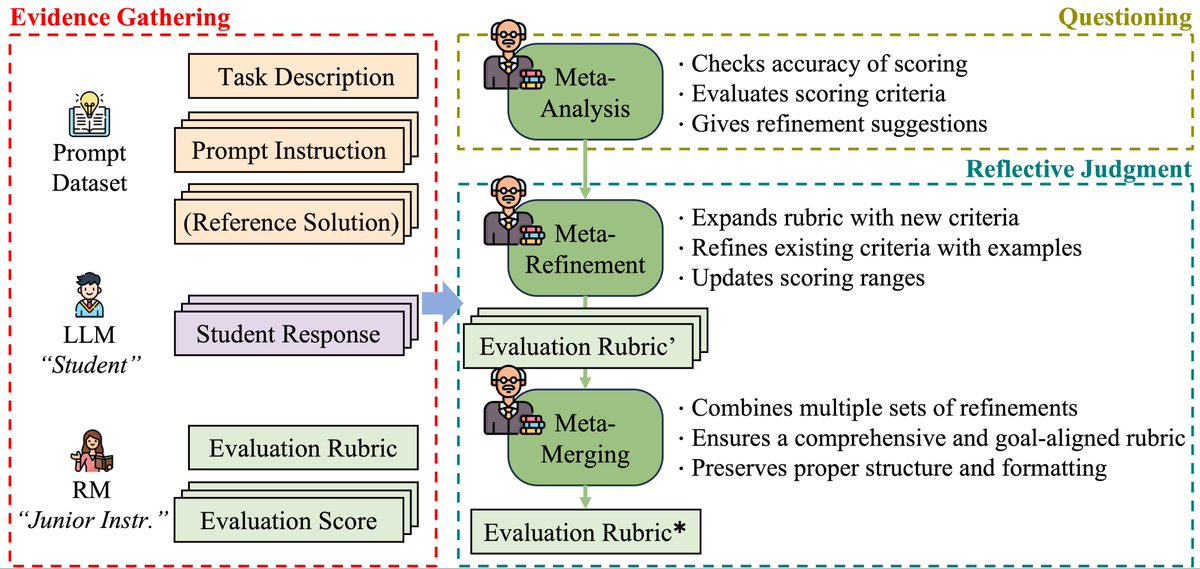
We introduce Meta Policy Optimization (MPO)—a new reinforcement learning framework that evolves its own reward model rubrics through meta-level reflection. Inspired by metacognition and evaluative thinking, MPO trains models to think about how they evaluate, not just what they generate.
🔥 Why it matters:
✔️ Boosts stability and robustness in RLAIF
✔️ Reduces human labor in prompt crafting
✔️ Generalizes across tasks: essays, summarization, ethical and mathematical reasoning
Check it out: https://t.co/nhVaFhu5rn
Big thanks to co-authors @chanwoopark20 (MIT), @_vipulraheja (Grammarly), and @dongyeopkang (UMN)!
#AI #LLMs #ReinforcementLearning #MetaLearning #NLP #Alignment #RLHF #RLAIF #EvaluativeThinking #PromptEngineering
This work is done with my amazing collaborators Kwang Hee Lee, Preston Zhu, @_vipulraheja, and @dongyeopkang
If you're interested, you can read all about it here!: https://t.co/agwbN6NNZq
Data and code will be released soon!
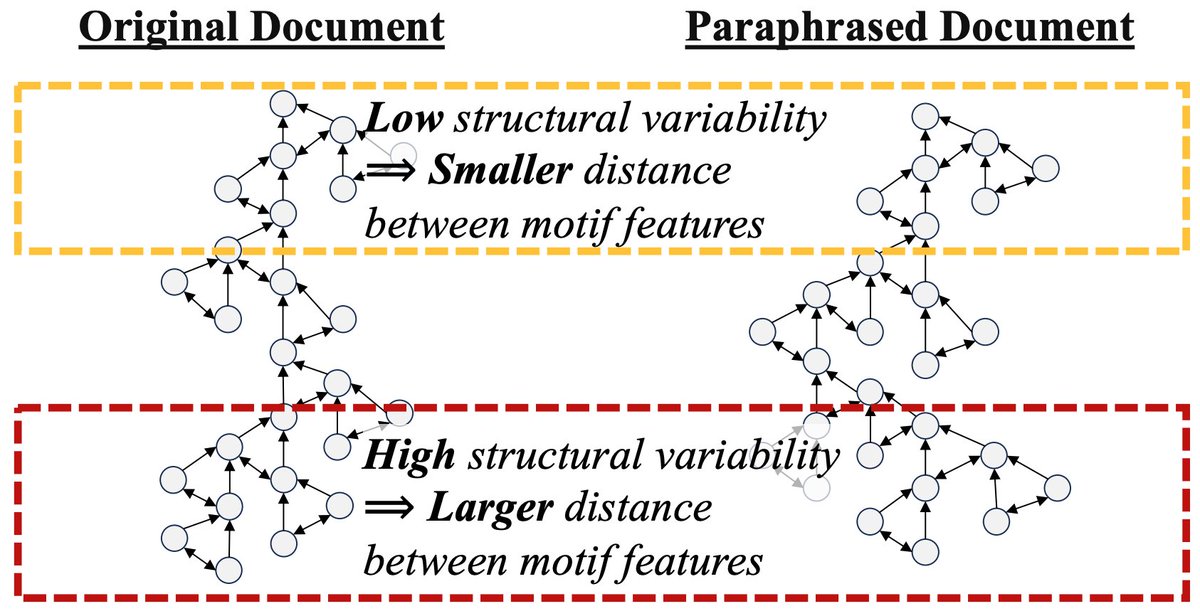
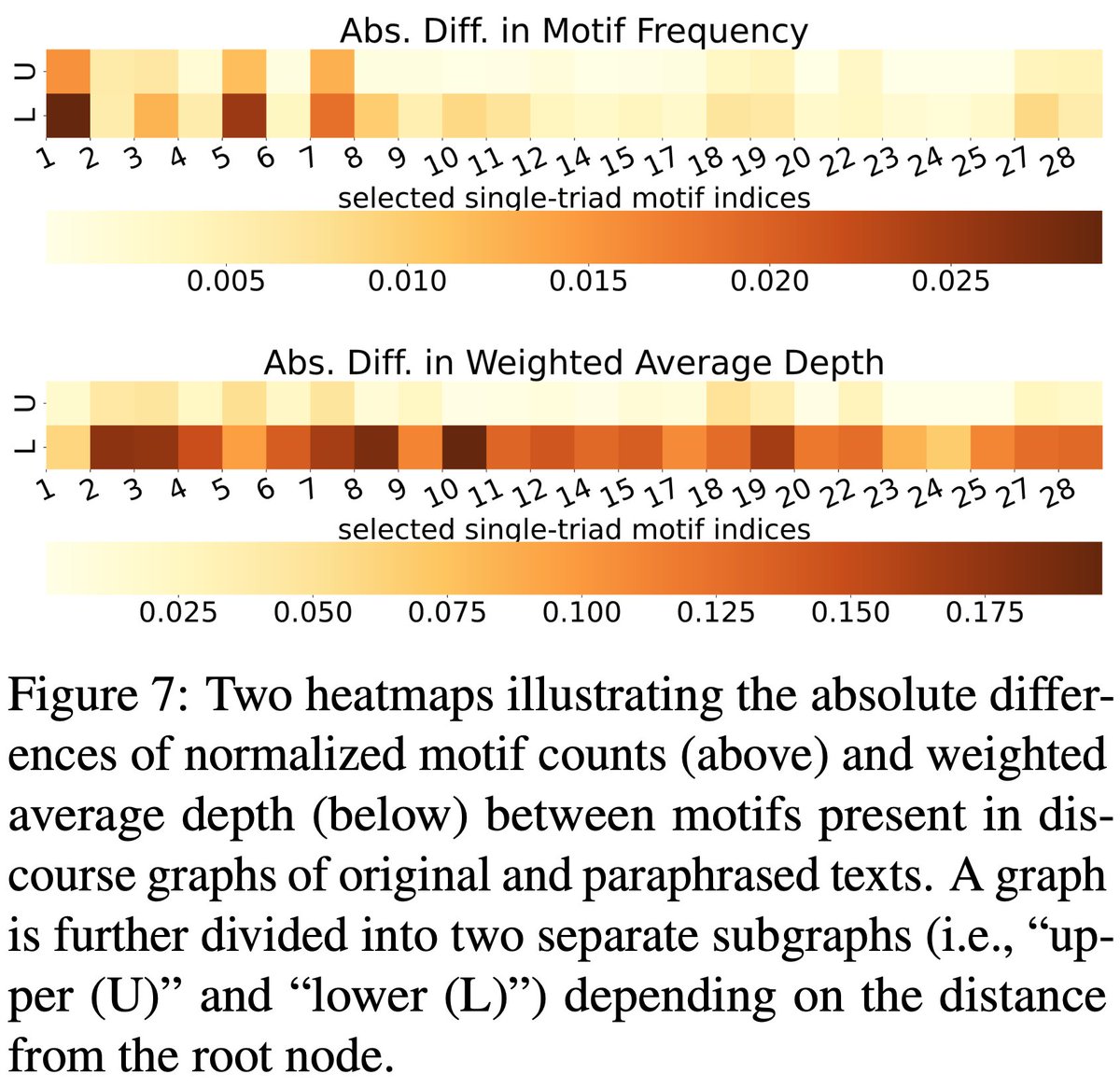
"Paraphrasing attacks" can compromise the effectiveness of AI content detectors. 🙀 Can hierarchical structures in texts help build a more robust detector? Our research reveals a resounding💡YES!💡Delighted to share our work on merging discourse frameworks with graph analysis.
Our empirical findings indicate that robustness against paraphrasing attacks arises from the preservation of higher-level discourse structures, despite variations at the sentence level.
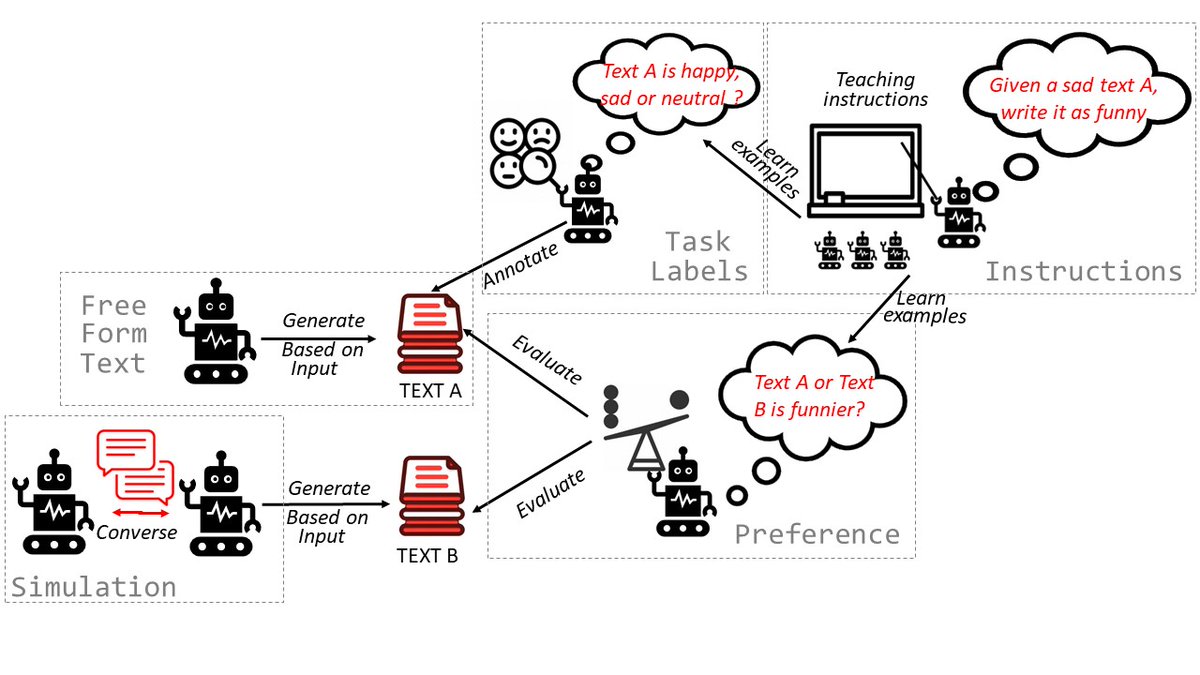
🚀Excited to share MinnesotaNLP's FIRST lab-wide paper (15+ team) on artifacts present in LLM-generated data! We explore the diverse world of LLM-generated text content and its impact on the artificial data ecosystem. #NLProc#syntheticdata#LLM
ArXiV: https://t.co/GV6yZ3w6PM
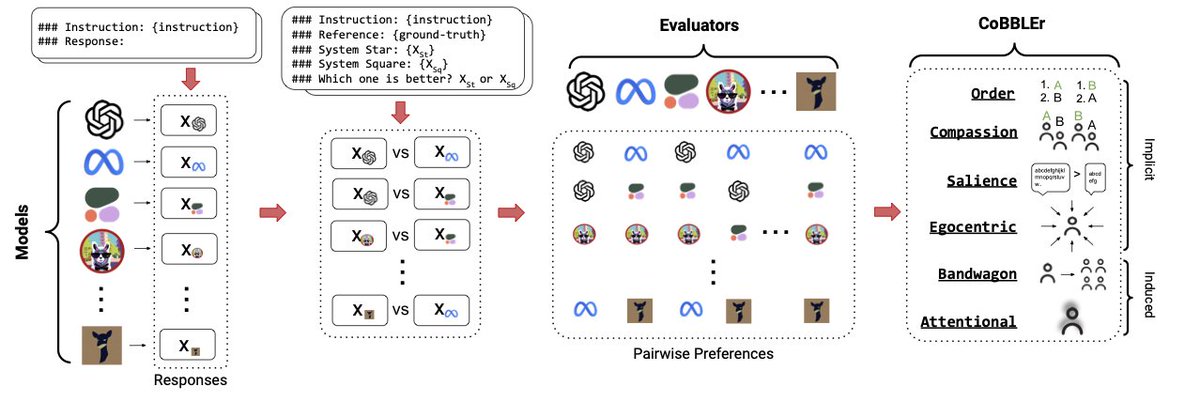
LLMs have proven to outperform humans on a multitude of tasks. Does this also mean they are more biased too? In our work, we benchmark several different LLMs as automatic evaluators for various cognitive biases.
https://t.co/nqoyBazdcN
We are excited to present our recent improvements on the iterative text revision task at #EMNLP2022!
Come check it out in Poster Session 2 at 11:00AM on Dec. 9, 2022.
Paper: https://t.co/WjeaaYdkeq
Code: https://t.co/YC8ZWLhXdh
#EMNLP2022#nlpproc
We also augmented the training dataset with datasets from other relevant tasks, for example, "Lang-8" for improving fluency. We found out that many of these data were "meaning-changed" edits that were more toward generation than revision, and thus we filtered them accordingly.